For a stationery or hobby kit you own, list what leaves with it, note its condition and agree when and how it will come back. Keep a copy of that card with the lender. If the kit belongs to a library or another lender, check its rules first: borrowing an item does not automatically give permission to lend it to someone else.
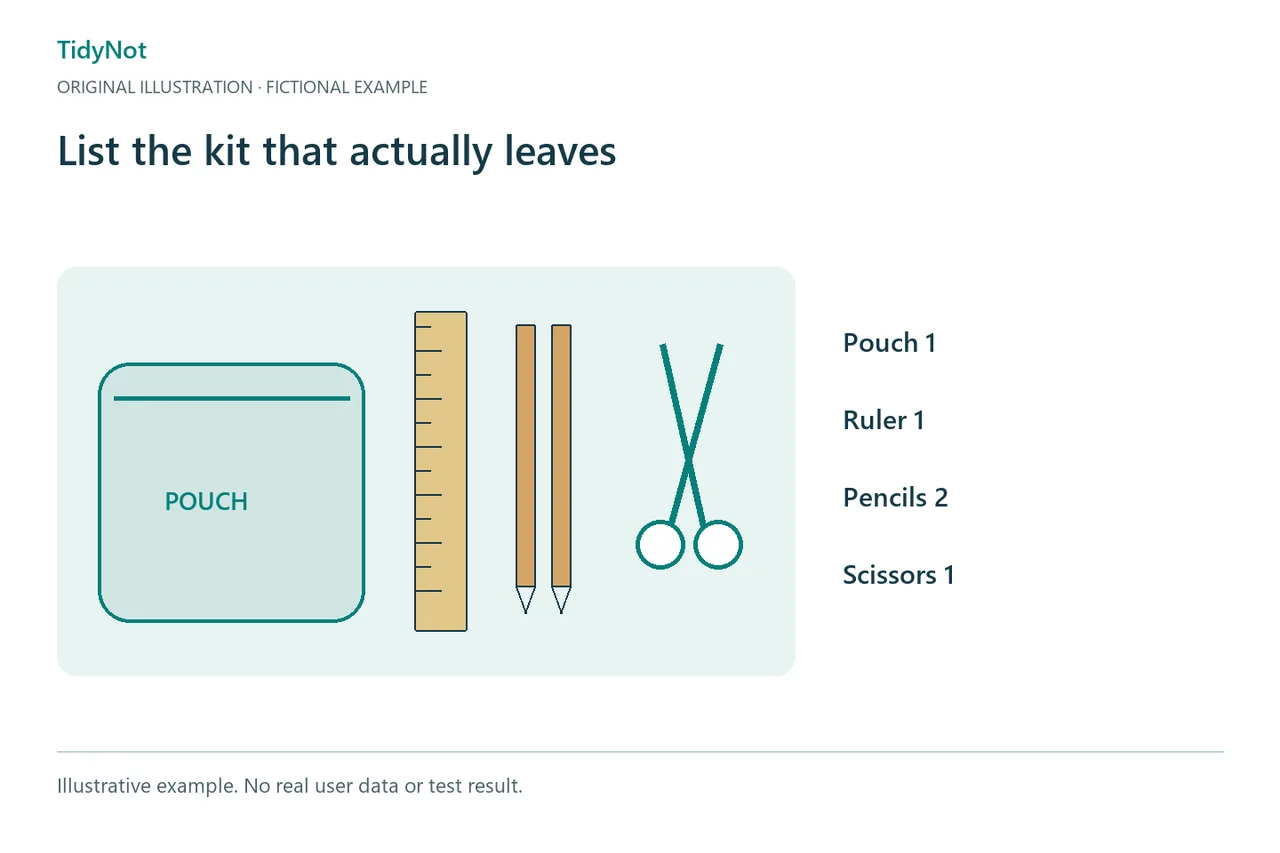
Fictional contents for explaining the record. Count the pieces in your actual kit.
Choose something you are entitled to lend
Use a small stationery kit you own for this example. Its contents can be named without teaching anyone how to use hazardous equipment. Before passing on something borrowed, check the actual lender’s restrictions. Owning a similar object does not give you authority over the one you borrowed.
Smithsonian reported examples of libraries lending objects beyond books in 2014. That history shows a broader lending context, without establishing what your library offers today. Berkeley Public Library’s tool rules also show why authority matters: permission to borrow does not automatically include permission to let another person use the item. Source 9.1 Source 9.2
A handoff card for a privately owned stationery kit
Field | What both people record | Return check |
|---|---|---|
Contents | The actual included pieces | Compare with the same list |
Condition | Existing marks or missing pieces | Note any change without guessing its cause |
Return arrangement | Agreed date, place and contact route | Confirm receipt |
Authority to lend | Who owns the kit and any restrictions | Do not pass on restricted borrowed property |
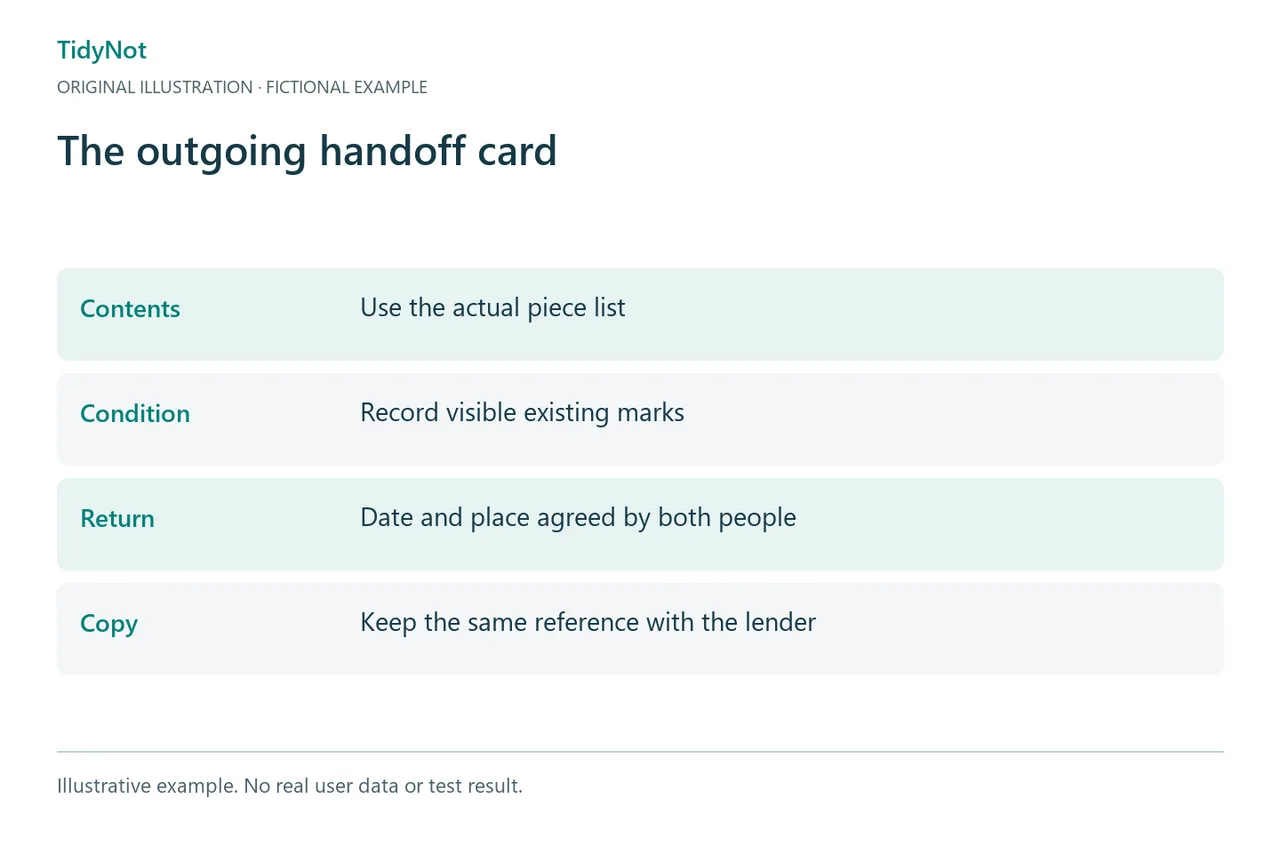
Unagreed return details stay unresolved.
Make the outgoing card together
Lay out the actual pieces before completing a card. In the fictional illustration, the stationery kit has a ruler, scissors, two pencils and a pouch. That is an example inventory, not an assumed count for someone else’s kit. Leave space for a missing piece or an existing mark that both people can see.
Agree a return arrangement that both people understand. Record the agreed place and date only after the agreement exists. If those details are still open, mark them as unresolved. Give the borrower the contents reference and keep a copy with the lender, using only the personal details genuinely needed for the handoff.
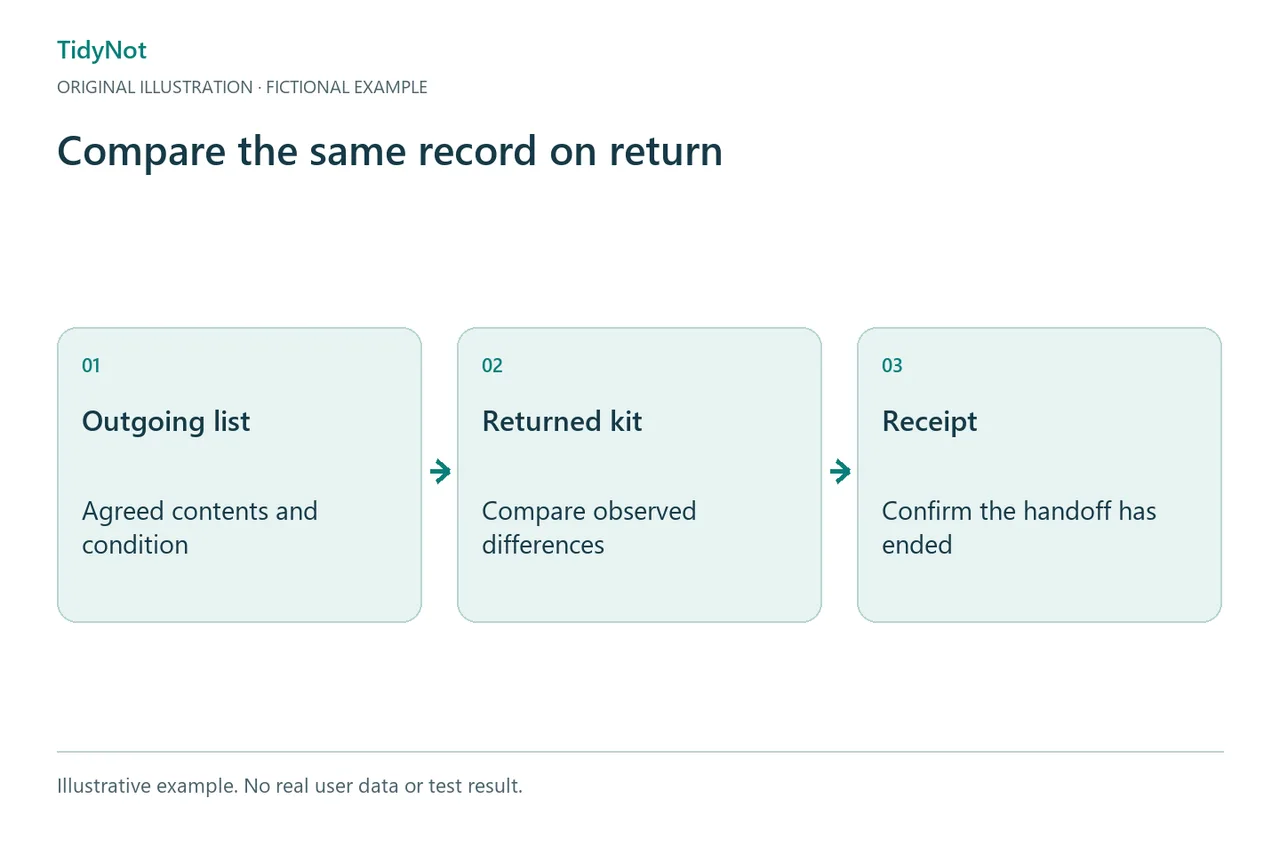
An observation of a change does not establish its cause.
Use the same list on return
Compare the returned pieces with the outgoing list and record any observed difference. A missing pencil is an observation; a story about who lost it is an inference. Keep those apart. Confirm receipt so that both people know the handoff has ended.
Institutional loans follow their own terms for condition, due dates and missing pieces. The private card here does not replace those rules or create a contract.
Close the loan only after checking receipt
Keep “return arranged” separate from “returned and checked.” When the kit comes back, compare the actual contents with the agreed list and record any mismatch with the owner. A check mark is a record of what was checked, not a guarantee that equipment is safe to use.
Try it with your own information
Create a contents and return card
Keep the contents list separate from an agreement about returning the kit.
An invented worked example
Use this scenario to see how the decisions fit together, then replace its details with your own observations.
Fictional kit: two pencils, one eraser, one ruler and one stapler: five pieces, four item types.
Before lending: one pencil has a worn eraser. Record the condition rather than treating it as new damage afterward.
Return arrangement: the borrower proposes Sunday; the lender has not confirmed it. Keep “proposed” visible until both agree.
No account needed. Open the worksheet, enter your own notes, then download a text copy. You can also download it blank to complete elsewhere.
Open and download your worksheet
Sources and scope
[9.1] Mary Beth Griggs. Libraries Are Great at Lending All Sorts of Things—Not Just Books. Smithsonian Magazine, 2014-09-11. https://www.smithsonianmag.com/smart-news/checking-out-tools-and-telescopes-local-libraries-180952662/ Read scope: Article body/byline/date read. Limits: Historical examples; no current local availability or household lending outcome verified.
[9.2] Berkeley Public Library. Borrowing Tools. Berkeley Public Library Tool Lending Library, Undated; checked 2026-10-20. https://www.berkeleypubliclibrary.org/locations/tool-lending-library/borrowing-tools Read scope: Actual rules 1–11 read, including authorized users, due date, condition, loss and damage. Limits: One institution’s rules, not the reader’s local policy. Our example is a privately owned stationery kit; library property must follow its lender’s restrictions.
Source relationship: Historical reporting plus an actual operator’s rules; neither is an experiment showing that the proposed card prevents losses.
The images are original explanatory illustrations of fictional examples. They are not photographs, product screenshots or evidence of a completed practical test.
Evidence and scope
1. Berkeley Public Library. Borrowing Tools. Berkeley Public Library Tool Lending Library, Undated; checked 2026-10-20.
Claim covered: Borrowing rules depend on the actual lender
Smithsonian reported examples of libraries lending objects beyond books in 2014. That history shows a broader lending context, without establishing what your library offers today. Berkeley Public Library’s tool rules also show why authority matters: permission to borrow does not automatically include permission to let another person use the item. Source 9.1 Source 9.2
Berkeley Public Library. Borrowing Tools. Berkeley Public Library Tool Lending Library, Undated; checked 2026-10-20.. English edition; source-specific context. Checked: .
Actual rules 1–11 read, including authorized users, due date, condition, loss and damage. One institution’s rules, not the reader’s local policy. Our example is a privately owned stationery kit; library property must follow its lender’s restrictions.
2. Editorial application
Claim covered: A practical step to try in your own setting
Keep “return arranged” separate from “returned and checked.” When the kit comes back, compare the actual contents with the agreed list and record any mismatch with the owner. A check mark is a record of what was checked, not a guarantee that equipment is safe to use.
TidyNot editorial suggestion. English edition; fictional example. Checked: .
TidyNot editorial proposal. No completed practical trial, measured benefit or universal outcome is claimed.