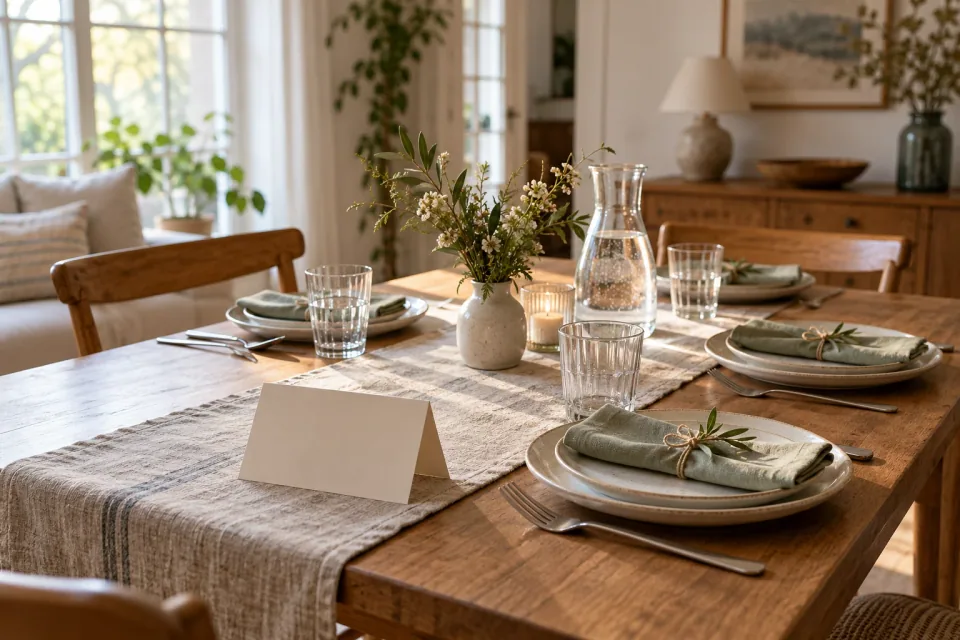
AI-generated editorial illustration; not a photograph of an actual event.
Start with the guest’s decision
A warm invitation can also be a clear one. “Come over on Saturday” may be enough between friends who already know the plan. For someone unfamiliar with the place or format, it leaves several practical questions unanswered.
The publisher’s overview of Priya Parker’s The Art of Gathering emphasizes the people involved rather than relying on familiar conventions.1 For this invitation, apply that idea by asking what a guest needs to decide whether the gathering works for them. The purpose of the event can stay brief.
Put the essentials together
Give the date, start time, expected end, and location or connection details. Explain whether people will sit down together, drop in, or take part in an activity. If a meal, payment, contribution, or preparation is involved, say so before someone accepts.
Share the exact address with invited guests early enough for them to plan. A public invitation image does not need to expose a private home address or entrance code. Use a direct, appropriate channel for details that should stay within the invited group.
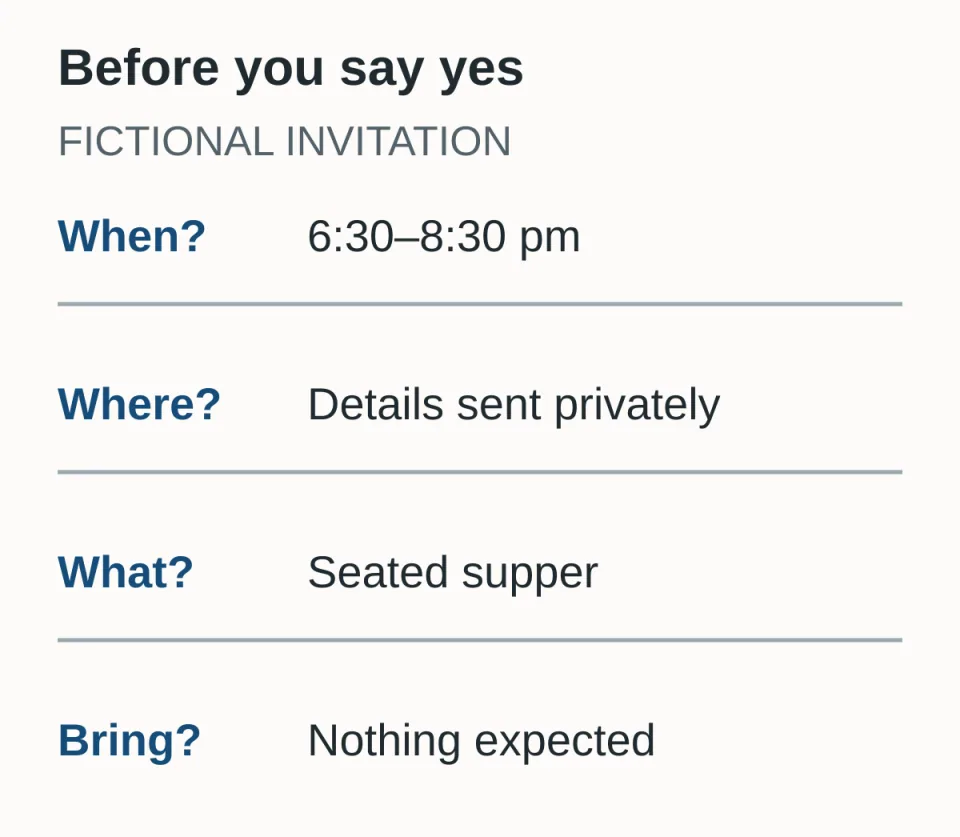
Put the practical details in one place. Fictional invitation.
Describe the access facts you know
“Accessible venue” can conceal important gaps. W3C’s event-planning guidance asks organizers to consider entrances, rooms, bathrooms, participant requirements, and accessible materials.2 For a small gathering, use the relevant questions to check what you can honestly describe.
For example, saying that there are two front steps and that the side entrance has not been checked is more specific than an unverified general label. It still leaves work to do. Do not treat one feature as a complete assessment or promise an arrangement before confirming it.
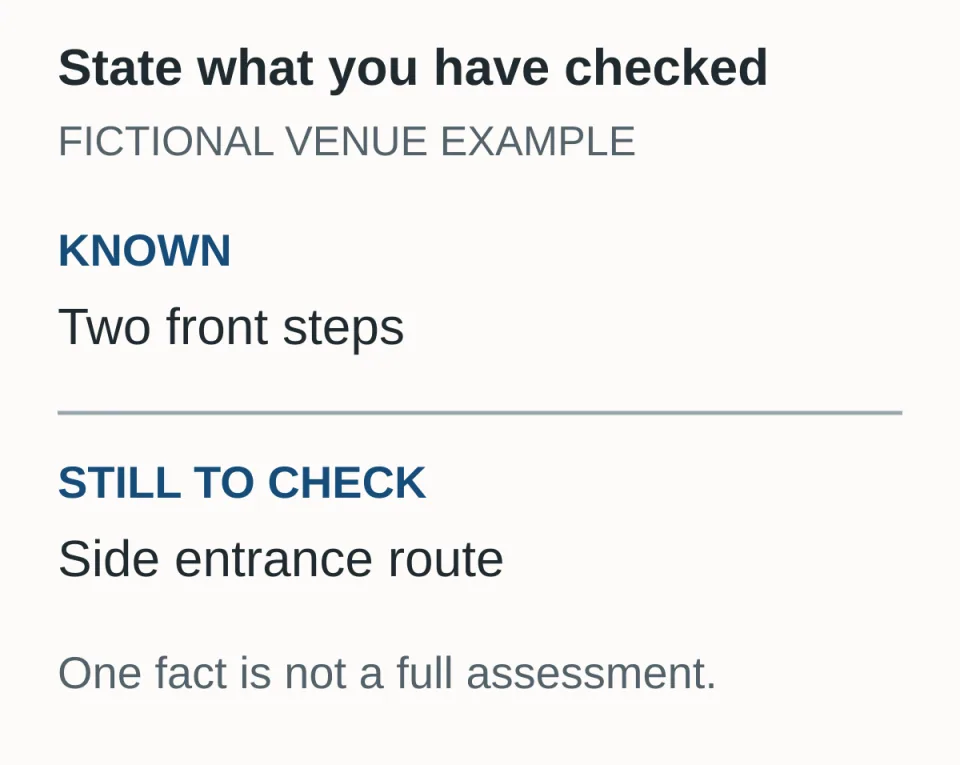
Separate checked facts from unresolved access questions. Fictional venue.
Give guests a useful information note
The following supper is entirely fictional. Its details demonstrate the fields to fill, not arrangements that have been verified at a real home. Keep the actual invitation in readable text even if you also send a decorative image.
Practical information for a fictional supper invitation
Guest’s question | Illustrative wording |
|---|---|
When? | Saturday, 7 November, 6:30–8:30 pm. We will eat around 7. |
Where? | At my home. I will send invited guests the address and entrance directions directly. |
What will happen? | A seated supper and conversation. No presentation or game to prepare for. |
Bring anything or pay? | Food is provided; no contribution is expected. Nothing to bring. |
What access facts are known? | Two front steps. I have not checked the side entrance for a step-free route. |
How can I ask? | Message me privately if you need a detail to decide whether this works for you. |
When should I reply? | Please let me know by Thursday. I will send changes in this conversation. |
On a narrow screen, scroll the table horizontally.
Make questions welcome without asking for a diagnosis
Offer a contact method you will actually check. A guest might need to ask about seating, noise, food, the route inside, or something you have not considered. Ask what information or arrangement would help rather than requesting an explanation of their health.
Handle the answer privately. A guest’s question is not permission to share their personal circumstances with the group. If you cannot confirm an arrangement yet, say what is unresolved and follow up before asking them to rely on it.
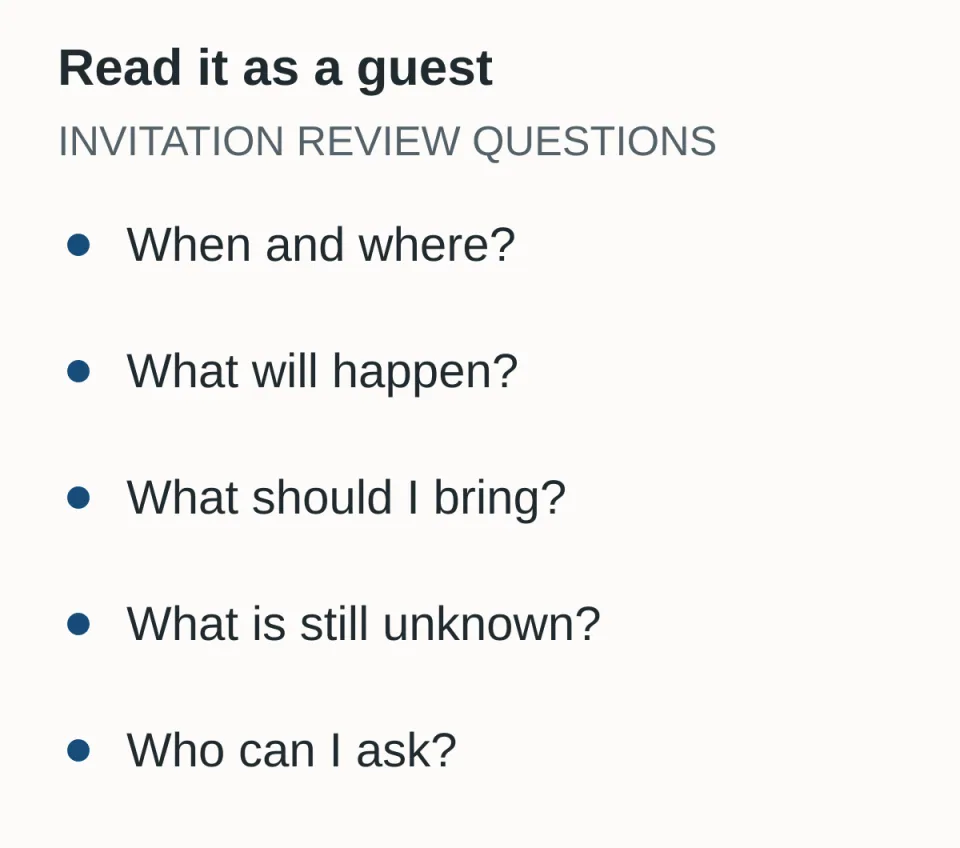
Read the invitation from a guest’s point of view.
Make a changed detail easy to find
If the time, location, or format changes, identify the change clearly in the channel guests are using. W3C also advises keeping participants informed ahead of schedule changes.2 Do not leave an old invitation image as the only visible reference.
Finally, read the invitation as someone who has never been to this place. Can they judge whether to come, plan the journey, and know what is expected? A concise note will not guarantee that every need is met, but it can make the remaining questions easier to ask.
Source notes
- Priya Parker, The Art of Gathering, Riverhead Books. Read: publisher Book Description and format dates only; full book not read. People-centered framing, not the source of this template or measured attendance claims. Checked 24 October 2026 UTC / 25 October KST.
- W3C Web Accessibility Initiative, Making Events Accessible, updated 31 August 2022. Read: accessible materials, initial event planning, and schedule-change guidance. Principles adapted to a small gathering; no venue assessment or compliance certification performed. Checked 24 October 2026 UTC / 25 October KST.
All diagrams are original editorial SVG illustrations. Examples are fictional where marked. No use test, outcome measurement, or venue assessment is implied.
Evidence and scope
1. Making Events Accessible — W3C WAI
Claim covered: “Accessible venue” can conceal important gaps. W3C’s event-planning guidance asks organizers to consider entrances, rooms, bathrooms, participant requirements, and accessible materials.2 For a small gathering, use the relevant questions to check what you can honestly describe.
Event planning includes accessible entrances, rooms, bathrooms, materials and participant requirements.
Making Events Accessible — W3C WAI. English edition; source jurisdiction as stated. Checked: .
No venue assessment or compliance certification; apply only questions relevant to the event.
2. Editorial application
Claim covered: For a small gathering, give guests the details that affect whether they can come and how they should prepare. Include when it starts and ends, where it is, what will happen, and whether they need to bring or do anything. Add the access facts you have checked, say what is still unknown, and offer a private way to ask a question.
TidyNot practical application, separated from the original source’s claims.
TidyNot editorial suggestion. English edition. Checked: .
No venue assessment or compliance certification; apply only questions relevant to the event.