A useful paper household contact card contains agreed contact details and meeting places, is readable by the person carrying it, and can be found without opening a phone. Make it during ordinary planning time, not during an active emergency. The card is one part of a broader household emergency plan and cannot guarantee communication or safety.
Agree on the information before designing the card
Sit down with the household members who will use the cards. Identify whose contact details belong on them and ask the proposed outside contact whether they are willing to take that role. Confirm the actual phone number directly through a normal agreed conversation.
The American Red Cross recommends an out-of-area contact and two meeting places: one just outside the home for a sudden emergency and another outside the neighborhood if you cannot return home. It also recommends carrying written contact information. 1
Choose specific locations as part of your household’s wider plan. “Outside” or “The park” may not identify the same point to everyone. Write the agreed description clearly enough that each intended reader understands it, while recognizing that actual hazards and local authority instructions may require a different action.
If a contact has not agreed or a meeting point needs further discussion, keep it on a pending list. Do not print it as a settled arrangement merely to finish the layout.
Build a small master with only necessary details
Start with a plain master containing household contact names and agreed numbers, the out-of-area contact and number, both meeting-place descriptions, and a date checked. Use the name or relationship that each reader will recognize, not an unexplained nickname.
Keep private details limited to what this card needs to do. Leave out:
- Passwords and account information
- Government identifiers
- Medical records
A contact card should not become a portable copy of the household’s sensitive documents.
Write or print the master in a size the intended readers can actually use. A tiny wallet format is not an improvement if someone needs to enlarge it on a phone. A larger folded copy, clearer lettering, or a language the reader uses comfortably may be the better choice.
Check each number against the confirmed source before making copies. Read it back digit by digit during an ordinary conversation if needed. Do not place test calls to emergency numbers.
Make the copies and choose where they will be kept
Prepare one copy for each intended household user and any additional private copy you have agreed is needed. Compare every copy with the dated master, including the meeting places. Avoid making a fresh handwritten variation that quietly drops a digit or changes a location.
Let each person choose an accessible place they can remember, such as a wallet, everyday bag, or another suitable personal location. The purpose is to retrieve the information when a phone is unavailable, so a photograph stored only on the phone does not complete this task.
Keep distribution intentional. Do not publish an image of the filled card, place it on a public shared board, or send it broadly just because several people need copies. Share additional copies only with the people included in your agreed plan.
Record who has a copy so updates can reach the same people later. This can be a short private note beside the master rather than a new household database.
Run a simple read-and-find check
Ask each intended user to retrieve their copy and point to the out-of-area contact and both meeting places. Have them read the details from the card rather than from memory. This checks the actual artifact and its storage location.
If someone cannot find the card, improve its location. If the writing is hard to read, change the format. If people interpret a meeting description differently, resolve the wording together before treating the set as complete.
The Red Cross recommends practicing elements of the household plan. This small retrieval check addresses only the card; it does not replace evacuation planning or hazard-specific guidance. 1
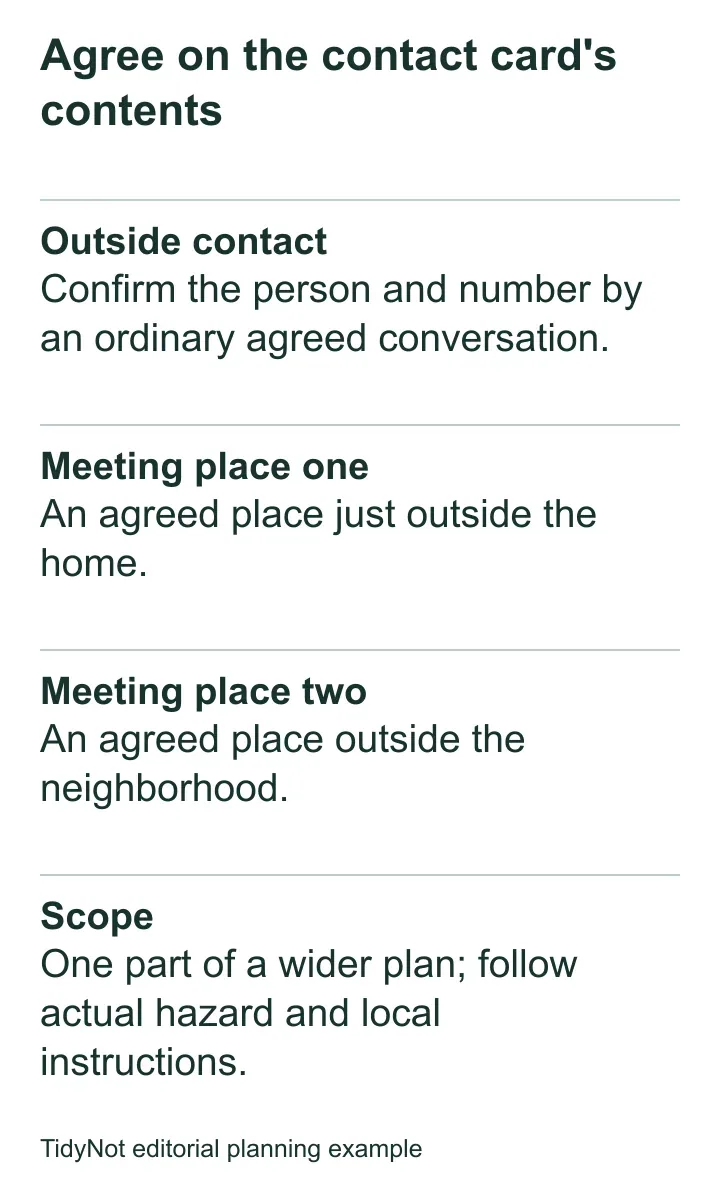
Choose a review date and update sooner whenever a relevant number or arrangement changes. Replace outdated copies as a set, mark the new master’s date, and make sure the old versions no longer look current.
A simple check sheet
Card field | Your agreed entry |
|---|---|
Household contacts | [Names and confirmed numbers] |
Out-of-area contact | [Agreed name and confirmed number] |
Near-home meeting place | [Specific agreed description] |
Outside-neighborhood meeting place | [Specific agreed description] |
Checked date | [Date you confirmed these details] |
Quick answers for your household contact card
What belongs on the card?
Use agreed household contact names and numbers, an agreed out-of-area contact, two agreed meeting-place descriptions, and a checked date. Carry a readable offline copy. These fields apply the Red Cross planning guidance; the layout below is TidyNot's editorial template.
Can I use a phone photo instead?
A phone photo can be an additional copy, but it cannot answer this task when that phone is unavailable. Check the paper copy's location and readability with its intended user.
What should stay off this small card?
- Passwords and account information
- Government identifiers
- Medical records
Keep those materials in their appropriate private arrangements rather than expanding this contact card into a sensitive-records file.
Final check
- Confirm contacts and agree on two meeting places.
- Prepare a readable, dated master with minimal information.
- Give matching copies to the intended household users.
- Test retrieval and reading without a phone.
When this task is done
Each intended user can produce and read a matching current copy, the contacts and locations are agreed, and pending details have not been printed as confirmed. You also know who needs a replacement when the master changes.
Sources
- American Red Cross: Make a Plan. Checked 2026-10-22. Written contacts, two meeting places, out-of-area contact, and plan practice. A card is only one planning component, not an emergency-response guarantee.
- Los Angeles County: Household Communication Plan. Checked 2026-10-29. Include agreed household and out-of-area contact details in your communication plan. US emergency-planning guidance; local hazards and authorities still govern.
- Red Cross Family Disaster Plan template. Checked 2026-10-29. Fields for a near-home meeting point, an outside-neighborhood meeting point and an out-of-area contact. Only these planning fields were used; no obsolete service instructions were adopted.
Evidence and scope
1. www.redcross.org — editor-verified original source
Claim covered: The American Red Cross recommends an out-of-area contact and two meeting places: one just outside the home for a sudden emergency and another outside the neighborhood if you cannot return home. It also recommends carrying written contact information. 1
The guidance identifies a meeting point outside the home and another outside the neighborhood, an out-of-area contact, and written contact details. Card design and privacy fields remain editorial suggestions.
www.redcross.org — editor-verified original source. Use only the locale/version and evidence scope stated in the manuscript and source notes.. Checked: .
2. www.redcross.org — editor-verified original source
Claim covered: The Red Cross recommends practicing elements of the household plan. This small retrieval check addresses only the card; it does not replace evacuation planning or hazard-specific guidance. 1
The guidance identifies a meeting point outside the home and another outside the neighborhood, an out-of-area contact, and written contact details. Card design and privacy fields remain editorial suggestions.
www.redcross.org — editor-verified original source. Use only the locale/version and evidence scope stated in the manuscript and source notes.. Checked: .
3. www.redcross.org — editor-verified original source
Claim covered: American Red Cross: Make a Plan. Checked 2026-10-22. Written contacts, two meeting places, out-of-area contact, and plan practice. A card is only one planning component, not an emergency-response guarantee.
The guidance identifies a meeting point outside the home and another outside the neighborhood, an out-of-area contact, and written contact details. Card design and privacy fields remain editorial suggestions.
www.redcross.org — editor-verified original source. Use only the locale/version and evidence scope stated in the manuscript and source notes.. Checked: .
4. Editorial application
Claim covered: TidyNot practical checklist, examples and step sequence.
Practical editorial suggestions distinguished from sourced factual claims.
TidyNot editorial suggestion. General readers within the manuscript stated scope.. Checked: .
No personal test, measured benefit, provider implementation or safety guarantee is claimed.