Plan changing-weather packing around the activities on the itinerary. For each part of the trip, note the conditions you still need to verify and the clothes you could combine. This turns a pile of possibilities into a plan you can check before closing the bag.
Real Simple’s transitional-weather article discusses packing pieces that can be layered.[S07] Begin with that general idea, then build a list for your actual itinerary. A generic packing list cannot tell you the forecast, venue requirements or luggage allowance for your trip.
Put the itinerary beside the clothes
Write the parts of the trip that call for a change: travel, time outdoors, an indoor visit or a planned event. Use current official forecasts and the relevant operator’s luggage rules when those details are available. Leave an unanswered condition marked as a question rather than filling it with a guessed temperature or limit.
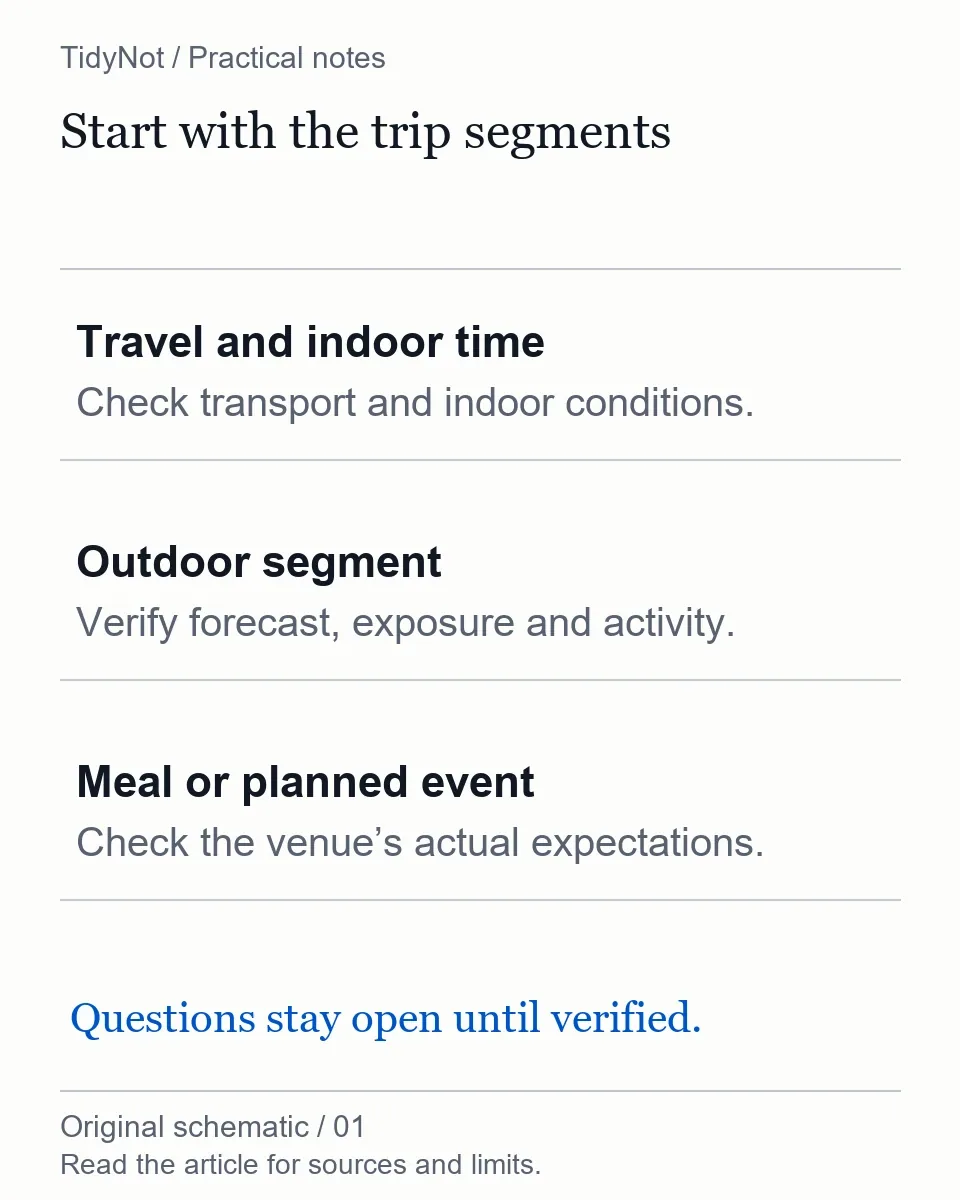
Start with the trip segments. Original TidyNot schematic.
Match each activity and expected condition with a combination of clothes you already have.
Trip segment | Conditions to verify | Combination to plan |
|---|---|---|
Travel and indoor time | Transport and indoor conditions | Comfortable base clothing and an accessible extra layer |
Outdoor walk | Current forecast, exposure and activity | Layers appropriate to the verified conditions |
Planned meal or event | Venue and dress expectations | A suitable combination from the same packed items where practical |
This is a planning example for an ordinary trip. A specialist outdoor activity or severe conditions need activity-specific preparation; the table is not an equipment or safety checklist for those situations.
Give each layer a job
REI’s layering guide distinguishes the functions of a base layer, an insulating middle layer and an outer layer, with the combination depending on activity and weather.[Q05] Use those roles to ask what each garment in your plan is expected to do. Several items with the same role may still be necessary, but the reason should come from the trip.
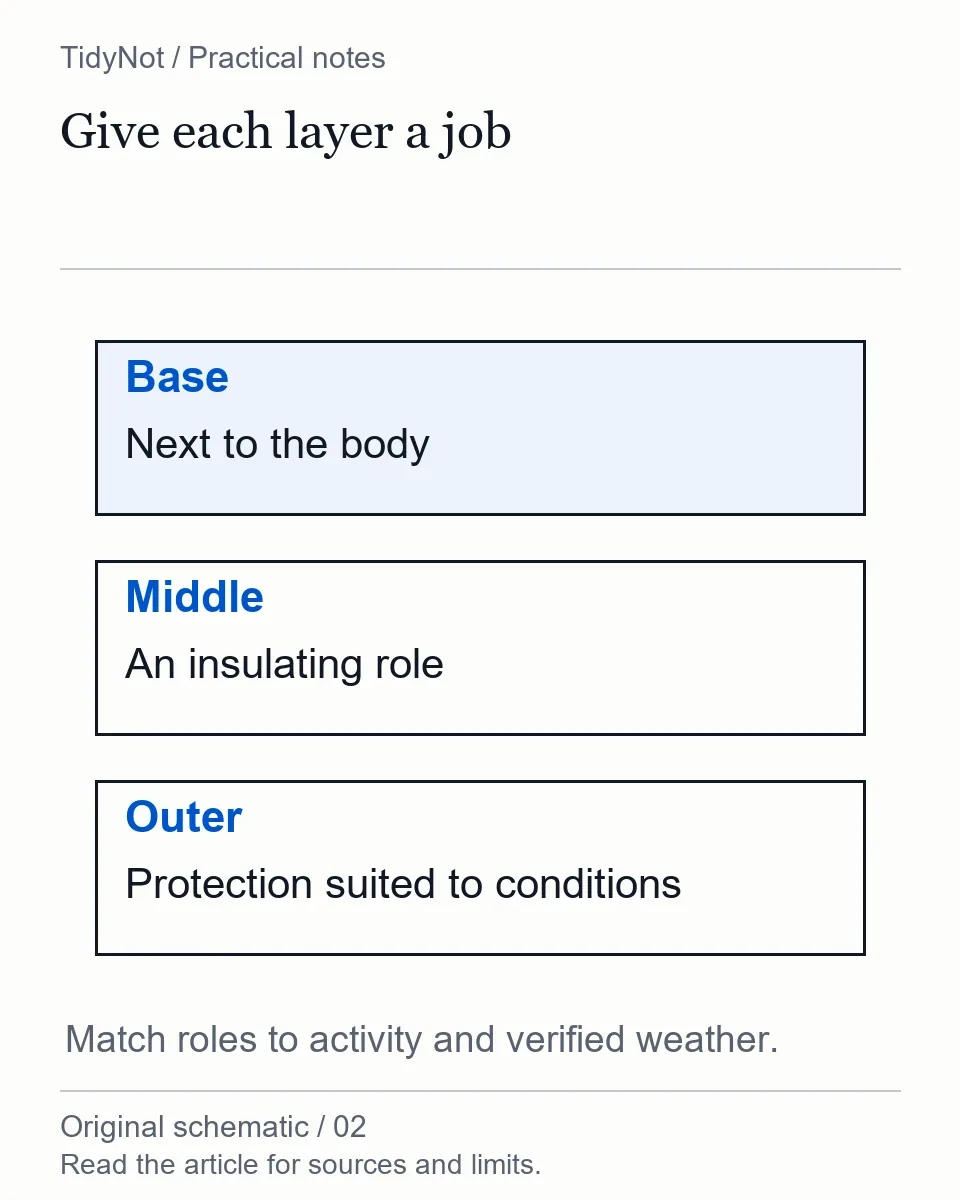
Give each layer a job. Original TidyNot schematic.
Lay out a combination for each planned segment. Try the pieces together and check fit, movement and any venue requirements that matter.
Mark what needs to stay accessible
A layer needed during the journey should be easy to reach in the bag you can access. Write that location beside the item. Also mark laundry or drying assumptions: if you are counting on rewearing something, the itinerary needs to make that practical.
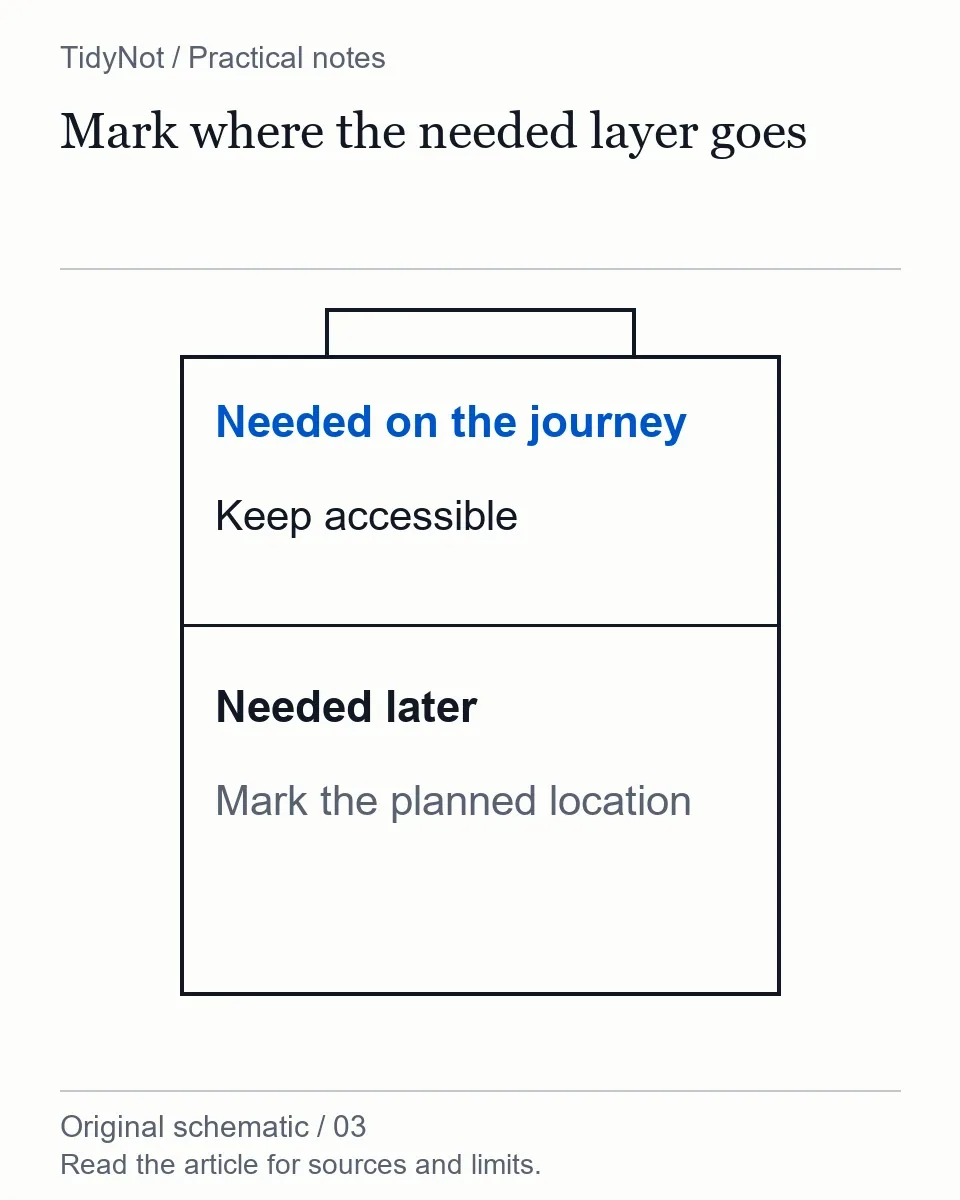
Mark where the needed layer goes. Original TidyNot schematic.
Before leaving, revisit the conditions that were still uncertain. Update the combinations when the forecast or itinerary changes. Keep any unresolved question on the list so it can be checked before departure.
Try it with your own information
Make an itinerary-to-bag map
Assign each garment a role and a bag location. Verify conditions before finalizing.
An invented worked example
Use this scenario to see how the decisions fit together, then replace its details with your own observations.
Fictional city trip: train journey, outdoor walk, indoor meal. A cardigan can serve the journey and meal if it fits the actual dress expectations.
The outdoor row stays pending until the forecast and exposure are checked. A repeated garment is not automatically appropriate for every weather condition.
A journey layer goes in the bag you can reach on the train. An item buried in checked luggage cannot serve that role during transit.
No account needed. Open the worksheet, enter your own notes, then download a text copy. You can also download it blank to complete elsewhere.
Open and download your worksheet
Sources and reading scope
- Nafeesah Allen. How to Pack for Multiple Climates and Transitional Weather. Real Simple; 2025-03-05 updated. https://www.realsimple.com/how-to-pack-for-transitional-weather-8608613. Article body, byline and updated date read. Practical journalism, not a trial of packing outcomes. No current forecast, luggage rule or product test verified.
- REI Co-op. Layering Basics. REI Expert Advice; Current public guide; a publication date was not freshly confirmed. https://www.rei.com/learn/expert-advice/layering-basics.html. Layer roles and activity/weather context read. Practitioner/retailer guide; no product comparison or specialist outdoor safety validation.
Evidence and scope
1. How to Pack for Multiple Climates and Transitional Weather
Claim covered: Real Simple’s transitional-weather article discusses packing pieces that can be layered.[S07] Begin with that general idea, then build a list for your actual itinerary. A generic packing list cannot tell you the forecast, venue requirements or luggage allowance for your trip.
Article body, byline and updated date read.
How to Pack for Multiple Climates and Transitional Weather. English edition. Checked: .
Practical journalism, not a trial of packing outcomes. No current forecast, luggage rule or product test verified.
2. Layering Basics
Claim covered: REI’s layering guide distinguishes the functions of a base layer, an insulating middle layer and an outer layer, with the combination depending on activity and weather.[Q05] Use those roles to ask what each garment in your plan is expected to do. Several items with the same role may still be necessary, but the reason should come from the trip.
Layer roles and activity/weather context read.
Layering Basics. English edition. Checked: .
Practitioner/retailer guide; no product comparison or specialist outdoor safety validation.
3. Editorial application
Claim covered: Plan changing-weather packing around the activities on the itinerary. For each part of the trip, note the conditions you still need to verify and the clothes you could combine. This turns a pile of possibilities into a plan you can check before closing the bag.
TidyNot editorial workflow suggestion, distinguished from the linked source statements.
TidyNot editorial suggestion. English edition. Checked: .
An editorial application, not a tested intervention or a guarantee of results.