To clear out used household batteries, identify their chemistry from the markings, confirm a collection route for those exact types, and record what the provider actually accepts. Sorting by AA, AAA, or button shape alone is not enough: EPA says battery type is identified by labeling, not shape or label color. 1
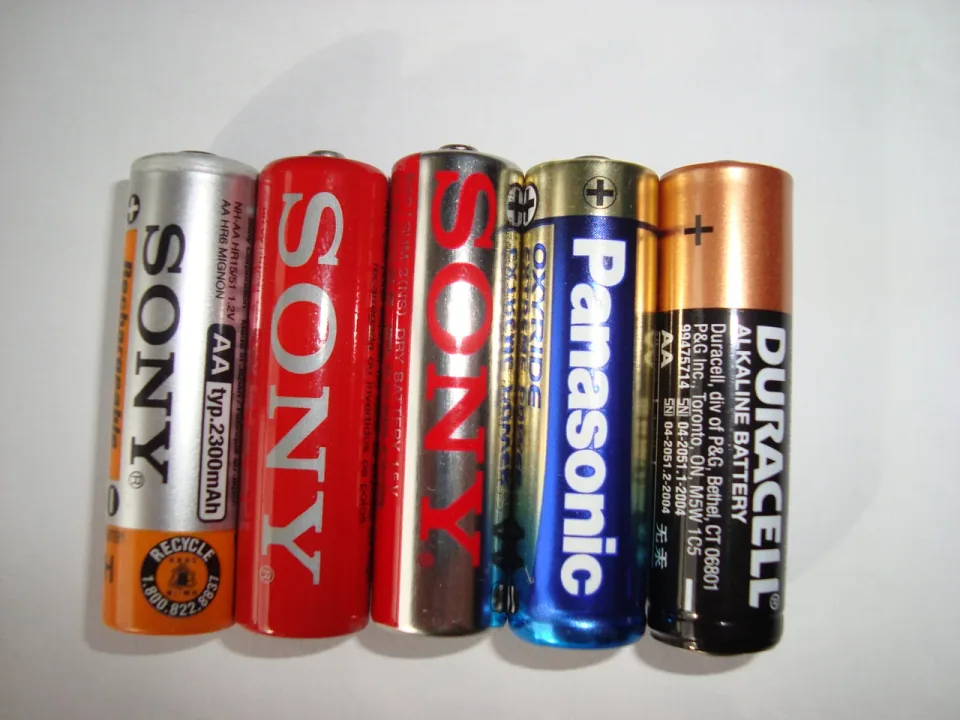
AA batteries with different label markings. The photo illustrates why size alone does not identify battery chemistry; it is not a disposal-preparation example. Photo: Cyberpunk / Wikimedia Commons. CC0 1.0. CC0 1.0
Limit the job to batteries you can identify safely
Start with a small batch already removed through normal user maintenance. Do not open a device or pry out a built-in battery to add it to the collection. This article covers small household batteries, not vehicle batteries or home energy-storage systems.
If a battery is swollen, leaking, damaged, or cannot be identified, stop ordinary sorting of that item. Seek its manufacturer’s or local hazardous-waste authority’s handling guidance before preparing or transporting it. Do not place it in an ordinary collection batch simply because the others look similar. EPA specifically directs readers with damaged lithium batteries to the manufacturer. 1
Make a short list with a line for each safely identifiable type: exact label wording, number of batteries, proposed collection provider, preparation instructions, and handoff status. Preserve unfamiliar abbreviations as written rather than translating them by guesswork.
Read the chemistry before choosing a destination
Look for markings such as alkaline, lithium, Li-ion, Ni-MH, or Ni-Cd, and record whether the label identifies the battery as rechargeable. Keep chemistry and size in separate fields. “AA” can describe the physical size without answering the disposal question.
EPA says lithium single-use, coin or button, and rechargeable batteries do not belong in household trash or municipal recycling bins. For alkaline and zinc-carbon batteries, check local or state waste guidance rather than assuming one nationwide trash rule. Keep small batteries out of children’s reach. 1
If you find only part of a label, write “Unidentified” and retain a separate open question. Completing the worksheet accurately is more useful than forcing every item into a familiar category.
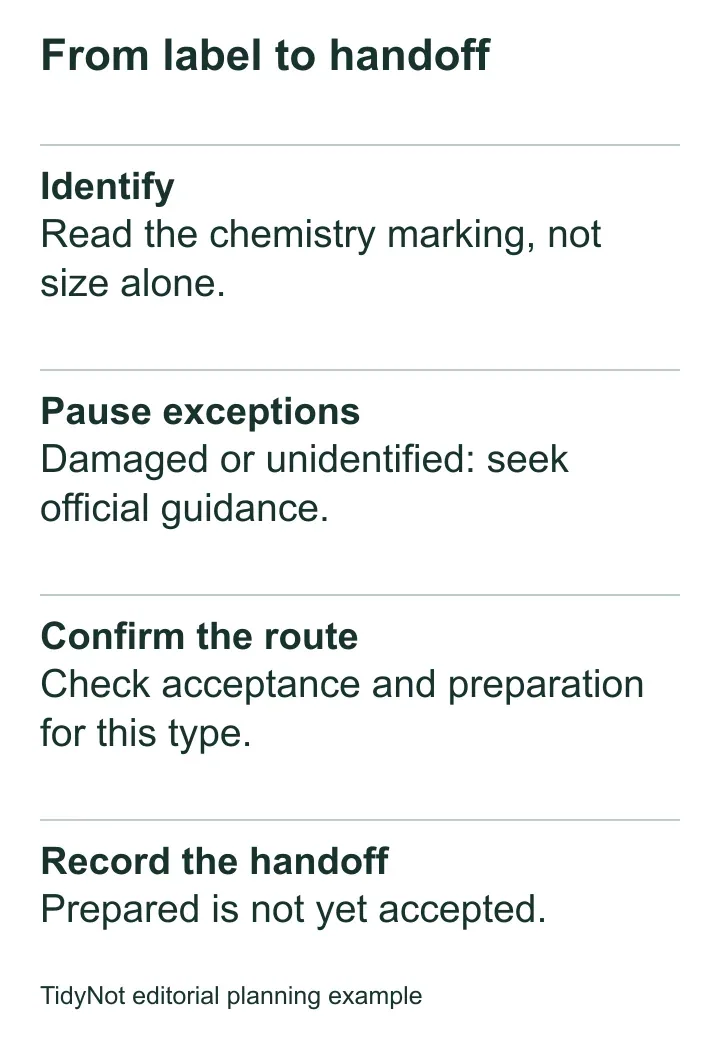
From label to handoff. Editorial planning example; not a photograph, product test or measured result.
Verify what the collection site will accept
Open your local authority’s waste page or the collection provider’s own instructions. A search result saying “Battery recycling” is only a lead. Check the exact chemistry accepted, household versus business limits, condition restrictions, current hours, and whether an appointment or fee applies.
Read the preparation and transport instructions for your identified type. EPA describes individual plastic bags or nonconductive terminal covering for specified battery categories; follow the applicable instructions and the receiving program’s requirements, rather than leaving loose exposed terminals together. 1
Put the provider’s official page or contact details beside the relevant line in your list. If its wording is ambiguous, ask a narrow question before traveling: “Do you currently accept these labeled household battery types, and how should they be prepared?” Do not describe an unidentified or damaged battery as an ordinary intact one.
A provider may accept only part of your batch. Assign different destinations when necessary instead of choosing the nearest site and hoping it will take everything.
Finish at the handoff rather than the front door
Prepare only the accepted types according to the confirmed instructions. Schedule the trip or approved collection step, and leave the status as “Prepared, not handed over.” A bag in the car or a box beside the door has not completed the clear-out.
At the site, follow the posted or staff-directed process. After acceptance, record the date, provider, and types handed over. A personal note is sufficient if the program does not issue a receipt; do not invent a formal recycling certificate.
If an item is refused, record that fact and the reason given. Reopen its destination field and name the next official contact. Never leave refused batteries beside a collection container or count them as disposed merely because the trip happened.
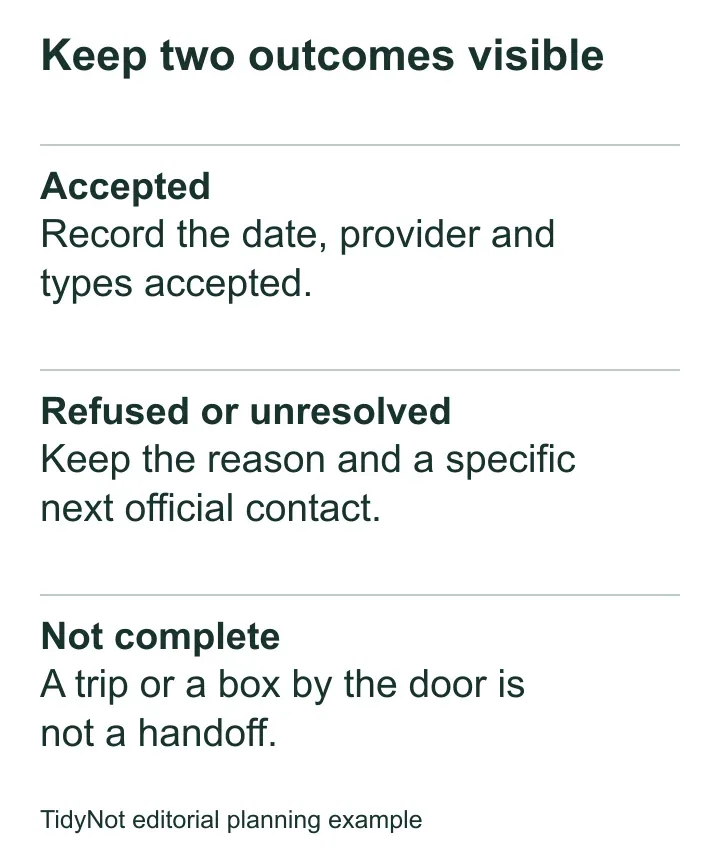
Keep two outcomes visible. Editorial planning example; not a photograph, product test or measured result.
Final check
- Identify chemistry from the actual marking.
- Exclude damaged and unidentified items from ordinary handling.
- Confirm current acceptance and preparation requirements.
- Record accepted items and a next contact for every refusal.
When this task is done
Every line now says either “Accepted” with a date and provider or “Unresolved” with a specific official contact. The disposal portion is complete only for accepted items; the whole batch is complete when no handoff remains outstanding.
Sources and limits
The step sequence, record fields, example entries, and completion tests are editorial applications of the cited guidance, not results of product testing or an evaluated organizing intervention.
- US EPA: Used Household Batteries. Source-package check: 2026-10-22. Chemistry identification, type-specific disposal, and household-battery handling precautions. Limits: US national guidance does not confirm any local site’s current acceptance.
Evidence and scope
1. US EPA: Used Household Batteries
Claim covered: To clear out used household batteries, identify their chemistry from the markings, confirm a collection route for those exact types, and record what the provider actually accepts. Sorting by AA, AAA, or button shape alone is not enough: EPA says battery type is identified by labeling, not shape or label color. 1
EPA background; single-use and rechargeable battery disposal/handling sections
US EPA: Used Household Batteries. English edition; jurisdiction limited to cited guidance. Checked: .
US national guidance, local acceptance not confirmed; no battery inspected.
2. US EPA: Used Household Batteries
Claim covered: If a battery is swollen, leaking, damaged, or cannot be identified, stop ordinary sorting of that item. Seek its manufacturer’s or local hazardous-waste authority’s handling guidance before preparing or transporting it. Do not place it in an ordinary collection batch simply because the others look similar. EPA specifically directs readers with damaged lithium batteries to the manufacturer. 1
EPA background; single-use and rechargeable battery disposal/handling sections
US EPA: Used Household Batteries. English edition; jurisdiction limited to cited guidance. Checked: .
US national guidance, local acceptance not confirmed; no battery inspected.
3. US EPA: Used Household Batteries
Claim covered: EPA says lithium single-use, coin or button, and rechargeable batteries do not belong in household trash or municipal recycling bins. For alkaline and zinc-carbon batteries, check local or state waste guidance rather than assuming one nationwide trash rule. Keep small batteries out of children’s reach. 1
EPA background; single-use and rechargeable battery disposal/handling sections
US EPA: Used Household Batteries. English edition; jurisdiction limited to cited guidance. Checked: .
US national guidance, local acceptance not confirmed; no battery inspected.
4. US EPA: Used Household Batteries
Claim covered: Read the preparation and transport instructions for your identified type. EPA describes individual plastic bags or nonconductive terminal covering for specified battery categories; follow the applicable instructions and the receiving program’s requirements, rather than leaving loose exposed terminals together. 1
EPA background; single-use and rechargeable battery disposal/handling sections
US EPA: Used Household Batteries. English edition; jurisdiction limited to cited guidance. Checked: .
US national guidance, local acceptance not confirmed; no battery inspected.
5. Editorial application
Claim covered: Start with a small batch already removed through normal user maintenance. Do not open a device or pry out a built-in battery to add it to the collection. This article covers small household batteries, not vehicle batteries or home energy-storage systems.
The step sequence, record fields, example entries, and completion tests are editorial applications of the cited guidance, not results of product testing or an evaluated organizing intervention.
TidyNot editorial suggestion. English edition. Checked: .
Do not remove non-user-serviceable batteries. Damaged, swollen, leaking or unidentified batteries require manufacturer or local hazardous-waste guidance, not this standard sorting workflow. Do not put lithium, coin/button or rechargeable batteries into household trash or municipal recycling. Follow the source for terminal protection and keep small batteries away from children. The article covers small household batteries only, not vehicle or home-energy-storage systems; local acceptance must be checked at publication and use.