Put the action you need in the opening of a request. Tell the reader what to review, choose or send, then give the context required to do it. A message can be short and still leave its actual request hard to find.
The GOV.UK clear-structure guidance recommends putting important information early and using headings that describe the content.[Q29] Apply that principle to the order of a message, even when the message only needs a few paragraphs.
Write the action before the history
In a draft, underline the sentence that says what the recipient should do. If it appears only at the end, try moving it to the opening. Give the file a recognizable name and point to the relevant part so the reader can locate the material.
Consider this constructed example: "Please review the two proposed headings in the attached draft and tell me which describes the section more accurately." The sentence names the action, its object and the response needed. It does not imply that the reader has already approved either heading.
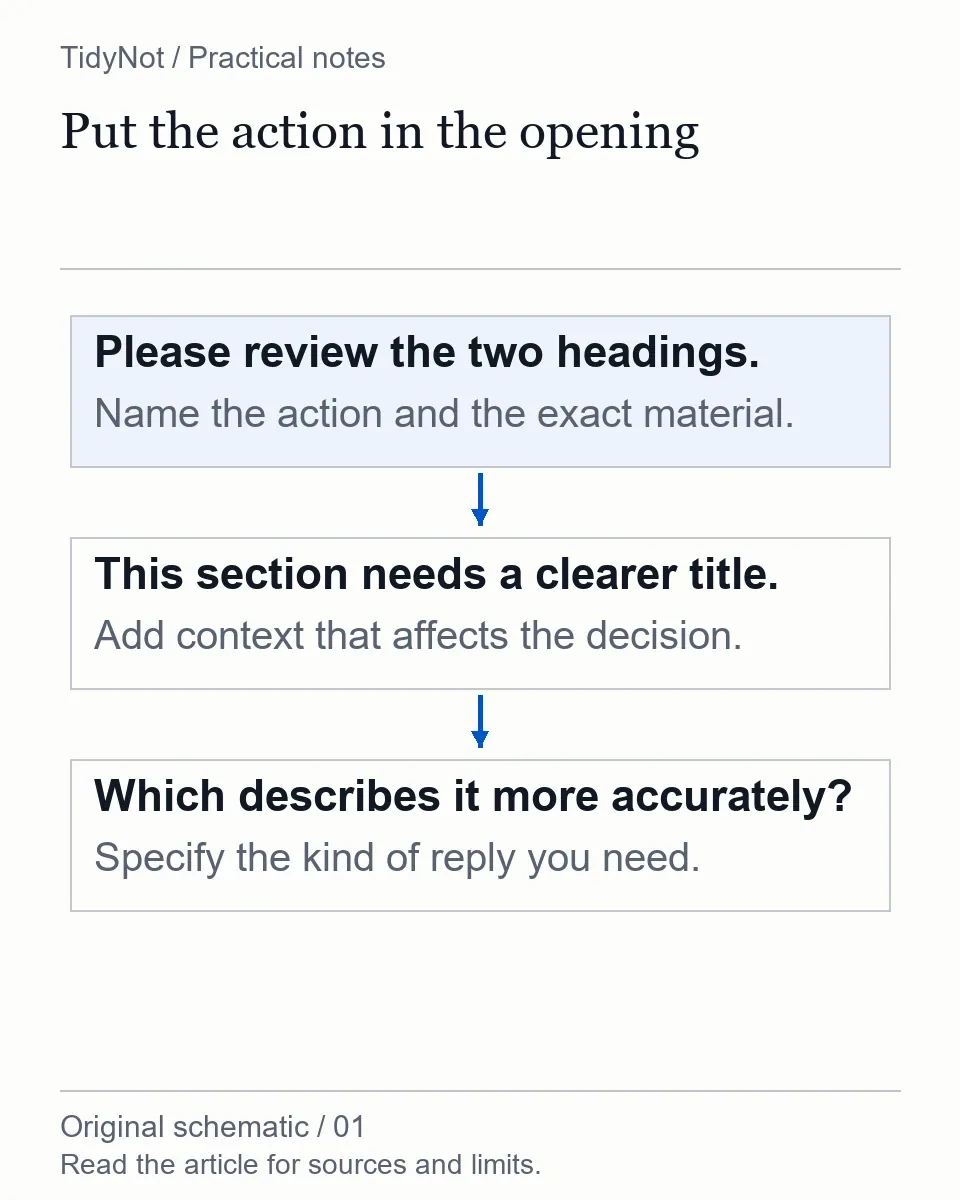
Put the action in the opening. Original TidyNot schematic.
Put the requested action first, followed by the information needed to respond.
Part of the message | Include | Avoid inventing |
|---|---|---|
Opening request | The action or decision you need | Approval the reader has not given |
Needed context | The file, choice or constraint behind it | Background that does not affect the answer |
Response timing | An actual agreed deadline, or a question about timing | An arbitrary urgency claim |
Keep the context that changes the answer
Follow with the reason for the request. Perhaps one heading is already used elsewhere, or the intended audience uses a different term. Include the detail that helps the reader decide. A complete history of the document can stay in its notes unless the decision depends on it.
The publisher’s introduction to Smart Brevity describes an approach to concise communication.[S16] The book’s public description is a planning reference here; it is not evidence that a particular message length will improve your response rate.
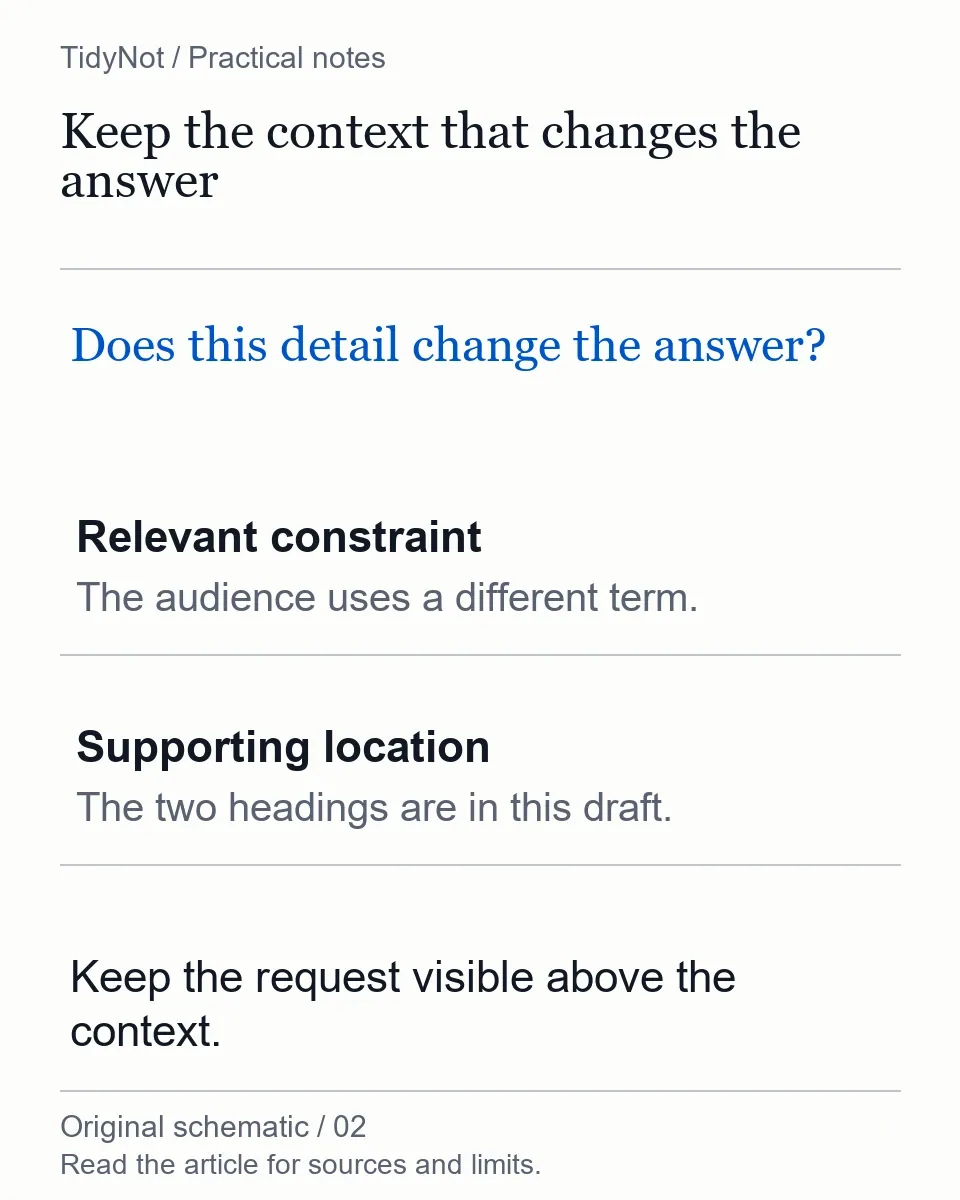
Keep the context that changes the answer. Original TidyNot schematic.
State timing accurately
If the response date has been agreed, include it with the request. When you need an answer by a particular time for a real dependency, explain that dependency and check whether the timing is feasible. If there is no deadline, ask when the recipient can respond. Avoid adding urgency simply to make the message look decisive.
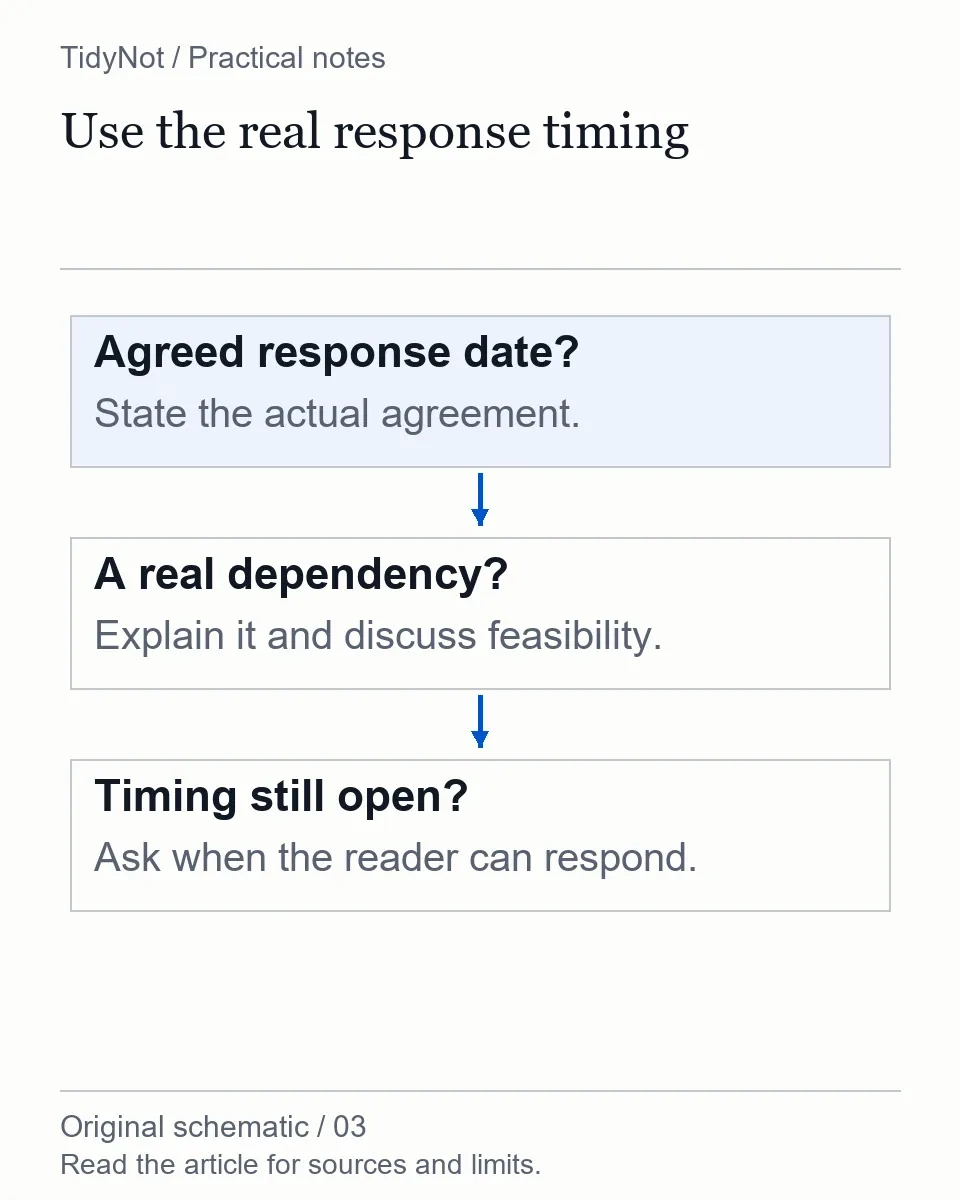
Use the real response timing. Original TidyNot schematic.
Read the draft once from the recipient’s position. Can they find the requested action, open the correct material and tell what kind of reply you need? If a link or permission is missing, fix that before sending.
Try it with your own information
Draft an answerable request
Compare these two fictional messages, then write your own without inventing urgency.
An invented worked example
Use this scenario to see how the decisions fit together, then replace its details with your own observations.
Before: “We have been working on the visitor guide and there were a few suggestions about the headings. I attached the latest version. Let me know your thoughts.” The recipient cannot tell which decision is needed.
After: “Please choose between ‘Before your visit’ and ‘Getting here’ for section 2 of Visitor-guide-v03. The section contains arrival directions only; preparation is in section 1. Which heading is clearer for first-time guests? The link below opens the two options.
Timing: Could you tell me when you can review them?”
Why it changes the task: one decision, a named version, a reason for the comparison and an honest timing question. No reply date has been agreed.
No account needed. Open the worksheet, enter your own notes, then download a text copy. You can also download it blank to complete elsewhere.
Open and download your worksheet
Sources and reading scope
- Jim VandeHei, Mike Allen and Roy Schwartz. Smart Brevity. Workman; 2022-09-20. https://www.hachettebookgroup.com/titles/jim-vandehei/smart-brevity/9781523516971/?lens=workman-publishing-company. Publisher description and listed date read after Workman redirect; book body not read. The current heading mentions a revised edition, but no new revision date was verified. No response-rate or ideal-length claim is inferred.
- Government Digital Service. Create a clear structure for your content. GOV.UK content and publishing guidance; Current public guidance checked 2026-10-20. https://guidance.publishing.service.gov.uk/writing-to-gov-uk-standards/writing-guidelines/clear-structure/. Frontloading and descriptive-heading sections read. Public content guidance adapted to message order; no claim that all GOV.UK formatting rules apply.
Evidence and scope
1. Create a clear structure for your content
Claim covered: The GOV.UK clear-structure guidance recommends putting important information early and using headings that describe the content.[Q29] Apply that principle to the order of a message, even when the message only needs a few paragraphs.
Frontloading and descriptive-heading sections read.
Create a clear structure for your content. English edition. Checked: .
Public content guidance adapted to message order; no claim that all GOV.UK formatting rules apply.
2. Smart Brevity
Claim covered: The publisher’s introduction to Smart Brevity describes an approach to concise communication.[S16] The book’s public description is a planning reference here; it is not evidence that a particular message length will improve your response rate.
Publisher description and listed date read after Workman redirect; book body not read.
Smart Brevity. English edition. Checked: .
The current heading mentions a revised edition, but no new revision date was verified. No response-rate or ideal-length claim is inferred.
3. Editorial application
Claim covered: Put the action you need in the opening of a request. Tell the reader what to review, choose or send, then give the context required to do it. A message can be short and still leave its actual request hard to find.
TidyNot editorial workflow suggestion, distinguished from the linked source statements.
TidyNot editorial suggestion. English edition. Checked: .
An editorial application, not a tested intervention or a guarantee of results.