Write down the deliverable, the conditions it needs to meet and the evidence the reviewer will use. Decide when feedback is useful while changes are still possible. For an unfamiliar task, make the first review a chance to test the approach and identify what still needs to be learned. A clear target alone does not remove uncertainty about how to reach it.
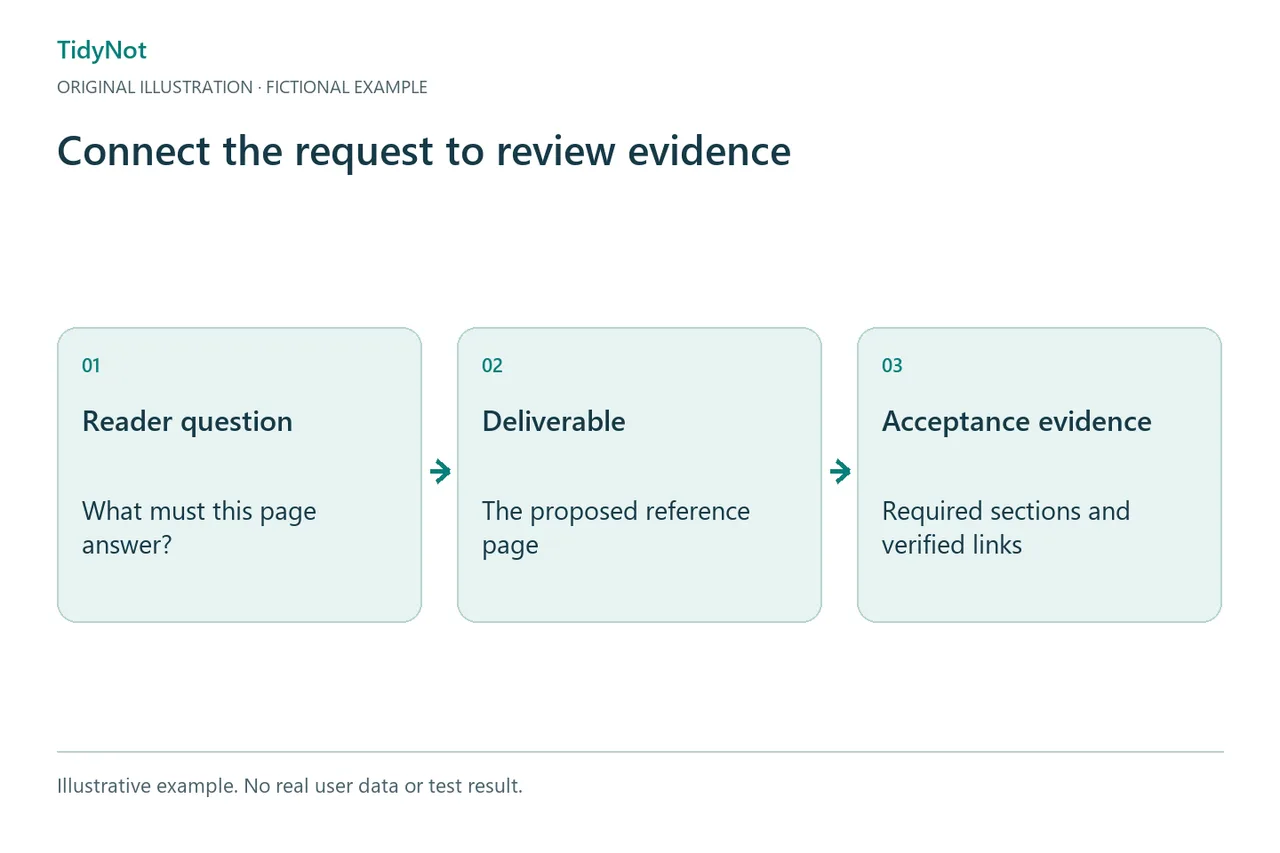
Fictional reference-page task, with acceptance conditions still to agree.
Make the result visible
For a fictional reference-page task, write the reader’s question and the page that should answer it. "Prepare something useful" leaves the result difficult to inspect. A more concrete proposal is a page covering the agreed question, with the required sections and source links that a reviewer can check.
Locke and Latham’s review discusses feedback and task complexity alongside specific goals. Keep those conditions in view: clear wording alone cannot settle an unfamiliar method, missing information or a changing request. The acceptance example here is our editorial proposal, rather than a task tested in that review. Source 15.1
An agreement between the task owner and reviewer
Agreement | Example for a draft reference page | Review evidence |
|---|---|---|
Deliverable | One page answering the agreed reader question | The actual draft |
Acceptance conditions | Required sections and verified links | Checks against the agreed list |
First feedback point | Review the outline before full drafting | Questions and decisions recorded |
Unfamiliar work | Identify what must be learned first | A test or a stated unresolved question |
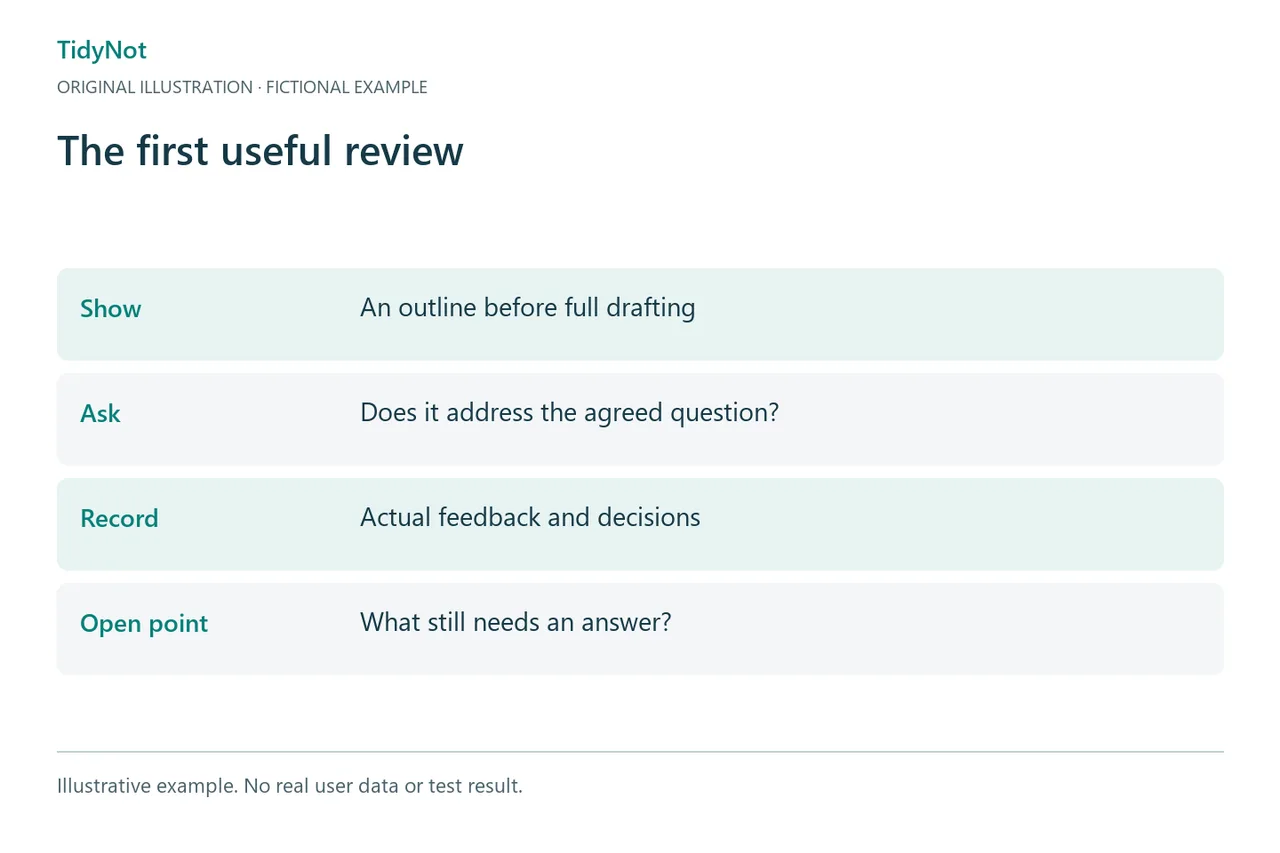
A scheduled review and received feedback are different states.
Ask for feedback while changes are possible
Choose what to show at the first useful review. For the reference page, an outline may reveal a misunderstood reader question before a full draft exists. Record which questions the reviewer should answer, rather than treating a review appointment as proof that feedback will resolve everything.
Debrief research offers a related perspective on structured reflection. Tannenbaum and Cerasoli synthesize studies across different settings; that work does not validate this exact table or justify promising an improvement percentage. Here it informs asking what happened, what evidence was available and what to change next. Source 15.2
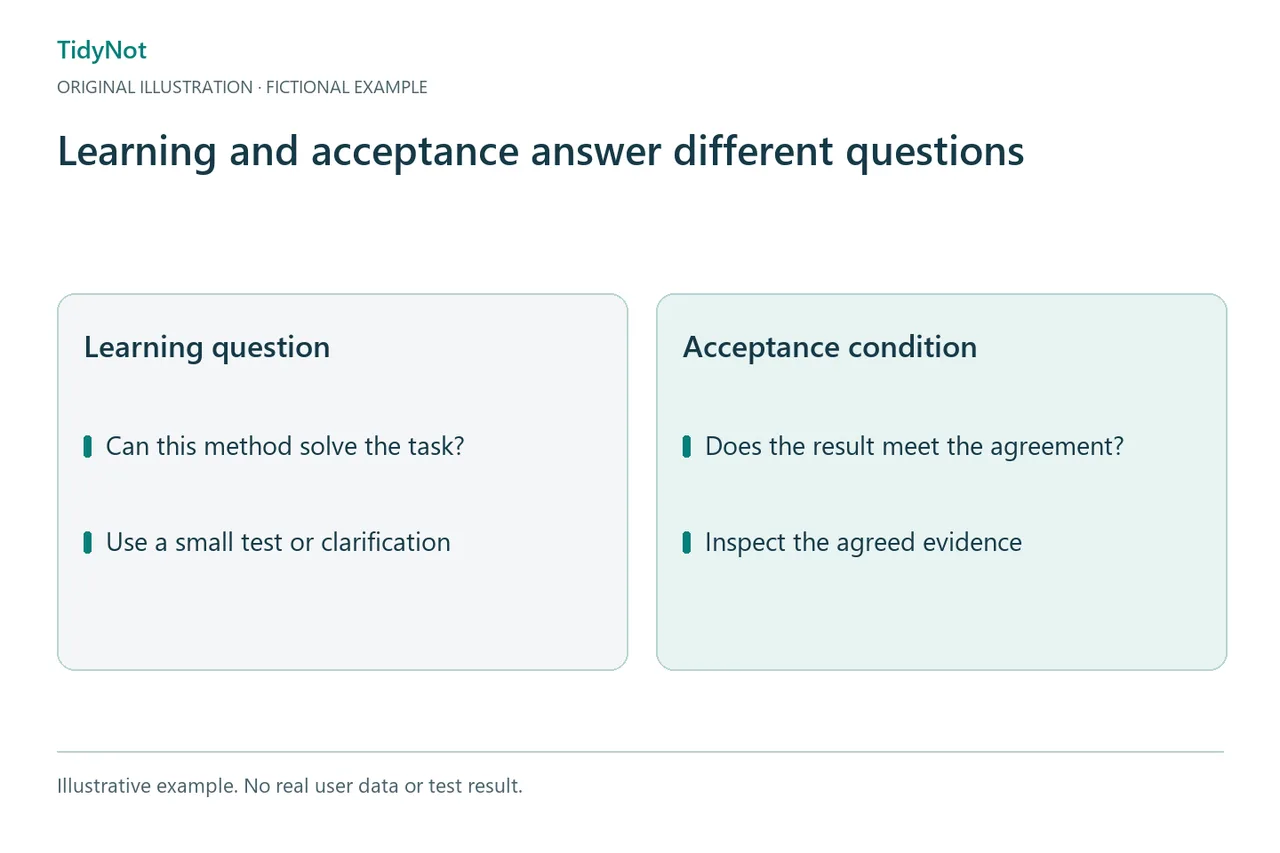
Keep uncertainty about the method visible.
Separate learning from acceptance
If the task uses a method the writer has not learned, make the uncertainty explicit. The first step may be a small test or a question for someone with the needed knowledge. A production target cannot substitute for discovering whether the method is suitable.
After a review, record the decision and any changed acceptance condition. Keep unresolved points visible. Confirm the actual deadline and responsible people through the real agreement. A draft can be ready for discussion while still failing a final acceptance condition. The record should show that difference without turning into a performance rating.
Make review possible before the handoff
Write down the expected output, the person who will review it and the check they will use. If the result needs revision, record which check was not met. Keep a request for new work separate from correcting the agreed result.
Try it with your own information
Write a reviewable brief
Describe the finished result and the evidence a reviewer needs to accept it.
An invented worked example
Use this scenario to see how the decisions fit together, then replace its details with your own observations.
Fictional result: a one-page visitor guide, supplied as an editable source and a readable PDF.
Acceptance: a first-time guest can find arrival location, contact route and what to bring. Unconfirmed venue facts are marked pending, not filled with guesses.
Early review: send the outline for a coverage check. A request for a second-language edition is a proposed scope change; a missing agreed contact section is a correction.
No account needed. Open the worksheet, enter your own notes, then download a text copy. You can also download it blank to complete elsewhere.
Open and download your worksheet
Sources and scope
[15.1] Edwin A. Locke and Gary P. Latham. Building a Practically Useful Theory of Goal Setting and Task Motivation: A 35-Year Odyssey. American Psychologist 57(9), 705–717, 2002-09. https://med.stanford.edu/content/dam/sm/s-spire/documents/PD.locke-and-latham-retrospective_Paper.pdf Read scope: Published paper hosted by Stanford: abstract, opening and visible goal/feedback discussion; not a systematic review conducted for this plan. Limits: Review/theory across different tasks. Specific wording alone is not a guaranteed performance intervention.
[15.2] Scott I. Tannenbaum and Christopher P. Cerasoli. Do Team and Individual Debriefs Enhance Performance? A Meta-Analysis. Human Factors 55(1), 231–245, 2013. https://doi.org/10.1177/0018720812448394 Read scope: Original journal abstract and method summary read. Limits: A synthesis of studies with different settings and structures. No fixed improvement percentage is promised.
Source relationship: Different goal-setting and debrief syntheses; their underlying literatures may overlap, so they are not described as independent replications.
The images are original explanatory illustrations of fictional examples. They are not photographs, product screenshots or evidence of a completed practical test.
Evidence and scope
1. Edwin A. Locke and Gary P. Latham. Building a Practically Useful Theory of Goal Setting and Task Motivation: A 35-Year Odyssey. American Psychologist 57(9), 705–717, 2002-09.
Claim covered: Goal-setting research discusses feedback and task complexity
Locke and Latham’s review discusses feedback and task complexity alongside specific goals. Keep those conditions in view: clear wording alone cannot settle an unfamiliar method, missing information or a changing request. The acceptance example here is our editorial proposal, rather than a task tested in that review. Source 15.1
Edwin A. Locke and Gary P. Latham. Building a Practically Useful Theory of Goal Setting and Task Motivation: A 35-Year Odyssey. American Psychologist 57(9), 705–717, 2002-09.. English edition; source-specific context. Checked: .
Published paper hosted by Stanford: abstract, opening and visible goal/feedback discussion; not a systematic review conducted for this plan. Review/theory across different tasks. Specific wording alone is not a guaranteed performance intervention.
2. Editorial application
Claim covered: A practical step to try in your own setting
Write down the expected output, the person who will review it and the check they will use. If the result needs revision, record which check was not met. Keep a request for new work separate from correcting the agreed result.
TidyNot editorial suggestion. English edition; fictional example. Checked: .
TidyNot editorial proposal. No completed practical trial, measured benefit or universal outcome is claimed.