
AI-generated editorial illustration; not a photograph of an actual event.
Name what someone will receive
Consider a fictional volunteer welcome pack. The intended result is a current pack that a new volunteer can read and use. “Write the pack” describes work. “Confirmed first-visit instructions” describes something the pack needs to contain. Both matter, but they answer different questions.
Start with the result and list its parts in ordinary language. You might need a welcome note, arrival instructions, a contact page and a readable final file. Include a service or completed outcome when that is what the project delivers. The map does not have to consist entirely of documents.
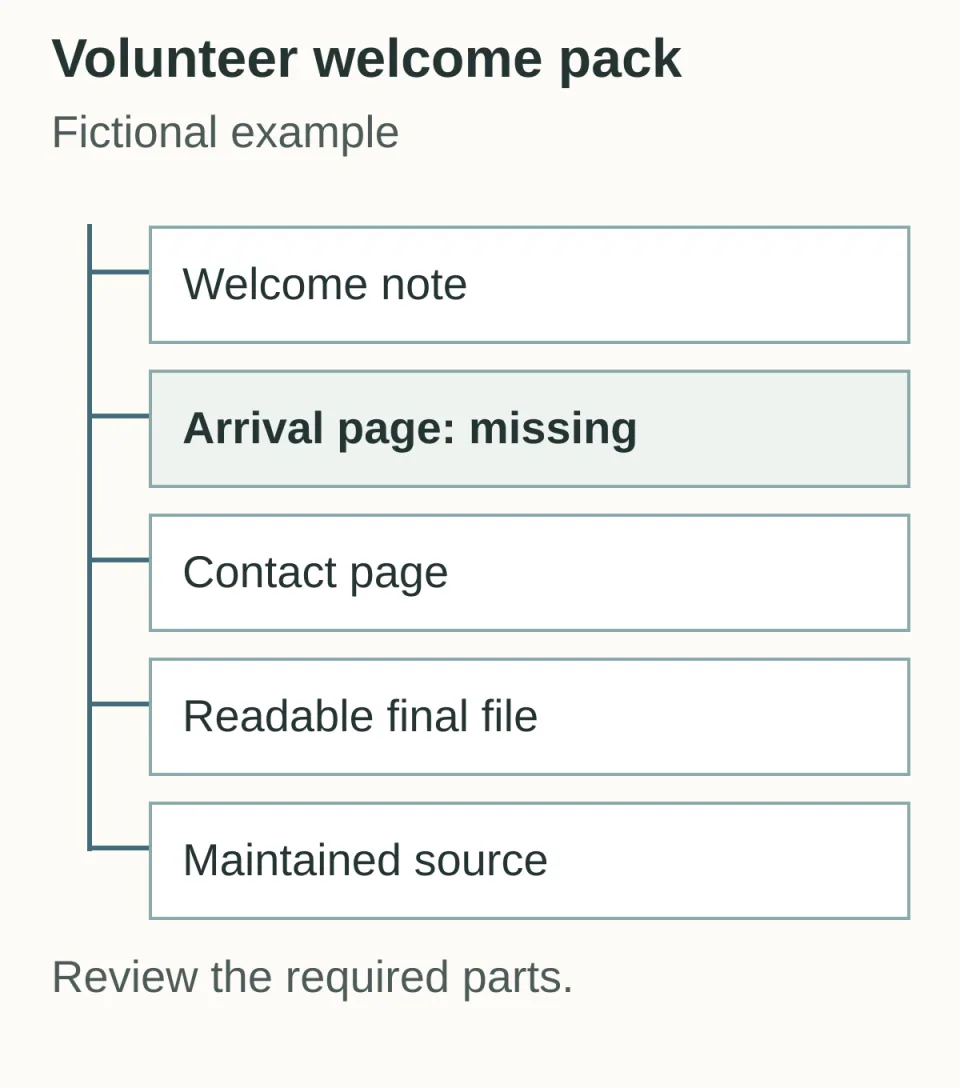
A busy task list can still omit a necessary part.
Inspect the gap before filling the calendar
The table deliberately leaves arrival instructions missing. This is an invented planning example, not a report of an actual project failure. Ask what the intended reader would still be unable to do if everything already on the task list were completed.
Fictional worked example
Required part | State in this example | Next clarification or action |
|---|---|---|
Welcome note | Draft named | Edit for the intended reader |
First-visit instructions | Missing | Confirm arrival details with the organizer |
Contact page | Unconfirmed | Check the role and approved contact route |
Readable final pack | Export task listed | Check content and page order, not only export |
Maintained source copy | Location not specified | Agree where later corrections belong |
Do not fill a gap with a guessed fact. An arrival location, access arrangement or contact detail needs the relevant person’s confirmation. Record an unanswered question visibly so that an attractive diagram does not make the project look more settled than it is.
Keep outputs and activities connected
Once you can see the required parts, connect each to the work that produces or checks it. “Confirm arrival details” can lead to “first-visit instructions.” Look in both directions: is an output missing any work, or is an activity attached to no agreed result? That second question can reveal work outside the intended scope.
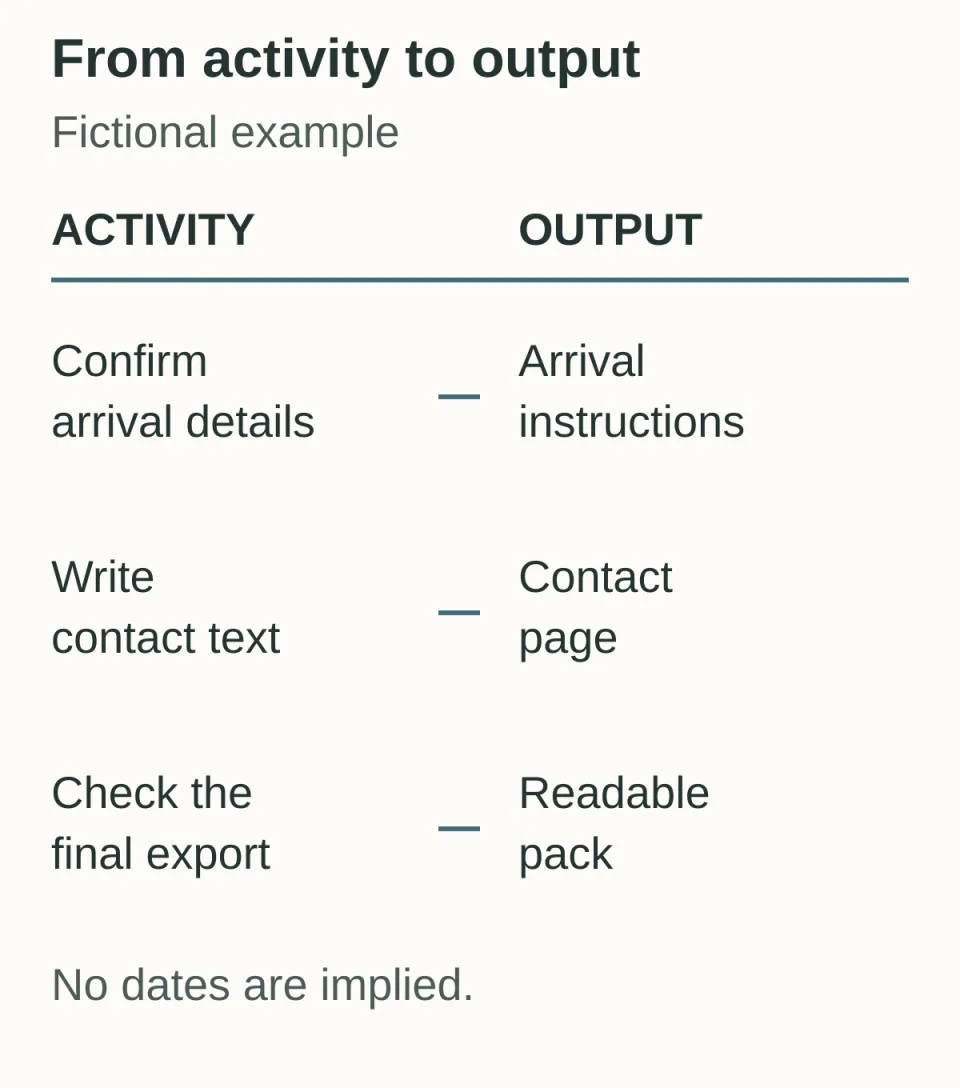
Connect the work to the thing it should produce.
There is a terminology wrinkle worth keeping clear. PMI’s current WBS explanation describes a deliverable-oriented breakdown of project scope. [1] APM’s briefing calls the outcomes structure a product breakdown structure and distinguishes it from an activity-based work breakdown structure. [2] Here, “deliverable map” is simply the name for the exercise, not a claim that the organizations use identical definitions.
Draw a boundary around the result
For the fictional welcome pack, a recruitment campaign is outside scope. If someone later asks for one, it is a proposed change, not another box to slip into the diagram. Likewise, mark parts supplied by someone else and check what has actually been agreed rather than assuming those inputs will appear.
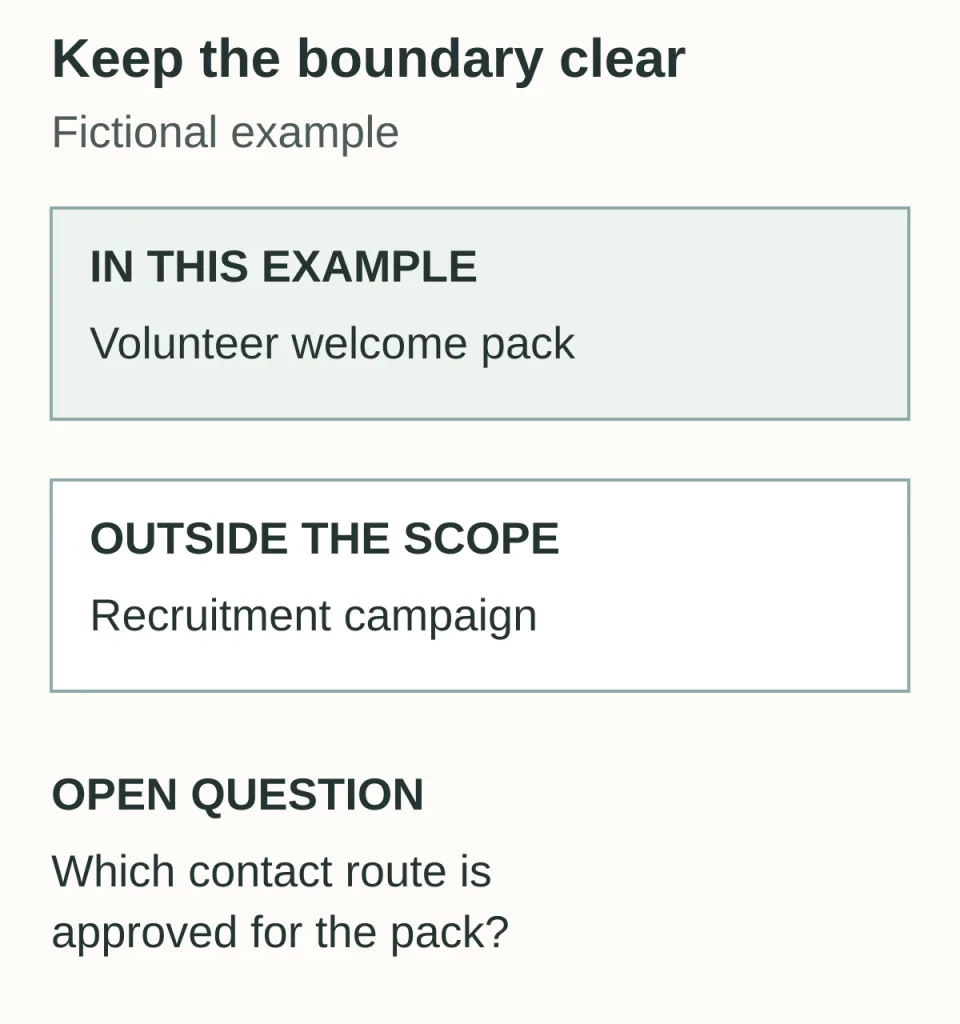
Keep unanswered requirements visible.
The tree also does not supply a schedule. Its visual order tells you how parts belong together; it does not establish dependencies, durations or delivery dates. Those need separate decisions. For shared work, the responsible people still need to agree what counts as complete.
Try the exercise on one current result: name its necessary parts, identify one unresolved requirement and compare the map with the work already listed. You may find nothing missing. If you do find a gap, you now have a specific question to resolve before adding another vague task.
Activity or an actual missing output?
Constructed example: a volunteer pack needs a confirmed location, an arrival instruction and an approved contact number. The team has held a planning meeting, but the pack still lacks a contact.
| Situation | Decision and next step |
|---|---|
| “Hold another meeting” | This names an activity, not the missing part. First specify: a contact number that its owner has agreed may be shared. |
| A number exists in an old email | The information exists, but current permission and suitability are unresolved. Assign that check rather than drafting a replacement number. |
| A translated version is suggested | Check whether it belongs to the agreed result. If it is new scope, assess and approve it separately instead of treating it as a missing baseline item. |
Write: required part → evidence currently available → missing or uncertain element → person who can resolve it → acceptance check. If the required result itself is unclear, agree on a task brief first.
These are editorial examples, not reported experiences or tested outcomes.
Source notes
1. Project Management Institute, Work Breakdown Structure: Define the Work Before You Build It, 18 August 2026. Checked October 25, 2026, Asia/Seoul (October 24 UTC): deliverable-oriented definition, scope and component descriptions. AI examples and performance claims were not used.
2. Association for Project Management, Use of product breakdown structures and work breakdown structures. Checked October 25, 2026, Asia/Seoul (October 24 UTC): PBS/WBS definitions, review questions and planning discussion. Prior ledger check: 20 October 2026. Two professional guides, not experimental validation of this worksheet.
Evidence and scope
1. What Is a Work Breakdown Structure? — PMI
Claim covered: There is a terminology wrinkle worth keeping clear. PMI’s current WBS explanation describes a deliverable-oriented breakdown of project scope. [1] APM’s briefing calls the outcomes structure a product breakdown structure and distinguishes it from an activity-based work breakdown structure. [2] Here, “deliverable map” is simply the name for the exercise, not a claim that the organizations use identical definitions.
PMI describes a deliverable-oriented scope breakdown; APM uses product breakdown for outcomes and an activity-oriented WBS distinction.
What Is a Work Breakdown Structure? — PMI. English edition; source jurisdiction as stated. Checked: .
Definitions differ across organizations; this worksheet does not resolve all project-planning requirements.
2. Editorial application
Claim covered: Before adding another task, write down what must exist when the project is finished. Split that result into its necessary parts, then check your activity list against them. A list that says “write, meet, review” can still miss the instructions someone needs to use the finished work. A simple deliverable map gives you a place to look for that gap.
TidyNot practical application, separated from the original source’s claims.
TidyNot editorial suggestion. English edition. Checked: .
Definitions differ across organizations; this worksheet does not resolve all project-planning requirements.