
AI-generated editorial illustration; not a photograph of an actual event.
Find the current agreement
Start with the brief, acceptance conditions, or approved plan. What result did everyone agree to produce? Without that reference point, it is difficult to tell whether the request adds a deliverable, changes one, or identifies work already needed to complete it.
Chuck Millhollan’s PMI conference paper on scope control distinguishes additional detail needed for an agreed objective from new or modified deliverables.1 A newly discovered task may still affect effort and timing, even when it does not change the intended result. Describe the effect before arguing over the label.
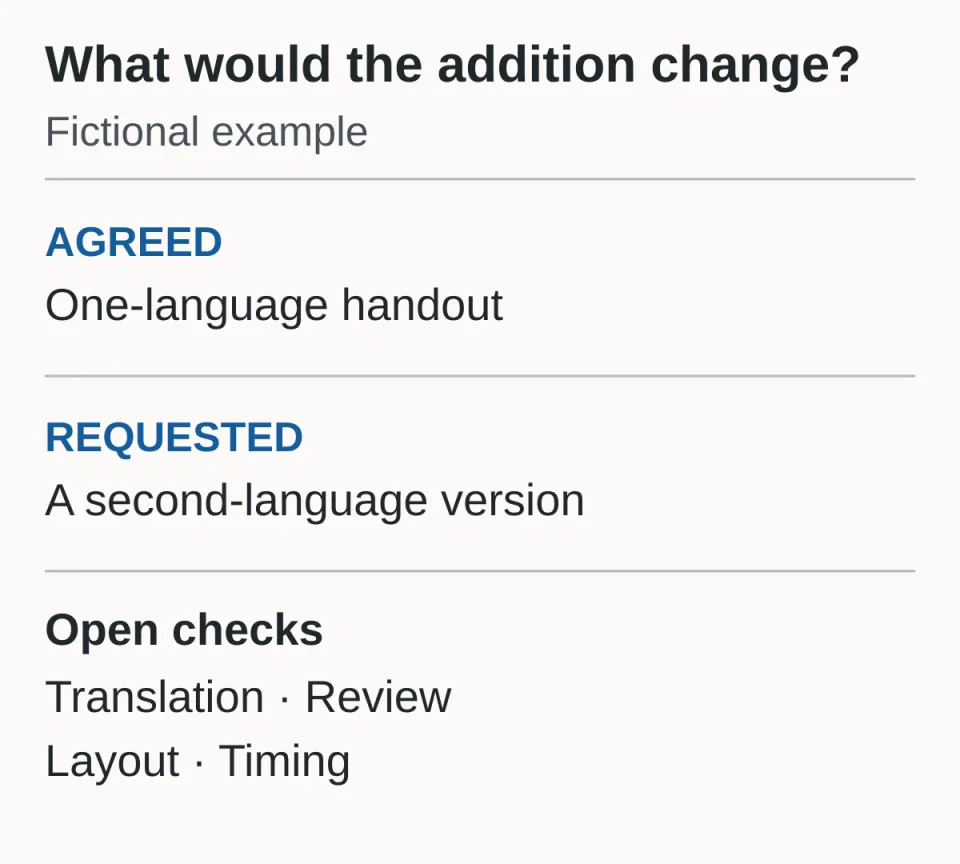
Compare the new request with the current agreement. Fictional handout example.
Capture the request without promising it
Write down what is wanted and why. “Add a second-language version” still leaves questions: which language, a separate file or a bilingual page, and who checks the wording? Clarifying those details is part of evaluating the request. It need not imply acceptance.
APM’s change-control guidance separates recording a request, evaluating its effects, making a decision, and updating the plan after approval.2 Keep those stages visible in a small project too, using the amount of documentation the decision actually needs.
Area | Baseline or likely effect | Question before deciding |
|---|---|---|
Deliverable | One-language handout; second version requested | Separate file or bilingual page? |
Content | Translation and language review would be added | Who supplies and approves them? |
Layout | Different text length may change proofing | Can it fit legibly at the agreed size? |
Timing | Existing delivery date remains the baseline | What do the added work and reviews require? |
Resources | Additional services may cost money | What estimate and budget approval are needed? |
Options | Add later, revise the plan, or replace another item | Which choice meets the project’s purpose? |
Decision | Request is awaiting review | Who has authority to decide? |
Fictional example. No timing estimate, extra budget, or approval is implied.
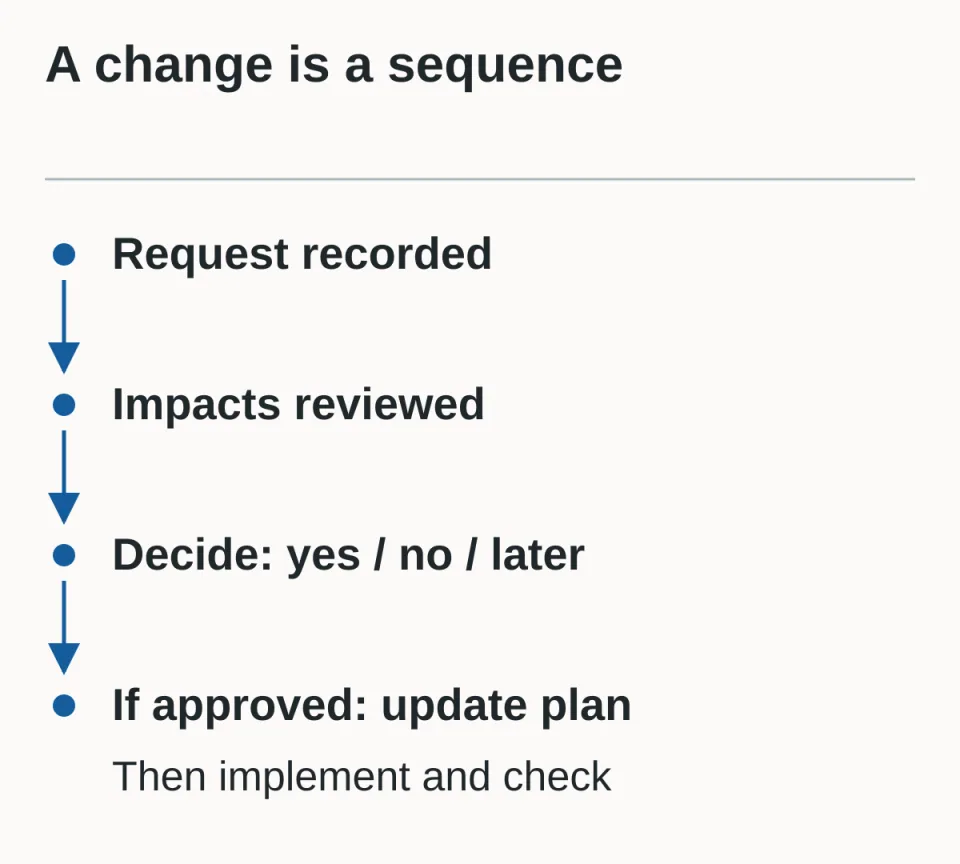
Keep review, decision, and implementation separate.
Separate facts, estimates, and questions
You may know that another reviewer is needed without knowing when that reviewer is available. Record both. If a cost or duration is an estimate, label it and note what would make it more reliable. Avoid turning a rough number into a commitment just because a table needs a value.
Look beyond the added task. Could the change invalidate finished work, delay another person, or require another check? Also consider what happens if the change is postponed or declined. The purpose is to make a decision understandable, not to make every request seem dangerous.
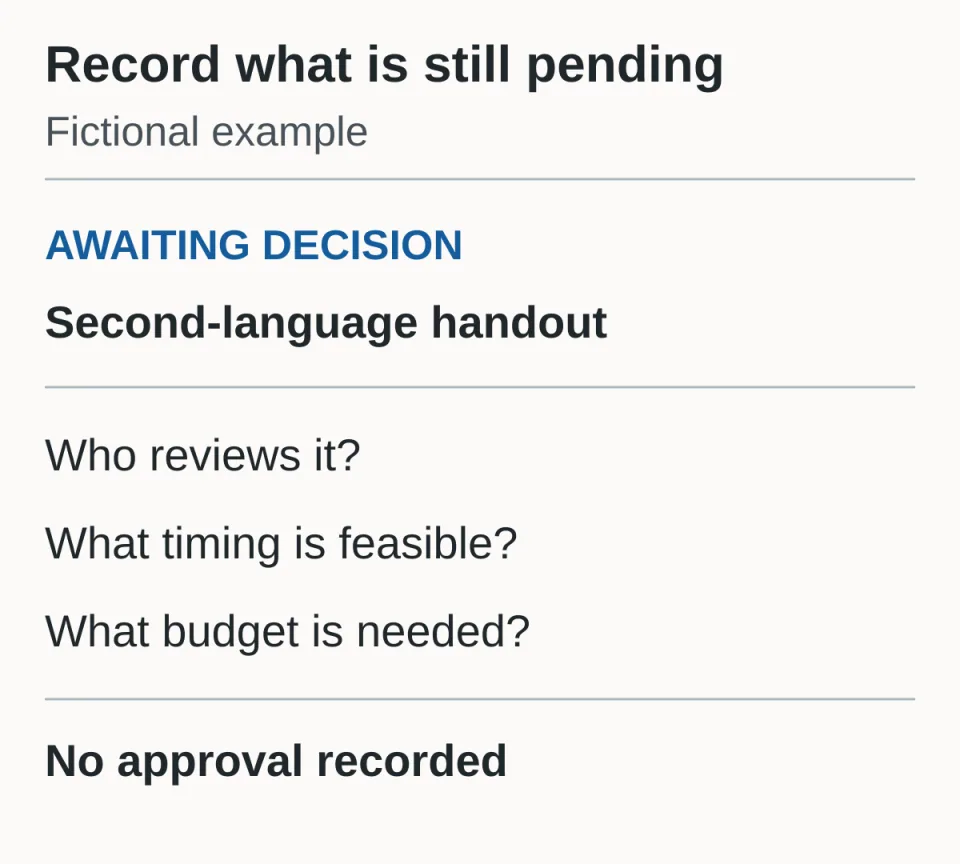
A pending record can be useful while important answers are still missing. Fictional change note.
Record the decision, then update the plan
Use the project’s actual approval arrangements. If you do not know who can decide, resolve that before making a promise. Do not borrow a budget limit or acceptable delay from someone else’s example. Those boundaries belong to the people responsible for this project.
After an authorized decision, record what was accepted, rejected, or deferred. If accepted, update the affected plan and communicate through the agreed process. Preserve the decision and previous baseline. An approved change can still be waiting to be implemented or checked.
For the next request, write four short lines: requested change; likely effects; unanswered questions; decision needed. That is enough to begin a useful review without pretending the answer is already yes.
Try it with your own information
Write a change request without approving it
Bring the baseline, effects and decision together before promising added work.
An invented worked example
Use this scenario to see how the decisions fit together, then replace its details with your own observations.
Fictional baseline: one-language visitor handout. Request: add another language in a separate PDF.
Effects: translation, language review, layout and final checks are additional work. Dates and costs remain unknown until estimated by the people doing them.
Decision record: pending. The original deadline is still the baseline; the request does not silently extend it or authorize spending.
No account needed. Open the worksheet, enter your own notes, then download a text copy. You can also download it blank to complete elsewhere.
Open and download your worksheet
Sources and reading scope
Checked October 25, 2026, Asia/Seoul (October 24 UTC).
- Chuck Millhollan, PMI Global Congress 2008, October 19, 2008. Read the scope distinction and impact-analysis/approval/planning passages. Historical practitioner guidance; example approval thresholds are not adopted.
- Association for Project Management, “What is change control?” Read the public definition and process; page attributes the definition to Body of Knowledge, 8th edition.
Evidence and scope
1. What is change control? — Association for Project Management
Claim covered: APM’s change-control guidance separates recording a request, evaluating its effects, making a decision, and updating the plan after approval.2 Keep those stages visible in a small project too, using the amount of documentation the decision actually needs.
Change control records, evaluates and decides requests before updating approved plans.
What is change control? — Association for Project Management. English edition; source jurisdiction as stated. Checked: .
Professional process guidance adapted to a small project, not a universal approval threshold.
2. Editorial application
Claim covered: Before accepting a scope change, compare the new request with what was already agreed and write down what else would need to change. Check the deliverable, effort, review work, timing, and cost, leaving unknowns marked as unknown. Then put the request in front of the person who can decide. Recording a request begins that conversation; it does not itself approve the work or change the deadline.
TidyNot practical application, separated from the original source’s claims.
TidyNot editorial suggestion. English edition. Checked: .
Professional process guidance adapted to a small project, not a universal approval threshold.