Before polishing an explanation, identify what its intended reader already needs to know. A sentence can be accurate and still omit the idea that makes the next step understandable. Start with a real audience, such as a colleague using a process for the first time.
GOV.UK’s clear-language guidance advises explaining necessary specialist terms when they first appear and using familiar language.[Q78] That approach gives the reader access to a concept without requiring you to remove the term they will encounter again.
Find the first unfamiliar idea
Read the opening slowly and mark words whose meaning depends on your work or experience. Keep the terms the reader needs, but explain what they mean in this setting. Expand an abbreviation when knowing the full name actually helps; a longer unfamiliar phrase may still need a plain explanation.
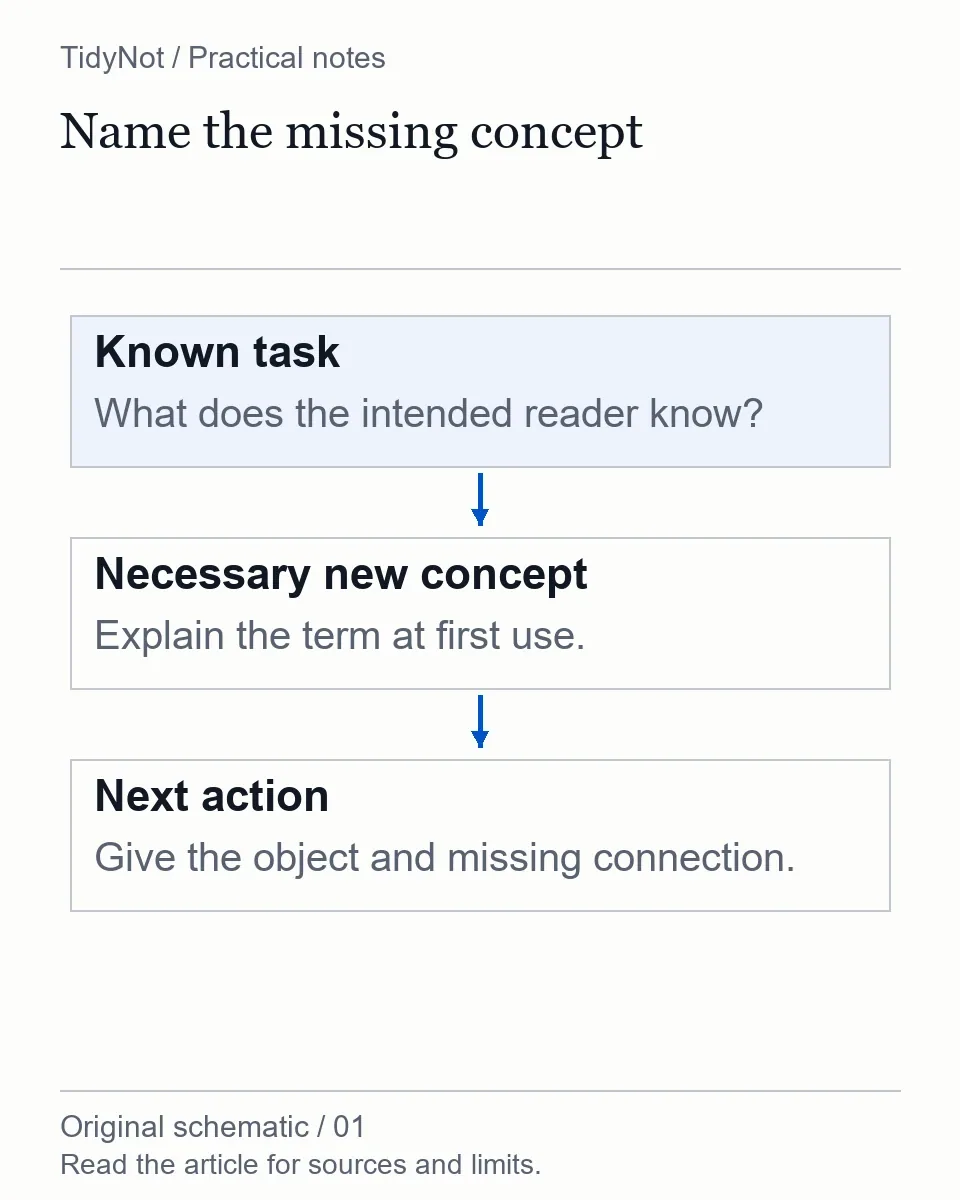
Name the missing concept. Original TidyNot schematic.
Consider the constructed instruction "Put the file in staging." A new colleague may understand every word and still not know which folder is meant. "Put the file in the Staging folder, where drafts wait for review" names the location and its purpose. The explanation should match the real process before you use it.
Identify the prerequisite idea and explain necessary terms at first use.
Look for | Reader’s likely question | Useful addition |
|---|---|---|
A necessary specialist term | What does that word mean here? | A short explanation at first use |
An unexplained reference | Which document or object do you mean? | A recognizable name and location |
A skipped step | How did you get from this action to that result? | The missing connection or a concrete example |
Follow the reader’s route through the task
Check the point where the reader must choose or act. Does the explanation show the object they need, the condition they should recognize and what follows? A background paragraph at the end may arrive too late for that decision.
Philippa Tomlinson’s CIEP discussion of author queries includes cases where writing assumes too much of the reader’s knowledge.[Q21] Use a query when the missing explanation requires the author’s judgment. State the gap: "A first-time reader has not yet been told where this folder is. Could you give its location?"
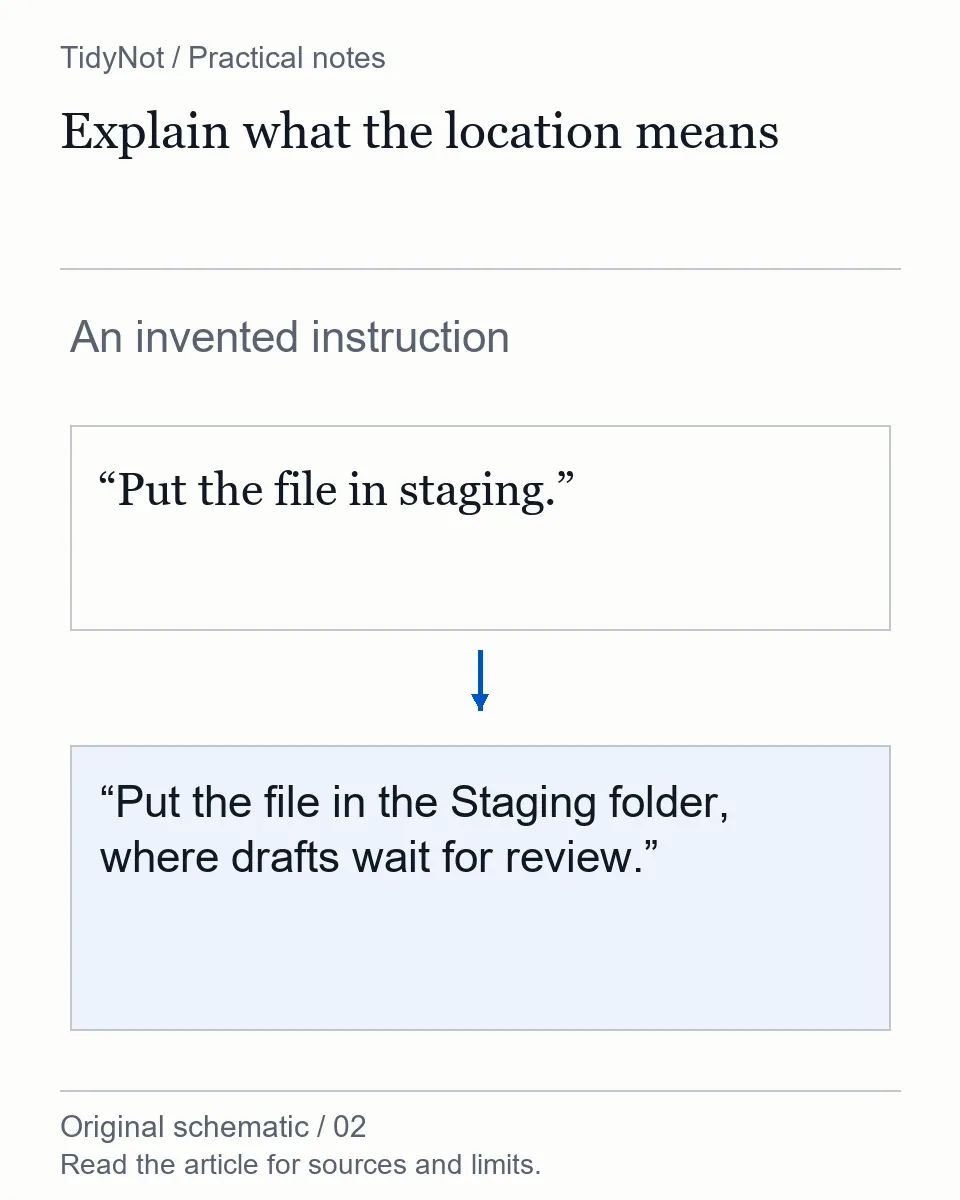
Explain what the location means. Original TidyNot schematic.
Check with the intended audience
Ask a suitable reader to point to the first place where they need an explanation or would have to guess. Record the wording they found difficult. If you cannot do that check yet, keep it as a review task rather than claiming the explanation has been tested.
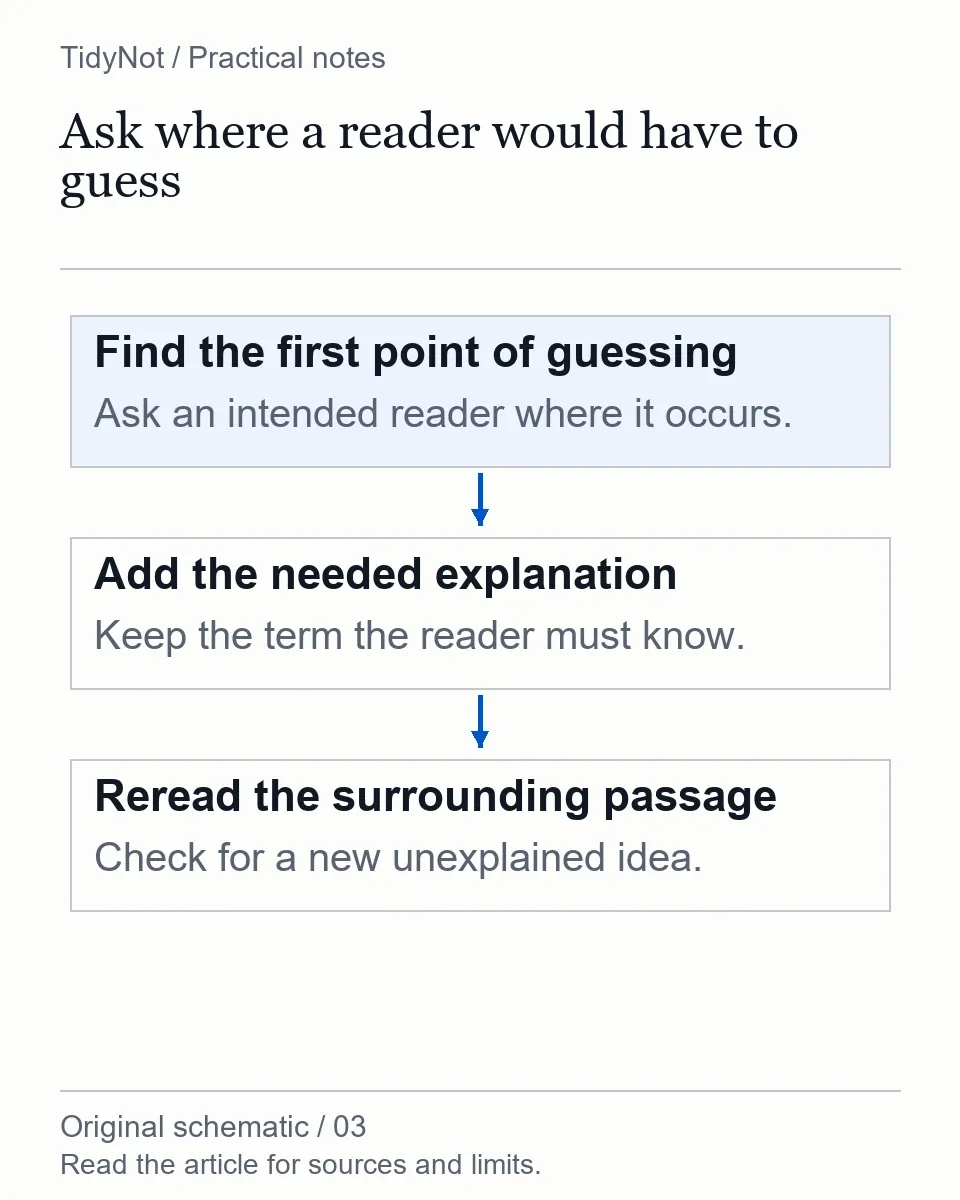
Ask where a reader would have to guess. Original TidyNot schematic.
After a revision, reread the surrounding passage. A definition may need to move earlier, and an example may introduce a second unfamiliar idea. Keep the details the reader needs at the point where those details become useful.
Try it with your own information
Repair a skipped assumption
Identify what the reader cannot yet locate or understand, then add only the missing connection.
An invented worked example
Use this scenario to see how the decisions fit together, then replace its details with your own observations.
Before: “Put it in staging and ping the owner.” Two locations/roles are unexplained.
After: “Save the draft in the shared Staging folder, where documents wait for review. Send the document link to the reviewer named in the task. If no reviewer is named, ask the coordinator before sending.”
The example is invented. Replace the folder and role with the actual process; adding a fictional path would make the instruction worse.
No account needed. Open the worksheet, enter your own notes, then download a text copy. You can also download it blank to complete elsewhere.
Open and download your worksheet
Sources and reading scope
- Government Digital Service. Use clear language. GOV.UK content and publishing guidance; Current public text checked 2026-10-20. https://guidance.publishing.service.gov.uk/writing-to-gov-uk-standards/writing-guidelines/clear-language/. Familiar words and first-use explanation of necessary specialist terms read. Writing guidance; no readability score or audience test has been measured.
- Philippa Tomlinson. What are queries, and how should an author respond?. CIEP; 2024-01-19. https://www.ciep.uk/resource/queries-author.html. Author-query examples read, including discrepancies, dependencies and assumed reader knowledge. Professional practice examples, not a controlled test of this checklist or explanation.
Evidence and scope
1. Use clear language
Claim covered: GOV.UK’s clear-language guidance advises explaining necessary specialist terms when they first appear and using familiar language.[Q78] That approach gives the reader access to a concept without requiring you to remove the term they will encounter again.
Familiar words and first-use explanation of necessary specialist terms read.
Use clear language. English edition. Checked: .
Writing guidance; no readability score or audience test has been measured.
2. What are queries, and how should an author respond?
Claim covered: Philippa Tomlinson’s CIEP discussion of author queries includes cases where writing assumes too much of the reader’s knowledge.[Q21] Use a query when the missing explanation requires the author’s judgment. State the gap: "A first-time reader has not yet been told where this folder is. Could you give its location?"
Author-query examples read, including discrepancies, dependencies and assumed reader knowledge.
What are queries, and how should an author respond?. English edition. Checked: .
Professional practice examples, not a controlled test of this checklist or explanation.
3. Editorial application
Claim covered: Before polishing an explanation, identify what its intended reader already needs to know. A sentence can be accurate and still omit the idea that makes the next step understandable. Start with a real audience, such as a colleague using a process for the first time.
TidyNot editorial workflow suggestion, distinguished from the linked source statements.
TidyNot editorial suggestion. English edition. Checked: .
An editorial application, not a tested intervention or a guarantee of results.