
AI-generated editorial illustration; not a photograph of an actual event.
Label the relationship to the source
A topic label such as “opening hours” tells you what a note concerns. It does not tell you whether the sentence was copied, rewritten or invented as a question. Put that second kind of label where you will see it, rather than relying on memory or a color with no explanation.
Purdue OWL’s guide distinguishes exact quotations, paraphrases and summaries, and explains that all three need attribution. [1] The note layout here is a suggested way to preserve that distinction while gathering material, not an official citation system.
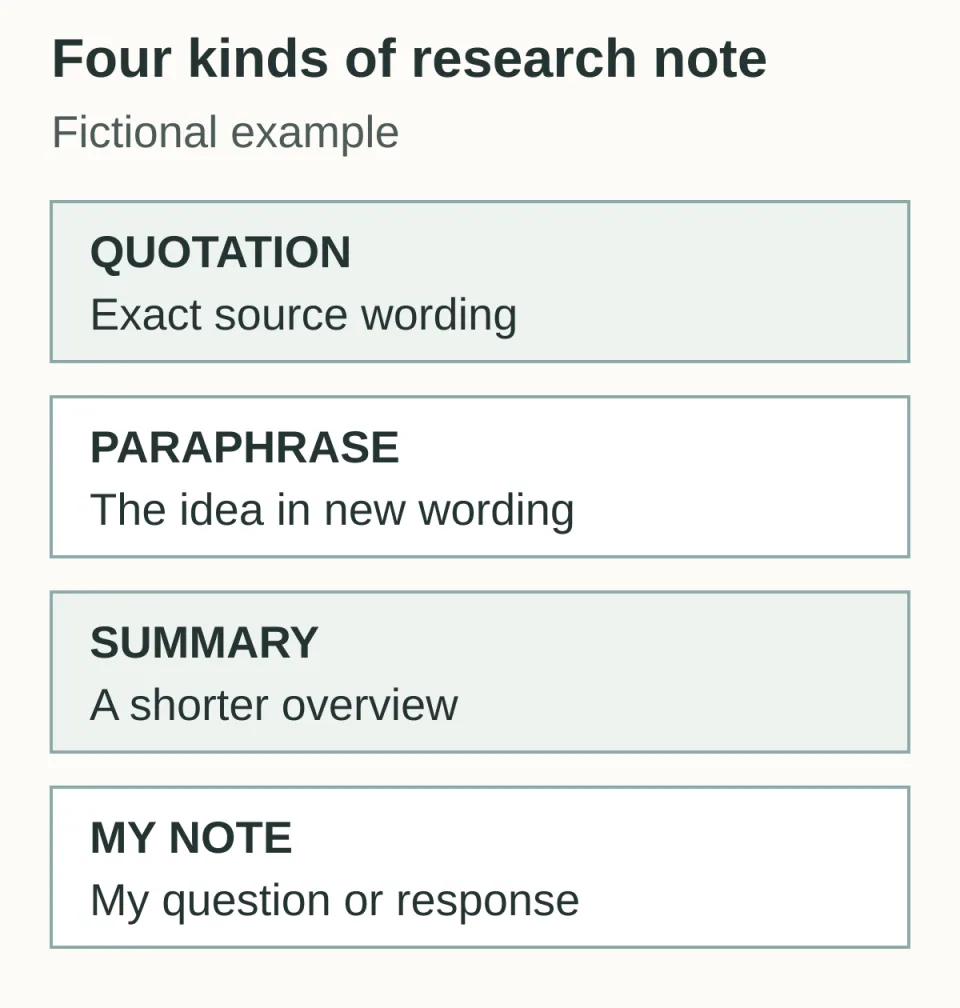
A topic label is not enough to identify whose words these are.
Try the labels on one small source
This source is invented for the demonstration: “On weekdays, the reading room closes at 6 p.m. Before leaving, return borrowed cushions to the basket. Ask the entrance desk if you have questions about access.” Call it “Reading-room memo,” section “Weekdays.” It is not information about an actual room.
Fictional worked example
Label | Example note | Source trail |
|---|---|---|
Quotation | “On weekdays, the reading room closes at 6 p.m.” | Invented memo, Weekdays, sentence 1 |
Paraphrase | The room shuts at six in the evening on weekdays. | Invented memo, Weekdays, sentence 1 |
Summary | The memo covers closing, returning cushions and access questions. | Invented memo, Weekdays, full section |
My note | Check whether weekend hours are mentioned elsewhere. | My question about the invented memo |
Notice that the paraphrase still carries information from the source. “My note” marks a question raised by the reader; it does not turn an idea borrowed from elsewhere into an original one. The summary is broader and shorter than the complete source, rather than a sentence with a few words exchanged.
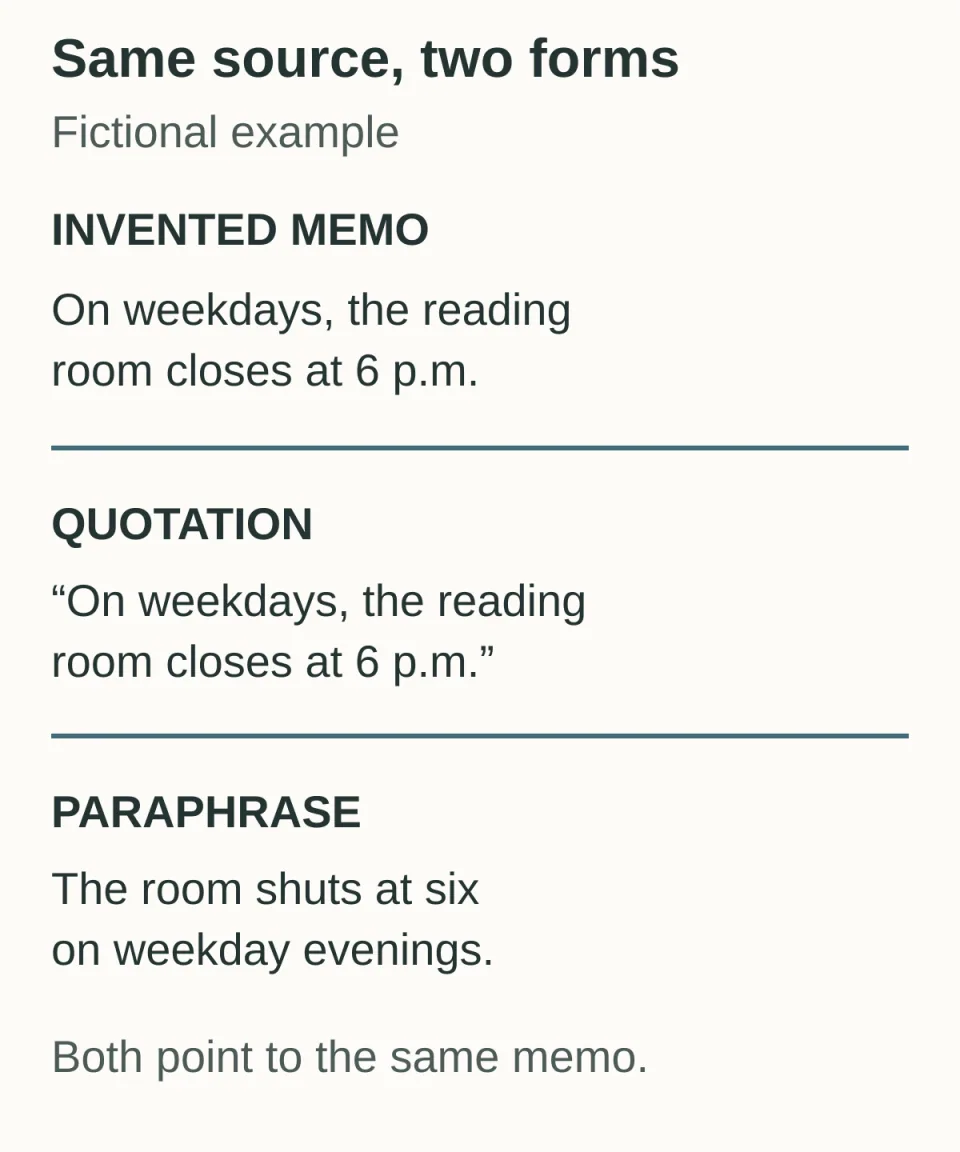
New wording still needs the source.
Keep a usable way back
For real material, record the author or organization, title, link or identifier, and the page or section actually used. For a changing webpage, include when you consulted it. If pages are unavailable, use an honest locator such as a named section. Do not invent a page number to fill an empty field.
Oxford’s academic guidance discusses missing citation information in notes and distinguishing borrowed language and ideas. [2] Its practical warning is relevant here, but Oxford’s assessment rules and penalties do not automatically govern every reader or publication.
Check a paraphrase against the source
Read the passage for meaning, put it aside and write your understanding. Then compare the note with the original. Does it preserve the point without adding a conclusion the source did not make? Have you kept distinctive wording that should instead be marked as a quotation? Record the source even when your wording is different.
Finished work may require a particular citation style or other acknowledgments. Follow those requirements when drafting; the labels in a private notebook do not replace them. Keep source details attached when moving a note into another document.
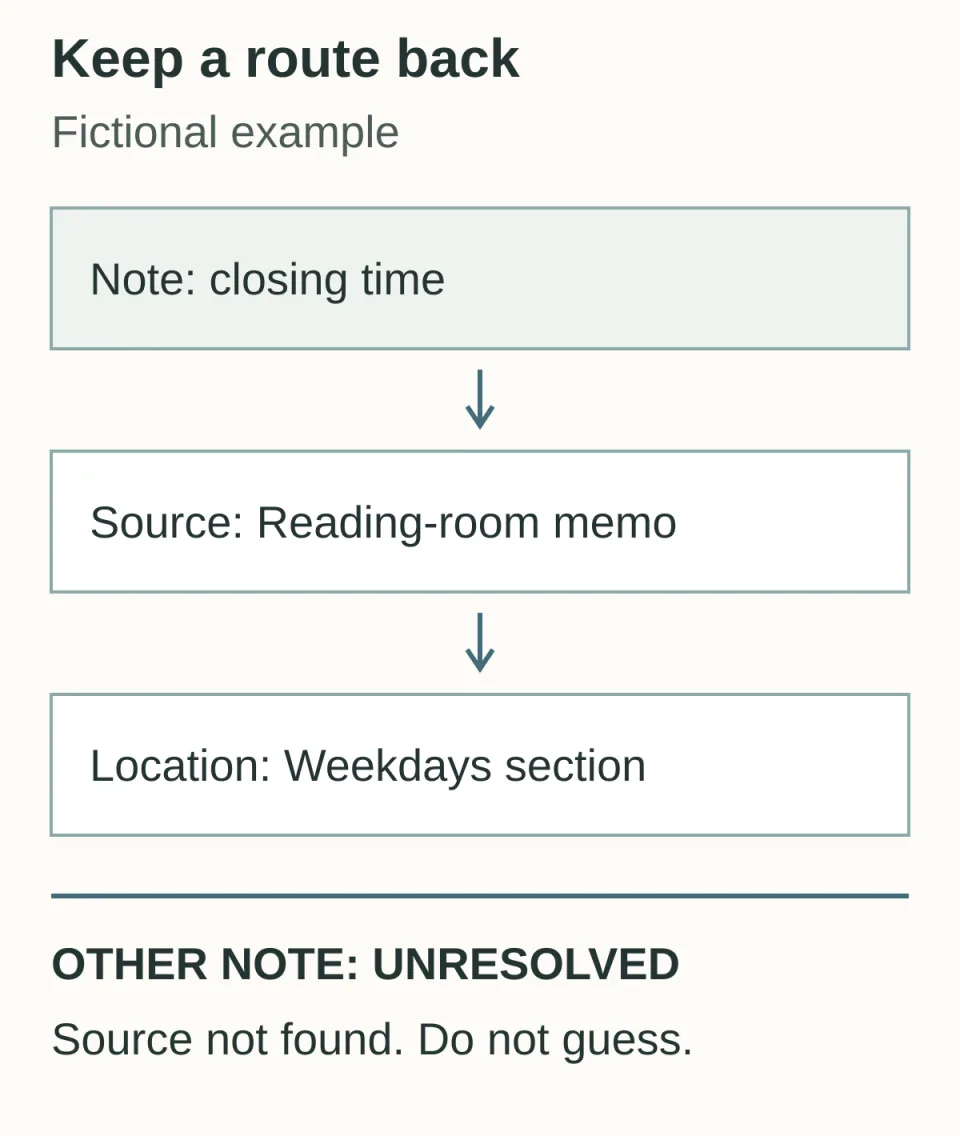
An unresolved note needs a check, not an invented citation.
Leave an uncertain note uncertain
If an old note has no source, try to trace it before using it. Check any recovered passage against the wording, then add the appropriate label. If the origin remains unknown, mark “source not found.” Do not present it as a verified quotation, attach a convenient author or quietly treat it as your own discovery.
Before drafting, take one quick pass through the notes you intend to use. Can each quotation be matched to its source, each borrowed idea traced and each personal reaction recognized? An unresolved note can wait. A confident-looking but invented citation only hides the work still needed.
Try it with your own information
Save a note with its source trail
Keep the type of note next to the wording, not just in a color or a folder name.
An invented worked example
Use this scenario to see how the decisions fit together, then replace its details with your own observations.
Invented source: “Return the cushions before leaving.” Quotation: copy those exact words in quotation marks and attach the source locator.
Paraphrase: “Put the cushions back before you leave.” It still needs the same source; changing words does not make the idea unborrowed.
My note: “Where is the cushion basket?” This is a question, not a claim the source made.
No account needed. Open the worksheet, enter your own notes, then download a text copy. You can also download it blank to complete elsewhere.
Open and download your worksheet
Source notes
1. Purdue University Writing Lab, Quoting, Paraphrasing, and Summarizing. Checked October 25, 2026, Asia/Seoul (October 24 UTC): definitions and attribution guidance. Prior ledger check: 20 October 2026. The reading-room example is original and fictional, not copied from Purdue.
2. University of Oxford, Plagiarism. Checked October 25, 2026, Asia/Seoul (October 24 UTC): quotation, paraphrase, inaccurate-citation and note-taking passages. Prior ledger check: 20 October 2026. Used for note distinctions only, not legal advice or universal institutional rules. These guides do not validate the proposed template as error-proof.
Evidence and scope
1. Quoting, Paraphrasing, and Summarizing — Purdue OWL
Claim covered: Purdue OWL’s guide distinguishes exact quotations, paraphrases and summaries, and explains that all three need attribution. [1] The note layout here is a suggested way to preserve that distinction while gathering material, not an official citation system.
Quotations, paraphrases and summaries differ in closeness to the original and require attribution.
Quoting, Paraphrasing, and Summarizing — Purdue OWL. English edition; source jurisdiction as stated. Checked: .
The note layout is an editorial suggestion, not an official citation style or a substitute for local academic rules.
2. Editorial application
Claim covered: Mark a copied sentence as a quotation as soon as you save it, and keep its source and location beside it. Label your own restatement “paraphrase,” a shorter overview “summary,” and your reaction “my note.” That gives you a way to tell whose wording and ideas you are looking at when you return. Rewriting a passage does not remove the need to record its source.
TidyNot practical application, separated from the original source’s claims.
TidyNot editorial suggestion. English edition. Checked: .
The note layout is an editorial suggestion, not an official citation style or a substitute for local academic rules.