
AI-generated editorial illustration; not a photograph of an actual event.
Start with a decision you have already made
Suppose a fictional reading project appears as “Open Shelf” in one handout and “OpenShelf” in another. Before changing either version, check which name the project actually uses. A person’s name or an organization’s official title needs verification; a preference about date layout needs an editorial decision. Keep those two reasons distinct.
Editors Canada’s consistency standards recommend developing or following a style sheet for recurring choices such as abbreviations, numbers and spelling. That is professional guidance, not a promise that a worksheet will catch every error. [1]
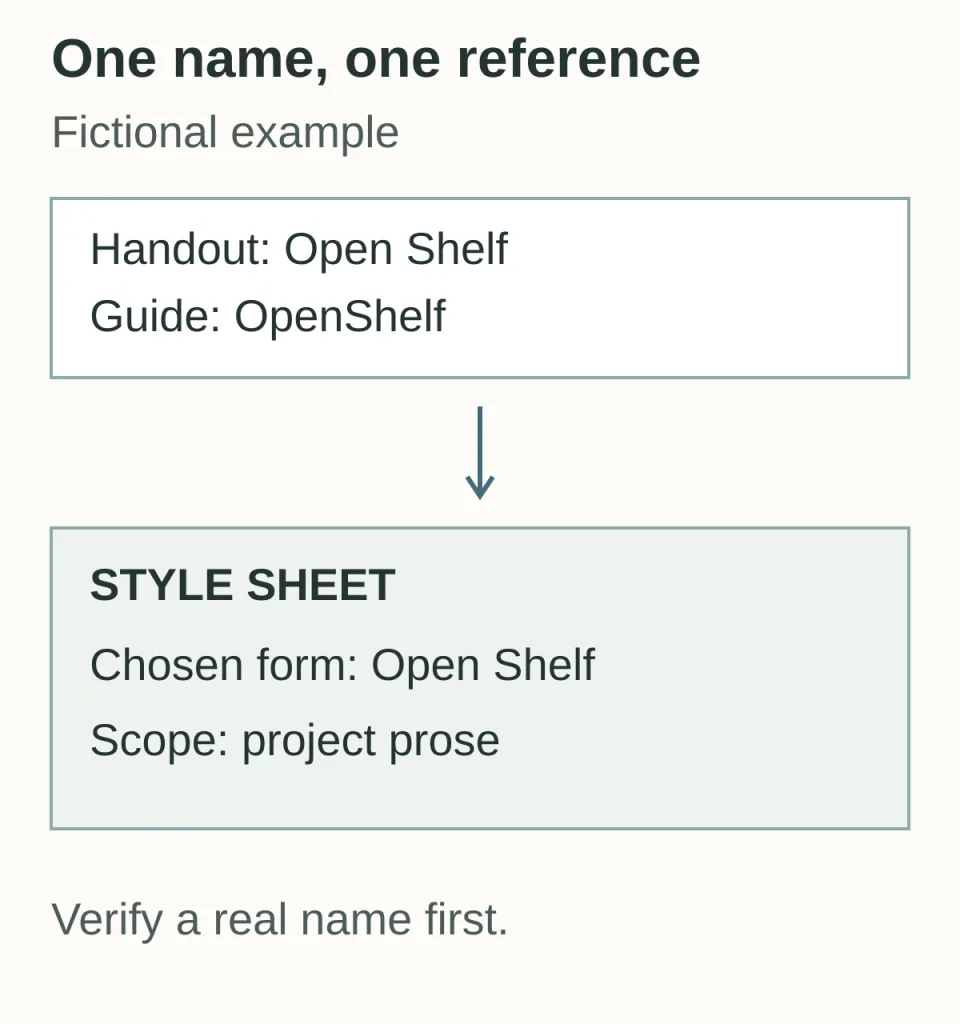
A style sheet records a choice you can reuse.
Write down where the choice belongs
A useful entry says more than “always write it this way.” It tells you where the choice applies and what to leave alone. The examples below belong to an invented project. They are not rules for another organization’s writing.
Fictional worked example
Entry | Chosen form | Scope or exception |
|---|---|---|
Project name | Open Shelf | Original project prose; verify real names separately |
Role abbreviation | reading group coordinator (RGC), then RGC | Explain at first use in each standalone guide |
Date | 25 October 2026 | Prose labels; preserve required export formats |
Compound | sign-up form; sign up | Noun phrase versus verb; preserve official titles |
Spelling | colour; organise | Project preference; retain quoted spelling |
Add the reason or reference beside any choice likely to be questioned. “Agreed project name” and “our chosen dictionary” do different jobs. If nobody has decided a form yet, mark it as a question instead of allowing a tentative guess to look approved.
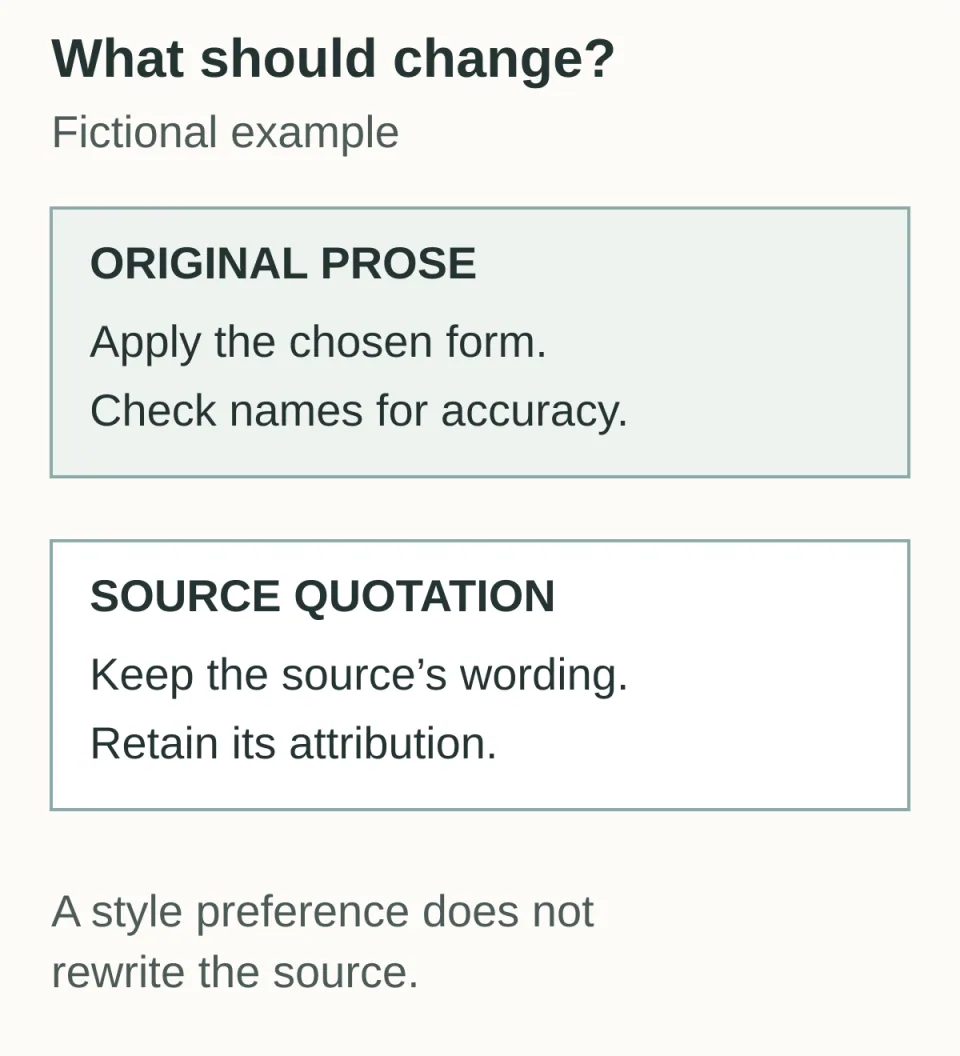
Check the context before replacing a variant.
Keep the reference smaller than the work
Use one maintained sheet rather than starting a new copy for every document. A short alphabetical list is enough at first. Add an example when a rule alone leaves room for confusion, and put the sheet somewhere the people doing the editing can find it. These are practical suggestions for this exercise, not measured results from a trial.
Cathy Tingle’s CIEP discussion of consistency considers house style across related communications, rather than treating every item as isolated. A project sheet can record the few choices that need to stay aligned while an existing reference guide handles the rest. [2]
Search for variants, then read the context
During an editing pass, search for a known alternative such as “OpenShelf.” Read each occurrence before changing it. The text might be a quotation, a URL, an official title or an example deliberately showing the old spelling. A search result is a place to inspect, not permission to replace everything.
If a decision changes, update the maintained sheet and identify the documents affected. Avoid silently applying a new preference to someone else’s material. For a shared project, an unresolved choice belongs with the responsible editor or owner.
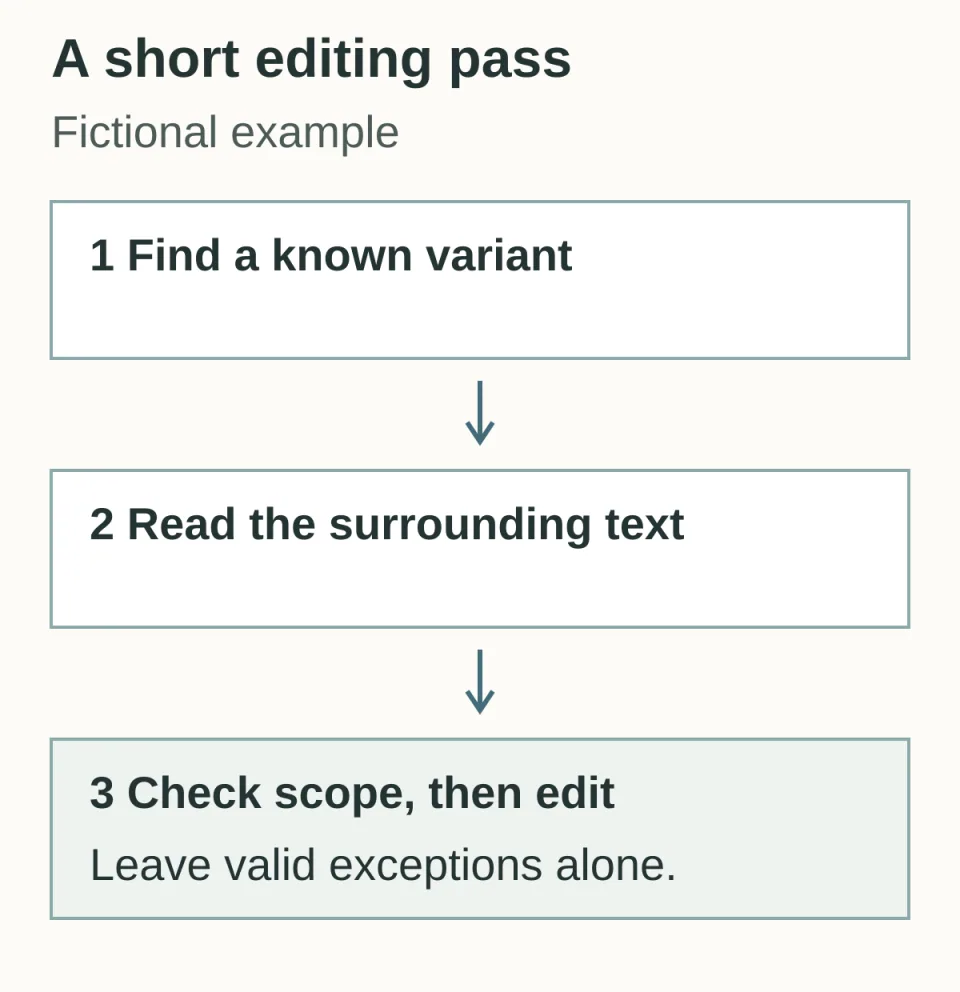
A search result tells you where to look.
Begin with one recurring name and one abbreviation from the document in front of you. Record their chosen forms, references and scope. That gives the next editing pass a concrete decision to consult without turning a small writing task into a separate publishing project.
Try it with your own information
Start a reusable style sheet
Keep each choice with its scope and exceptions so it can guide a later edit.
An invented worked example
Use this scenario to see how the decisions fit together, then replace its details with your own observations.
Fictional entry: Open Shelf, not OpenShelf. Scope: original project prose. Reason: project name agreed in the brief.
Exception: retain OpenShelf if it appears inside an exact quotation or an unchanged URL.
A new proposed spelling remains pending until the responsible editor confirms it; a search result does not settle the choice.
No account needed. Open the worksheet, enter your own notes, then download a text copy. You can also download it blank to complete elsewhere.
Open and download your worksheet
Source notes
1. Editors Canada, Professional Editorial Standards: D. Standards for Copy Editing. Checked October 25, 2026, Asia/Seoul (October 24 UTC): D2.1–D2.2 on consistency and source documentation. Prior ledger check: 20 October 2026. Professional standards, not an effectiveness study.
2. Cathy Tingle, First principles: Using 5Cs with any format, CIEP, 19 January 2024. Checked October 25, 2026, Asia/Seoul (October 24 UTC): Consistency section. The article describes one practitioner framework; its five Cs are not a universal mandatory scheme.
Evidence and scope
1. Standards for Copy Editing — Editors Canada
Claim covered: Editors Canada’s consistency standards recommend developing or following a style sheet for recurring choices such as abbreviations, numbers and spelling. That is professional guidance, not a promise that a worksheet will catch every error. [1]
Section D2.1 recommends a style sheet to track and consistently apply editorial choices.
Standards for Copy Editing — Editors Canada. English edition; source jurisdiction as stated. Checked: .
Professional guidance, not a guarantee that a worksheet detects every error.
2. Editorial application
Claim covered: Keep a small style sheet for the names and abbreviations you write repeatedly. Record the form you have chosen, the reason for it and the documents it applies to, then keep that sheet beside the next piece you edit. Start with choices you have already had to look up twice. You do not need to write a complete style manual before using a short list.
TidyNot practical application, separated from the original source’s claims.
TidyNot editorial suggestion. English edition. Checked: .
Professional guidance, not a guarantee that a worksheet detects every error.