After an edit, check the elements that depend on the changed passage. A renamed section can leave an old heading in the contents. A moved table can keep the right numbers but acquire the wrong callout. Reading each paragraph smoothly will not always reveal those broken connections.
Editors Canada’s proofreading standards include checking cross-references, captions, headings and links, as well as the effects of changes elsewhere in a document.[Q88] Make a short follow-up pass for those connections once the main wording is settled.
Begin with the change list
Open the version you intend to hand over. Note the sections that were renamed, moved, added or removed. You do not need a second copy of every editorial comment. A list of affected locations is enough to guide this pass.
For a small document, start at the first changed passage and follow every reference out of it. Then find references pointing back to it. In a longer document, use the editor’s search or cross-reference tools, while checking the visible result yourself.
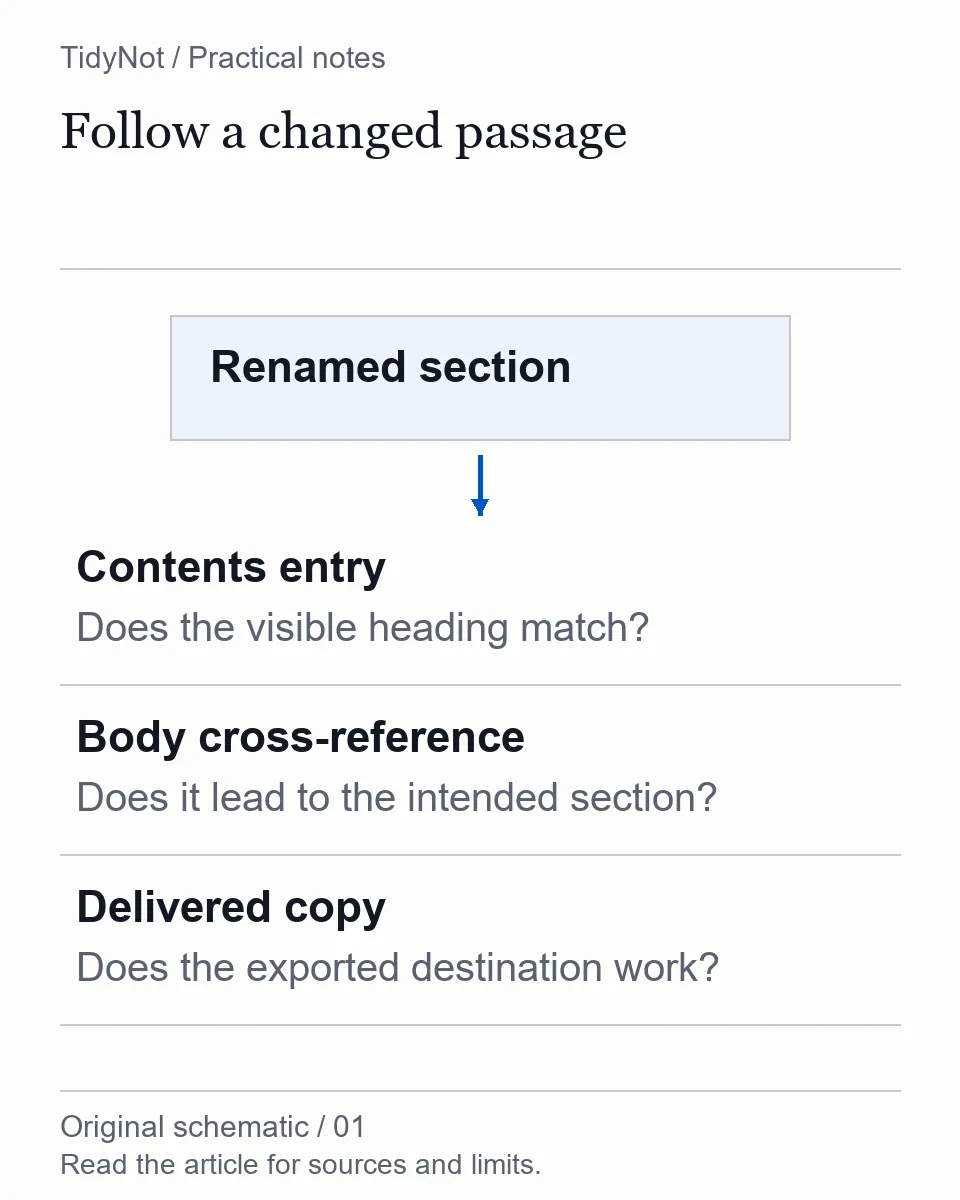
Follow a changed passage. Original TidyNot schematic.
Trace a changed passage to its dependent document elements.
Changed item | Follow the connection | Record the result |
|---|---|---|
Section heading | Contents entry and references to the section | Same wording and correct destination |
Table or figure | Caption, body callout and any list of illustrations | Correct number, title and placement |
Linked resource | Visible link text and destination | Expected document or page opens |
Check meaning as well as matching labels
A reference can be mechanically correct and still unhelpful. If a sentence says a table lists costs, confirm that the table actually includes those costs. A matching table number alone does not settle that question.
Philippa Tomlinson’s CIEP article gives practical reasons an editor may query an author, including discrepancies and the wider effects of changes.[Q21] Where the intended meaning is unclear, leave a specific query. "The text refers to a cost breakdown, but this table contains dates. Which should change?" gives the author a concrete decision.
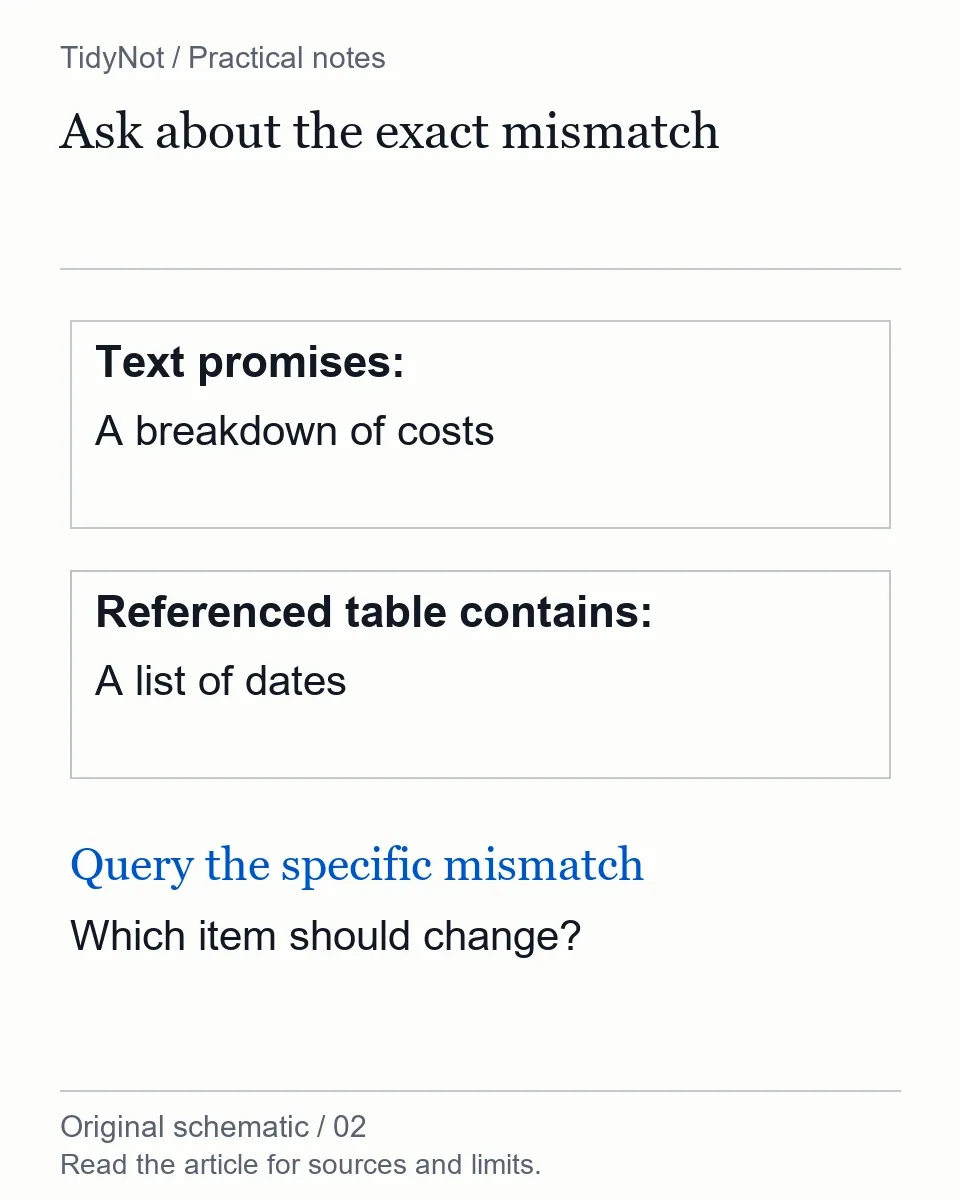
Ask about the exact mismatch. Original TidyNot schematic.
Close the pass in the delivered format
Export the document if that is how the reader will receive it. Check the affected page breaks and open the relevant links in the exported copy. A correct working file does not prove that every exported destination behaves as intended.
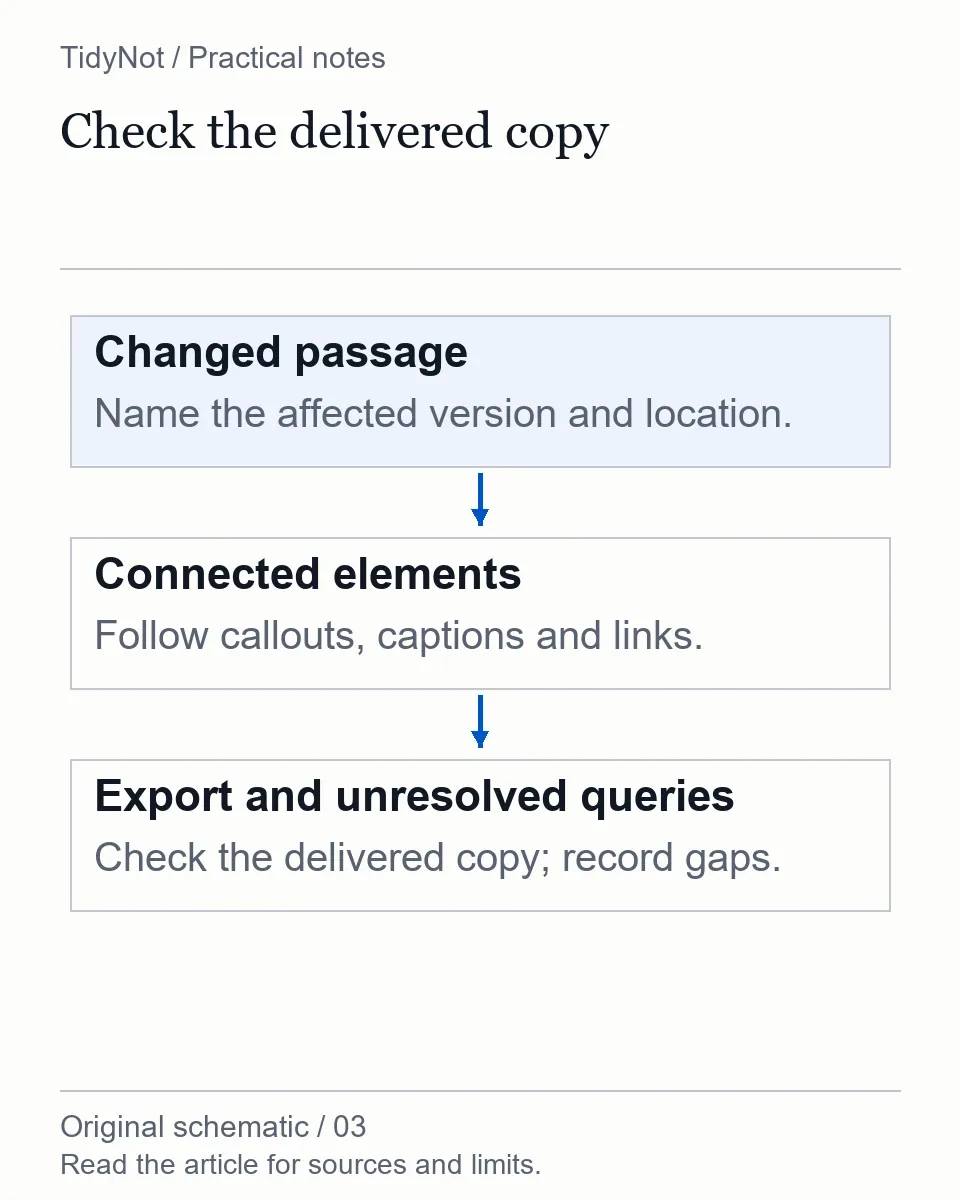
Check the delivered copy. Original TidyNot schematic.
Keep unresolved queries beside the affected locations, with an owner where one has been agreed. Record what you checked and which version you checked. If another edit moves a table or changes a heading, reopen the related checks rather than carrying their earlier result forward.
Try it with your own information
Trace a change through one document
Check dependencies rather than correcting only the first visible error.
An invented worked example
Use this scenario to see how the decisions fit together, then replace its details with your own observations.
Fictional edit: “Arrival details” moves from section 2 to section 3. The opening still says “see section 2”. Fix the reference, then follow it in the exported file.
A table changes from 12 to 14 participants, but the paragraph still says 12. Ask which value is supported; do not pick 14 merely because it looks newer.
Record: issue → authoritative answer → places changed → final-file check. Finding the mismatch is not the same as resolving it.
No account needed. Open the worksheet, enter your own notes, then download a text copy. You can also download it blank to complete elsewhere.
Open and download your worksheet
Sources and reading scope
- Philippa Tomlinson. What are queries, and how should an author respond?. CIEP; 2024-01-19. https://www.ciep.uk/resource/queries-author.html. Author-query examples read, including discrepancies, dependencies and assumed reader knowledge. Professional practice examples, not a controlled test of this checklist or explanation.
- Editors Canada. Professional Editorial Standards: E. Standards for Proofreading. Editors Canada; 2024 standards; current public page checked. https://editors.ca/publications/professional-editorial-standards/proofreading/. E2.4, E2.7 and E2.8 on cross-references, downstream changes and links read. Professional standards, not a measured reduction in errors from this checklist.
Evidence and scope
1. Professional Editorial Standards: E. Standards for Proofreading
Claim covered: Editors Canada’s proofreading standards include checking cross-references, captions, headings and links, as well as the effects of changes elsewhere in a document.[Q88] Make a short follow-up pass for those connections once the main wording is settled.
E2.4, E2.7 and E2.8 on cross-references, downstream changes and links read.
Professional Editorial Standards: E. Standards for Proofreading. English edition. Checked: .
Professional standards, not a measured reduction in errors from this checklist.
2. What are queries, and how should an author respond?
Claim covered: Philippa Tomlinson’s CIEP article gives practical reasons an editor may query an author, including discrepancies and the wider effects of changes.[Q21] Where the intended meaning is unclear, leave a specific query. "The text refers to a cost breakdown, but this table contains dates. Which should change?" gives the author a concrete decision.
Author-query examples read, including discrepancies, dependencies and assumed reader knowledge.
What are queries, and how should an author respond?. English edition. Checked: .
Professional practice examples, not a controlled test of this checklist or explanation.
3. Editorial application
Claim covered: After an edit, check the elements that depend on the changed passage. A renamed section can leave an old heading in the contents. A moved table can keep the right numbers but acquire the wrong callout. Reading each paragraph smoothly will not always reveal those broken connections.
TidyNot editorial workflow suggestion, distinguished from the linked source statements.
TidyNot editorial suggestion. English edition. Checked: .
An editorial application, not a tested intervention or a guarantee of results.