Find the fitted sheet’s corner pockets before trying to make a rectangle. The gathered edge can distract from the seams that show where each corner belongs. Opening the sheet enough to see those seams gives you a clearer starting point.
The Good Housekeeping tutorial explains how to nest the corners, then lay out and fold the sheet into a rectangle.[Q07] Use its illustrated sequence for the hand movements. The diagrams here show landmarks to look for; they are not photographs of a tested folding session.
Give the sheet room
Choose a clean surface where you can lay out the sheet without catching another item in the elastic. Locate the care label so you can find it again if the sheet needs special handling. This guide concerns folding a clean, dry sheet; it does not replace its care instructions.
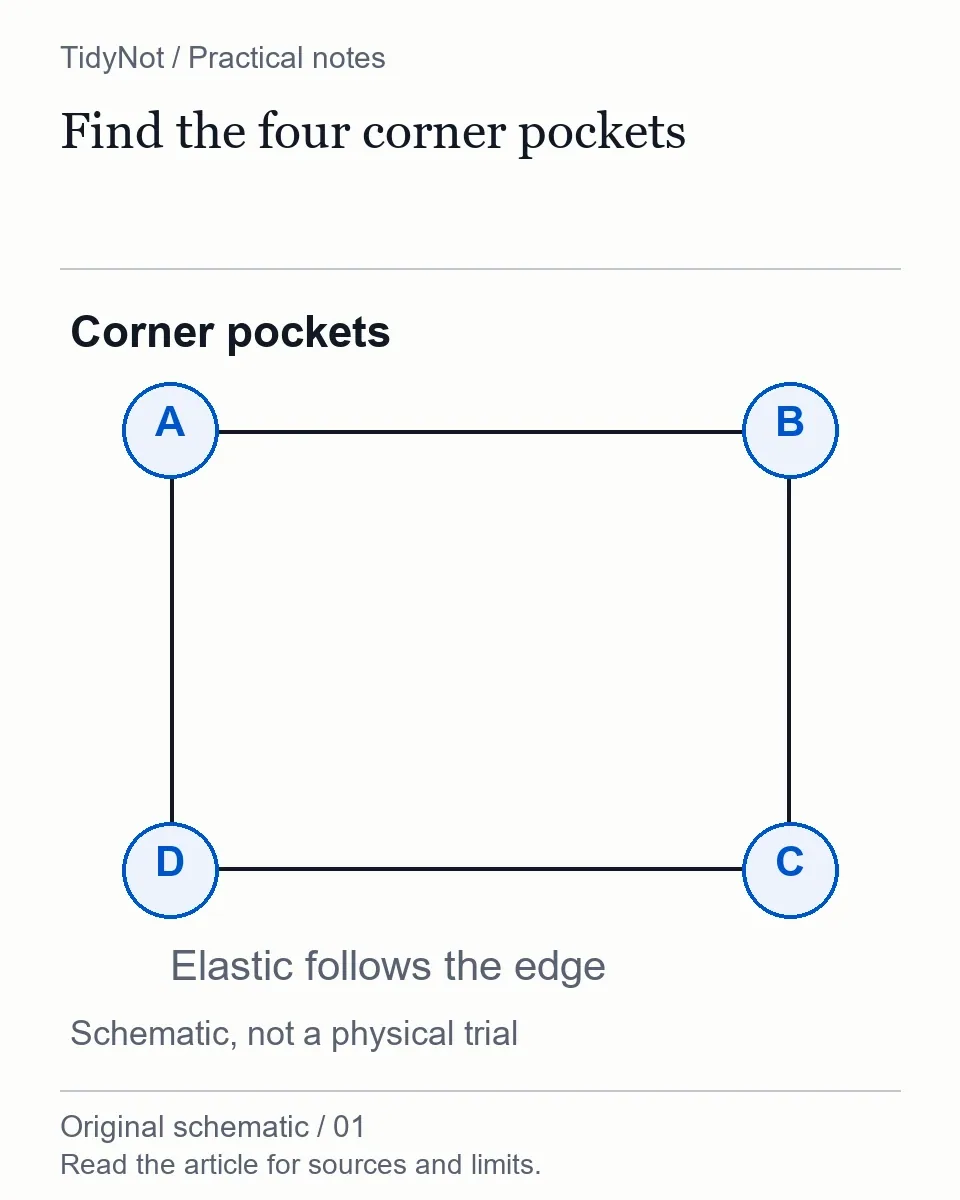
Find the four corner pockets. Original TidyNot schematic.
Identify all four corner pockets. If two sides have become tangled, open that section before continuing. There is no need to pull the elastic taut to decide which seam belongs to which corner.
Find and align the corner pockets, then use the supported tutorials for the folding sequence.
What you see | Check | Next move |
|---|---|---|
Elastic bunched at an edge | Can you identify the corner seams? | Find each pocket before folding |
A twisted bundle | Are two distant corners caught together? | Open it and separate the corners |
A broad uneven shape | Are the gathered edges tucked inside? | Lay it on a clear surface to finish |
Keep a visible reference point
Start with two identified corners and follow the linked tutorial’s nesting sequence. After each move, look for the remaining pockets rather than guessing from the loose outline. The Martha Stewart tutorial offers a separate demonstration.[Q08]
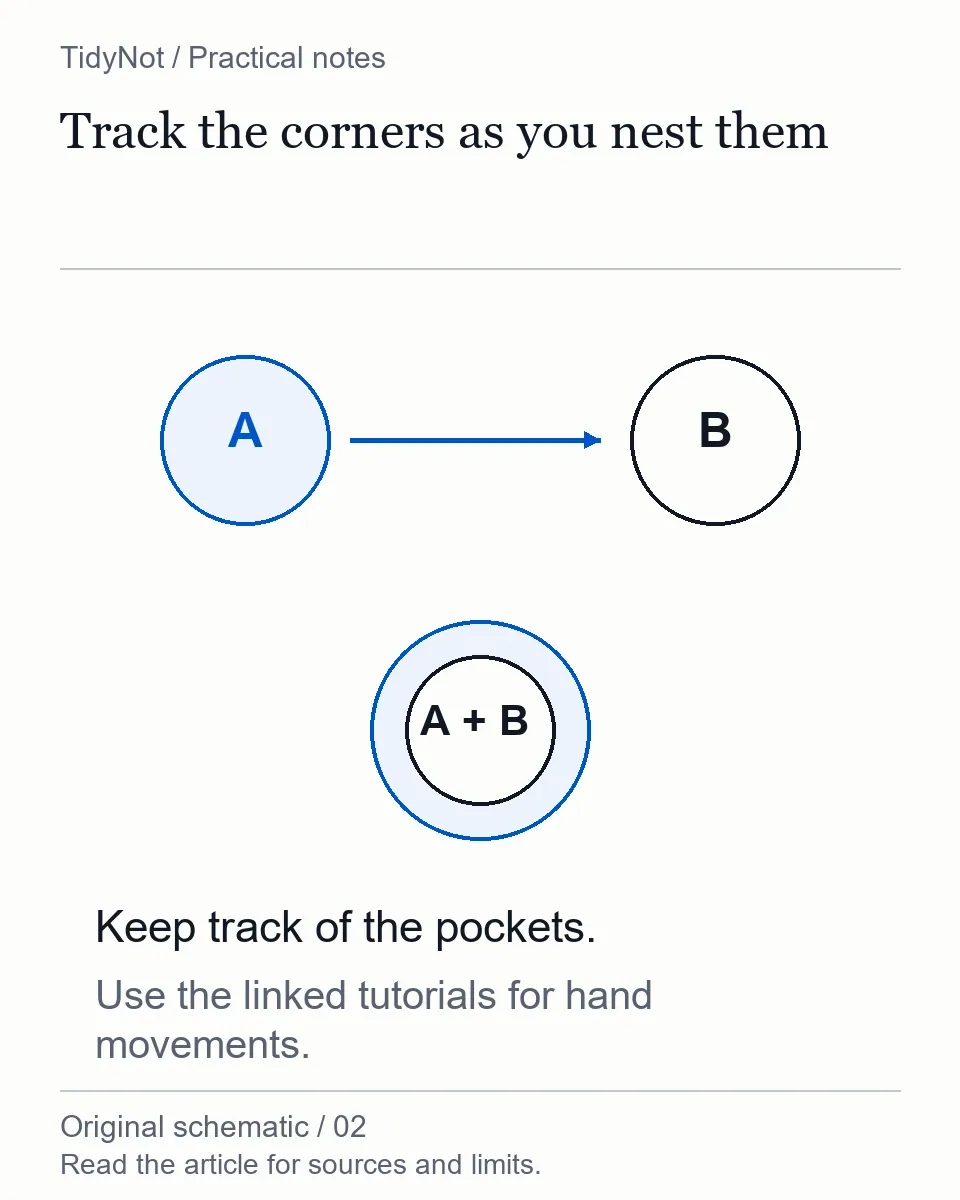
Track the corners as you nest them. Original TidyNot schematic.
Once the corners are together, use the flat surface to see where the elastic sits. An uneven bundle is easier to inspect on the surface than while it hangs from your hands. If the shape has twisted, return to the corner seams and reopen that part.
Check the result against your storage space
Finish with a bundle that fits where you keep the sheet. The exact folded dimensions depend on the sheet and the shelf; a display-perfect rectangle is not a requirement for finding the bedding again. Keep any label or size marker where you can read it.
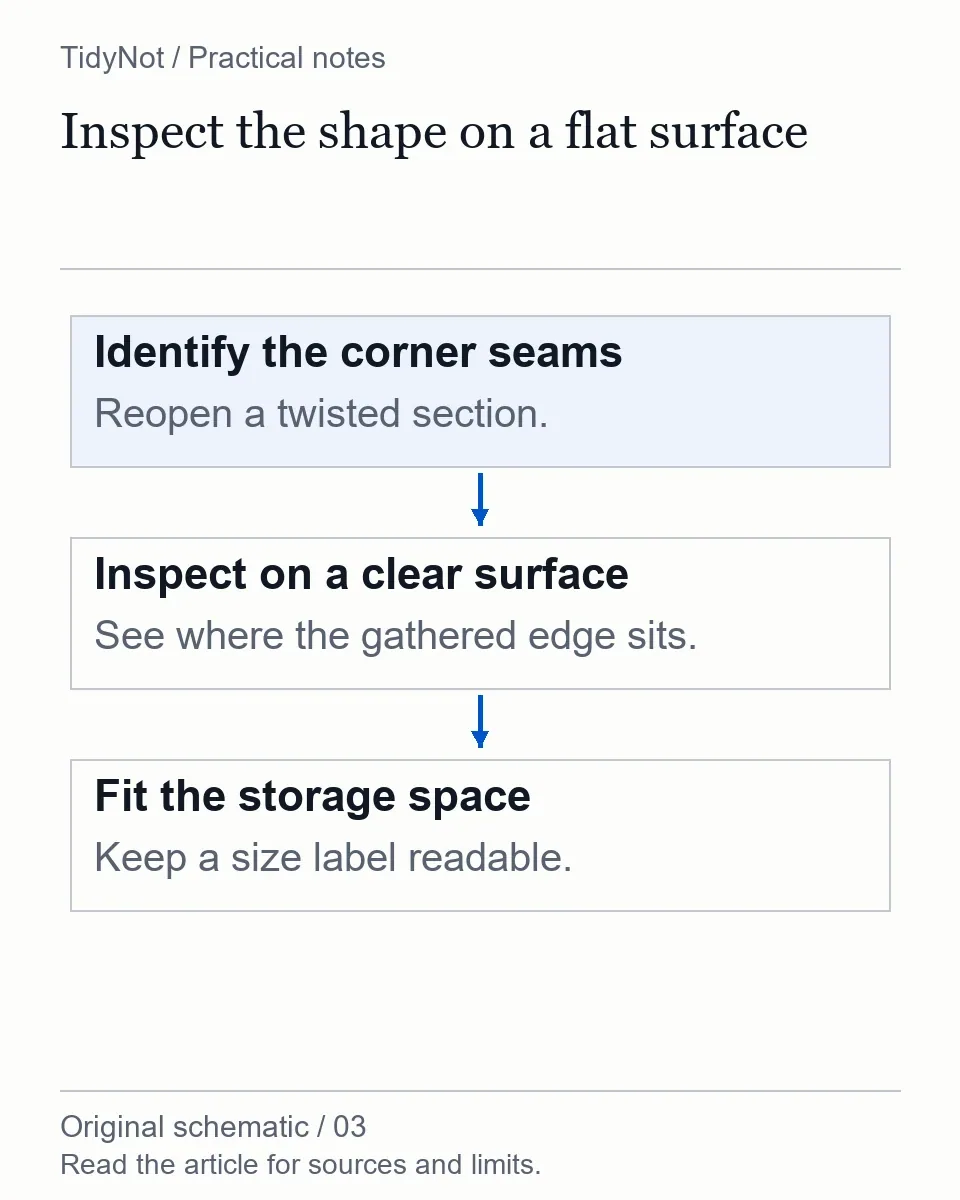
Inspect the shape on a flat surface. Original TidyNot schematic.
If you lose track of a corner, open the sheet enough to find its seam again. The labels in the diagrams are landmarks for inspection. They do not show measured folded dimensions.
A complete corner-to-shelf sequence
For a clean, dry fitted sheet, use the corner seams as your landmarks:
- Hold two corners so the sheet’s longer side spans your body and the top face of the fabric faces you. Put a hand inside each corner pocket.
- Bring one of those corners into the other. Nest the corresponding pair at the other end too, leaving the sheet folded in half.
- Bring the two nested pairs together and tuck one into the other. All four corner pockets now sit together. If one is missing or the fabric twists, reopen that part and find its seam.
- Lay the sheet on a clean flat surface. The gathered edge should form a C-like shape. Smooth the surrounding fabric so you can see the edges you will fold.
- Bring the outside edges inward in thirds. Fold the resulting strip in thirds in the other direction, then turn it over. Check the bundle against your actual shelf.
This is a paraphrase of Good Housekeeping’s five-step tutorial, with editorial checkpoints added. The written steps were rechecked on 9 November 2026; the page displays publication on 24 October 2025. Earlier source notes recorded 23 October. No hands-on folding trial, speed test or embedded-video review was performed here.
If the sheet becomes a twisted bundle, the useful reset is to separate and identify the corner pockets again. Folding tighter will not resolve a missing corner. A shelf-sized bundle you can identify is a practical finish; a perfectly uniform display is optional.
Sources and reading scope
- Lexie Sachs and Jamie Ballard. How to Fold a Fitted Sheet Like a Pro, According to Bedding Experts. Good Housekeeping; 2025-10-23. https://www.goodhousekeeping.com/home/organizing/a69136795/how-to-fold-fitted-sheet-like-a-pro/. Article instructions and byline checked on 2026-10-24. A tutorial rather than a measured folding-speed or wrinkle-reduction result.
- Madeline Buiano. How to Fold a Fitted Sheet, According to Martha Stewart. Martha Stewart; 2026-09-26. https://www.marthastewart.com/how-to-fold-a-fitted-sheet-according-to-martha-stewart-12138630. Article and byline checked on 2026-10-24; embedded video not viewed. Separate tutorial, not independent efficacy evidence.
Evidence and scope
1. How to Fold a Fitted Sheet Like a Pro, According to Bedding Experts
Claim covered: The Good Housekeeping tutorial explains how to nest the corners, then lay out and fold the sheet into a rectangle.[Q07] Use its illustrated sequence for the hand movements. The diagrams here show landmarks to look for; they are not photographs of a tested folding session.
Article instructions and byline checked on 2026-10-24. A tutorial rather than a measured folding-speed or wrinkle-reduction result.
How to Fold a Fitted Sheet Like a Pro, According to Bedding Experts. English edition. Checked: .
Tutorial, not a folding-speed or wrinkle-reduction test. No physical trial performed for this draft.
2. How to Fold a Fitted Sheet, According to Martha Stewart
Claim covered: Start with two identified corners and follow the linked tutorial’s nesting sequence. After each move, look for the remaining pockets rather than guessing from the loose outline. The Martha Stewart tutorial offers a separate demonstration.[Q08]
Article and byline checked on 2026-10-24; embedded video not viewed. Separate tutorial, not independent efficacy evidence.
How to Fold a Fitted Sheet, According to Martha Stewart. English edition. Checked: .
Separate demonstration, not independent efficacy evidence. No photos or video copied.
3. Editorial application
Claim covered: Find the fitted sheet’s corner pockets before trying to make a rectangle. The gathered edge can distract from the seams that show where each corner belongs. Opening the sheet enough to see those seams gives you a clearer starting point.
TidyNot editorial workflow suggestion, distinguished from the linked source statements.
TidyNot editorial suggestion. English edition. Checked: .
An editorial application, not a tested intervention or a guarantee of results.