Choose a small area containing things you can make decisions about, then return what belongs there, put other things back, and record anything that needs checking. This guide is for one first sorting session—not clearing an entire home or deciding what another person should discard.
The five steps below are an editorial suggestion. The drawer and its contents are fictional examples, not a before-and-after account or a tested promise about how long tidying takes.
1. Choose a place you can leave usable
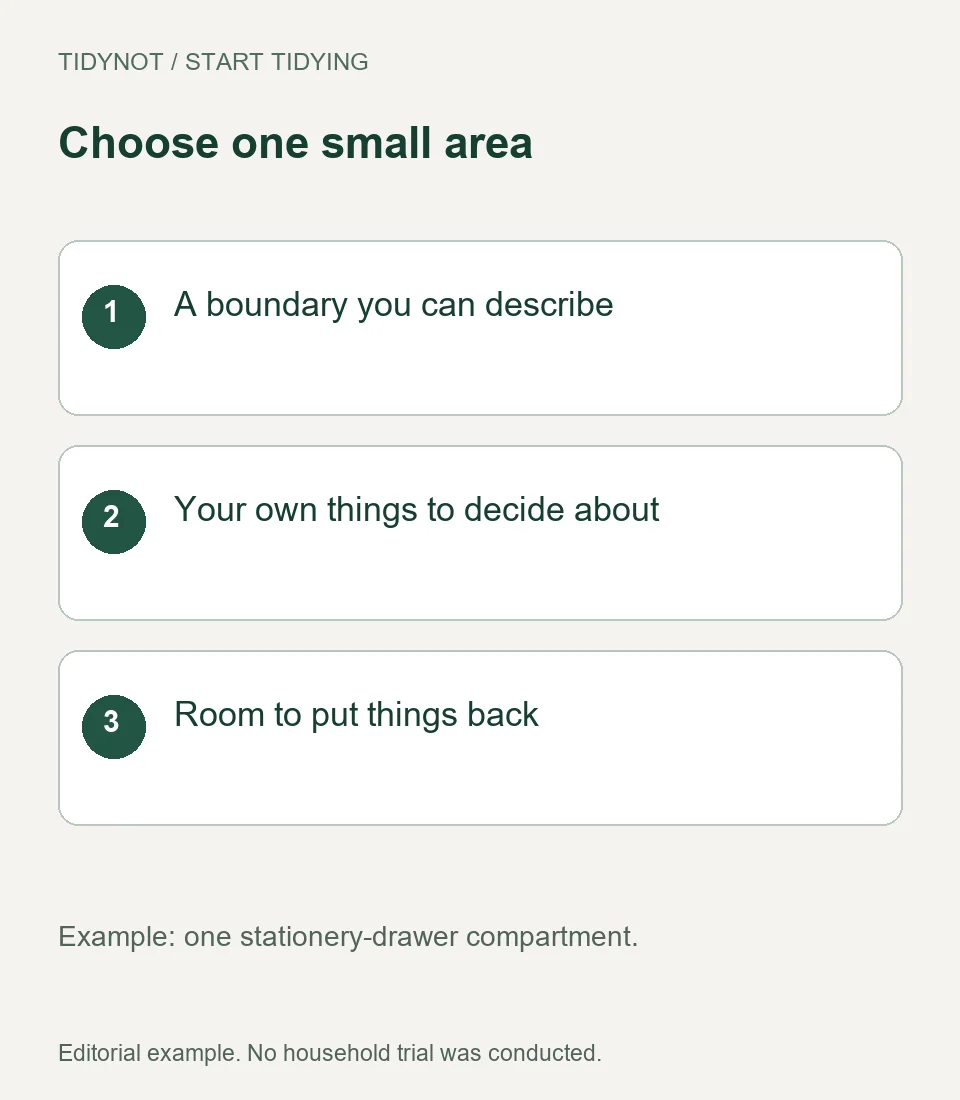
Look for a boundary you can describe: one compartment in your stationery drawer, for example. Make sure you have somewhere to put a few items while you look at them. If that would block a doorway or leave the shared table unusable, choose a smaller area or wait until there is room.
The most visible pile is not always the easiest place to make decisions. In this example, the owner chooses a stationery drawer because they know most of its contents and can put them back before stopping.
Possible starting place | Conditions in this fictional example | Decision for this session |
|---|---|---|
One compartment in your stationery drawer | Mostly your own things; a clear surface nearby | Start here |
A shared table covered with family papers | Ownership and reasons for keeping papers are unclear | Do not treat the papers as yours to discard |
A keepsake box | Several items need reading or discussion | Leave it for another session; it is not a bad starting place for everyone |
Before taking anything out, describe the finish: “I can reach and use my stationery, and everything I move has somewhere to go.” A completely empty drawer is not the goal.
2. Look at a few things at a time
Take out only what you can examine and put back. You do not need to empty the whole room—or even the whole drawer—to begin.
Separate ordinary rubbish only when you know it is yours to discard and know how to handle it. An unfamiliar object is not automatically rubbish. Stop rather than improvise if you encounter something damaged, sharp, leaking or otherwise unsafe; this guide does not cover hazardous materials or cleaning procedures.
3. Give each item a destination
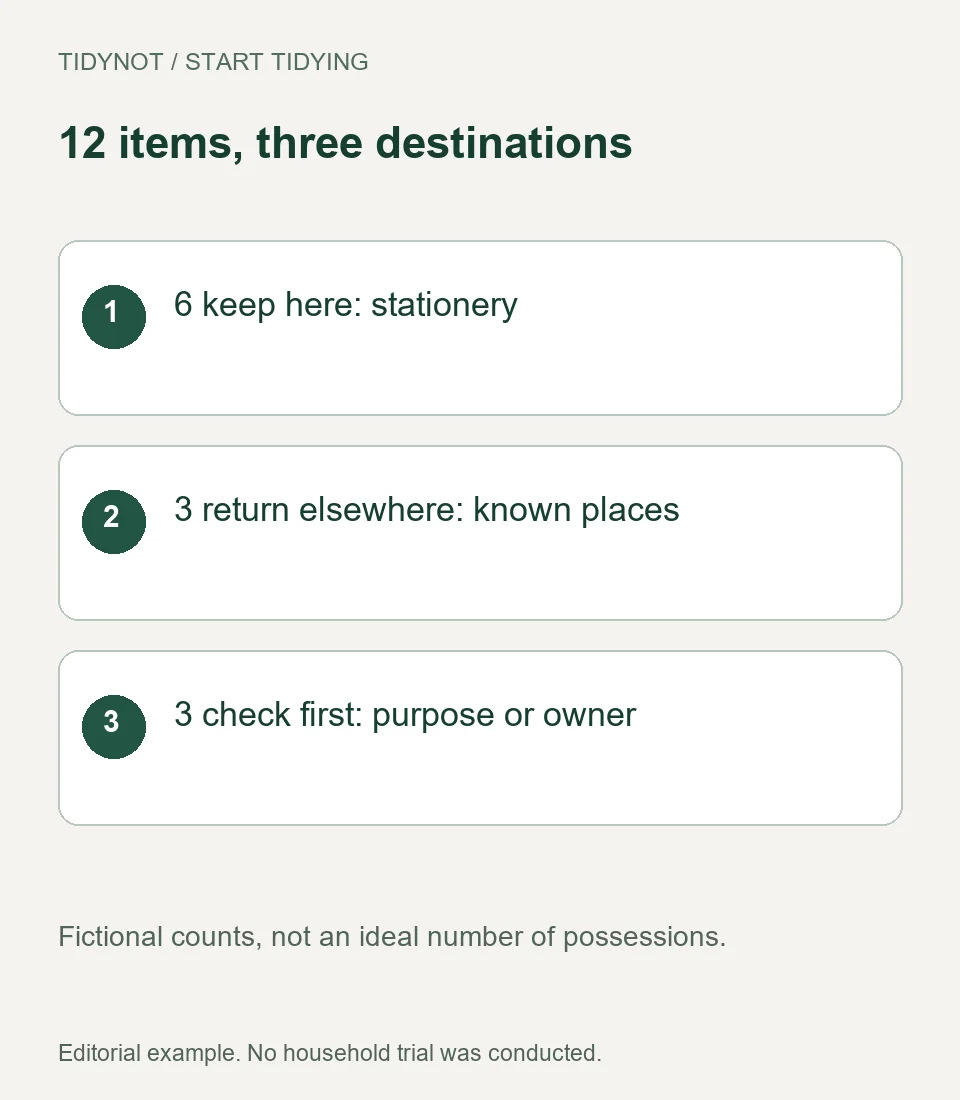
Use three decisions: keep here, return elsewhere, or check first. These are temporary sorting labels, not three storage products you need to buy.
In the example below, the drawer is used for stationery. There is already a bookshelf, a charging place and a place for shopping bags by the entrance. The six stationery items belong to the person doing the sorting. The USB drive belongs to a family member; its contents and purpose have not been checked.
Item | Decision | Next action |
|---|---|---|
Black pen used daily | Keep here | Give it a reachable place |
Frequently used pencil | Keep here | Put it with the pen |
Eraser in use | Keep here | Use an existing small compartment |
Ruler used at this drawer | Keep here | Leave room for its length |
Small notebook in use | Keep here | Return it without starting to read through it |
Container of paper clips | Keep here | Keep the current container |
Book with a place on the bookshelf | Return elsewhere | Put it on that shelf |
Cable used at the charging place | Return elsewhere | Return it there |
Shopping bag with a place by the entrance | Return elsewhere | Put it in that place |
Family member’s USB drive | Check first | Ask the owner before deciding; do not open or delete its contents |
Key with an unknown purpose | Check first | Identify what it opens; keep it while checking |
Receipt whose purpose is unclear | Check first | Check whether you need it for a record, return or another reason |
That makes six items here, three elsewhere and three to check. These counts explain the example; they are not an ideal number of possessions. The receipt row does not specify a retention period or replace financial or legal guidance.
“Return elsewhere” means an actual destination. Moving an item to a new pile beside the drawer only transfers the unfinished decision. If you cannot identify a destination, put that question on the check list instead.
4. Write down what needs checking
Keep uncertain items in a suitable temporary place that does not obstruct the area you need to use. Add a short note so you do not have to reconstruct the question later.
Item | Check with or about | Next chance to check | Action after checking |
|---|---|---|---|
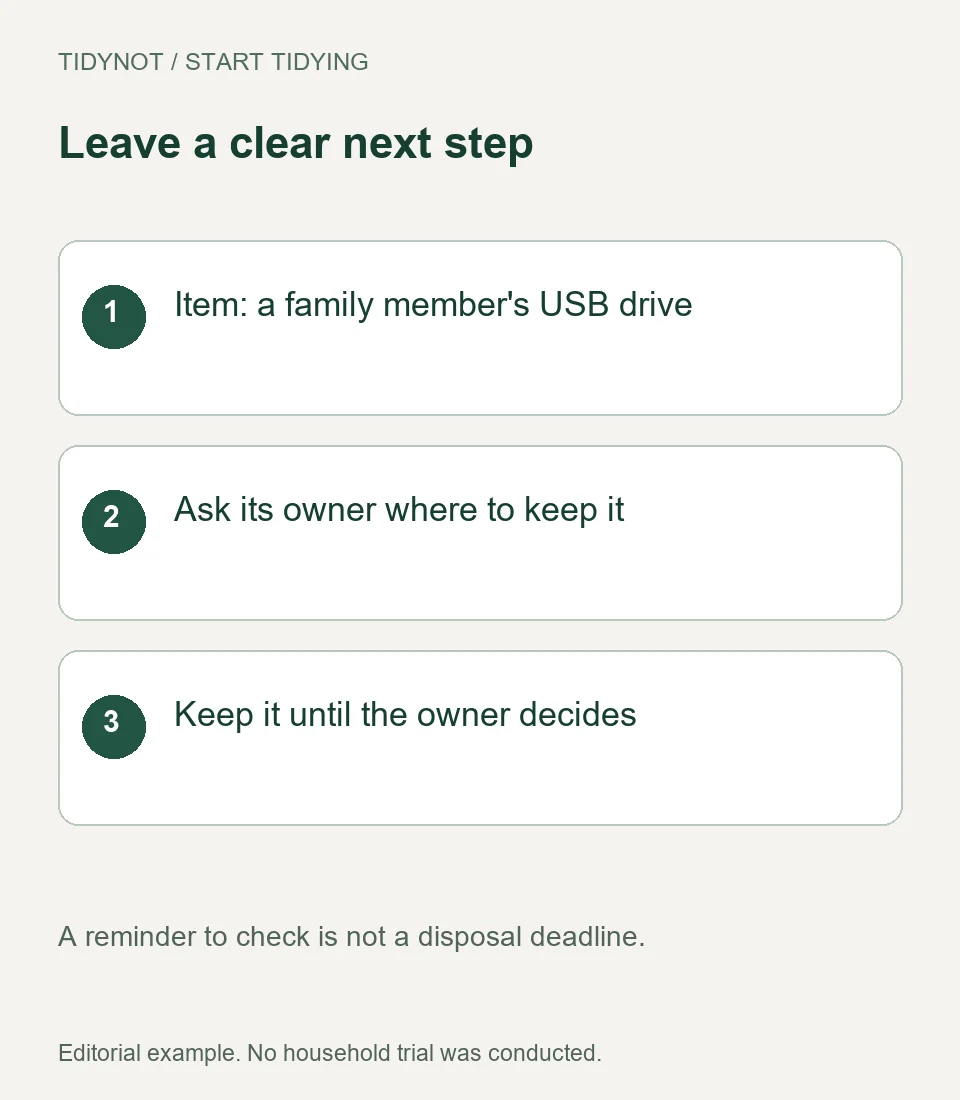
Family USB drive | Ask the owner whether it is theirs and where they want it kept | Next time you can discuss it together | Keep it until the owner decides |
Your item | Person or information needed | An occasion you can identify | Decide after you have the information |
A reminder is a prompt to check, not a disposal deadline. If the next opportunity passes, the item does not become yours to throw away. You can finish this session without contacting someone immediately or examining their private files.
5. Stop when this area works again
Return the things that belong in the drawer, put the other items in their known places, and leave the check notes with the uncertain items. Then ask:
- Can I use the area for its intended purpose?
- Have I avoided leaving a new pile around it?
- Does each item to check have a person, question or next action attached?
For this example, the finish is: “The drawer is usable, the other items are back in their places, and the three items to check have a next step.” You do not need to start a second area to make the first session count.
Scope
The selection table, twelve-item example and check card are TidyNot’s editorial examples. They do not establish an optimal sequence, a completion time or an effect on health or productivity. Whole-home clearance, serious accumulation, hazardous items and decisions about someone else’s belongings need a different scope.
Plan one small area
Choose a boundary you can leave usable. Separate relocation from unresolved ownership or disposal decisions.
Sources and application
USU’s 2026 practical tips and 2022 article inform the small-area starting point. They overlap substantially; the linked studies were not read, and this guide makes no health or productivity claim.
MUJI’s storage guide discusses return locations and temporary storage. We use that limited idea with existing containers, without recommending products. WAM’s second column discusses fixed locations, while its eleventh column connects classification with understanding an item’s purpose. Both are older columns by the same author, not independent tests. Our household example and check card are adaptations, not a tested procedure or a disposal timetable.
Evidence and scope
1. Ask an Expert – The Mental Health Benefits of Decluttering
Claim covered: Supports limiting the first session to a small area. Do not adopt health, anxiety, focus, productivity or time-to-result claims.
Main article including practical tips read in BrowserOS.
Ask an Expert – The Mental Health Benefits of Decluttering. English household editorial examples. Checked: .
Reworks the 2022 USU article; not independent evidence. No linked research, source-image review or household trial.
2. 整理整頓のモヤッとに。悩み別におすすめの収納用品
Claim covered: A named return location and temporary place fit the draft. Existing compartments are sufficient; no product recommendation or purchase requirement.
Introduction and relevant return-location, divider and temporary-storage text read; product images and linked product pages not reviewed.
整理整頓のモヤッとに。悩み別におすすめの収納用品. English household editorial examples. Checked: .
Manufacturer marketing guidance, not experimental evidence. No linked research, source-image review or household trial.
3. 第2回:必要なものがすぐに取り出せる!?
Claim covered: Fixed locations and returning used objects fit the draft. Reject extrapolation of claimed efficiency, motivation, mental-state or eye-movement effects.
Full column text read; illustrations not visually reviewed.
第2回:必要なものがすぐに取り出せる!?. English household editorial examples. Checked: .
Magazine column reprint by 坂戸健司; same author and series as comparison five. No linked research, source-image review or household trial.
4. The Mental Benefits of Decluttering
Claim covered: Small-area advice matches. Daily versus weekly wording varies even within the source; no prescribed frequency or ten-second promise adopted.
Full article text and reference list read; linked papers, consumer articles and ACT program not read or used.
The Mental Benefits of Decluttering. English household editorial examples. Checked: .
Underlying article for comparison one; authors Ashley Beckwith and Emma Parkhurst, substantial content overlap. No linked research, source-image review or household trial.
5. 第11回:分けるということはわかるということ
Claim covered: Understanding purpose before classification is relevant by analogy. Workplace-document advice does not establish household discard rules or retention periods. The check-first card remains our editorial adaptation.
Full column text read; linked columns and magazine not read.
第11回:分けるということはわかるということ. English household editorial examples. Checked: .
Same WAM author/series as comparison three; not independent research. No linked research, source-image review or household trial.
6. Editorial application
Claim covered: The five steps, fictional twelve-item 6/3/3 split and check card are editorial suggestions.
Fictional examples, not a before-and-after trial.
TidyNot editorial suggestion. One household area. Checked: .
No optimal-sequence, completion-time, health-effect or disposal-deadline validation.