An opened package is easy to lose behind another one. Before putting it in a new basket, check whether the storage directions will still be visible. Keep any known opened or prepared date with the food, and leave an unknown date marked as unknown.
Choose one refrigerated group to work on. Keep the food cold as you check it; take out only what you need to read and return it promptly. A small layout change should not turn into a long session with chilled food on the counter.
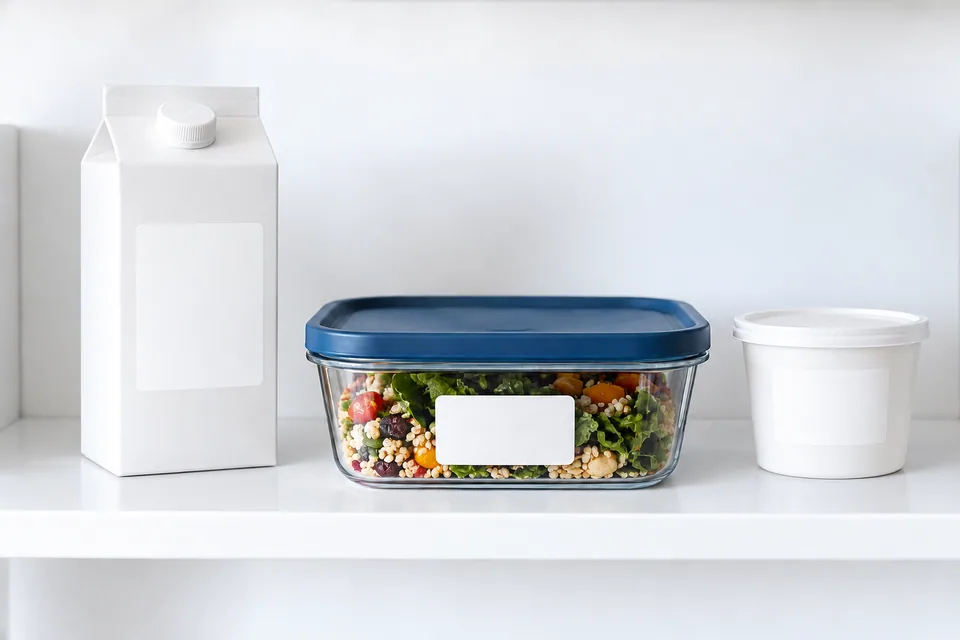
AI-generated editorial still life with blank labels. It does not establish storage conditions or a safe-until date.
Check the storage conditions first
The FDA's food storage guidance advises keeping a refrigerator at or below 40 F (4 C), checking the temperature and following storage directions on the food label. It also advises leaving room for air to circulate. Use those conditions when considering a new arrangement.
A clear shelf does not tell you the temperature. Check it with an appliance thermometer. Follow your refrigerator's instructions for where items and any added holders can go; a generic drawing cannot show the airflow or compartments of every model.
If the food label specifies refrigerated storage, keep that direction with the package. A group name such as "breakfast" does not change how an individual item should be stored.
Keep the information attached to the food
Read the label before moving a package into a holder. Check that the storage instructions and date wording can still be seen. If an outer carton carries information missing from the inner packs, keep that information available with them.
For a prepared dish, write a description you can recognize and a preparation date you actually know. For an opened package, record the known opening date when that information matters to the relevant storage guidance. Keep the original printed wording as well; a handwritten opening date describes a different event.
If someone else prepared or opened it, ask them. When the date is unknown, a new label should say that it is unknown. Moving a container or tidying its shelf does not restart its storage history.
Use a note you can read without moving several other packages. Keep it on the item or in a way that stays clearly linked to that item. A loose list can become misleading after packages have been moved or replaced.
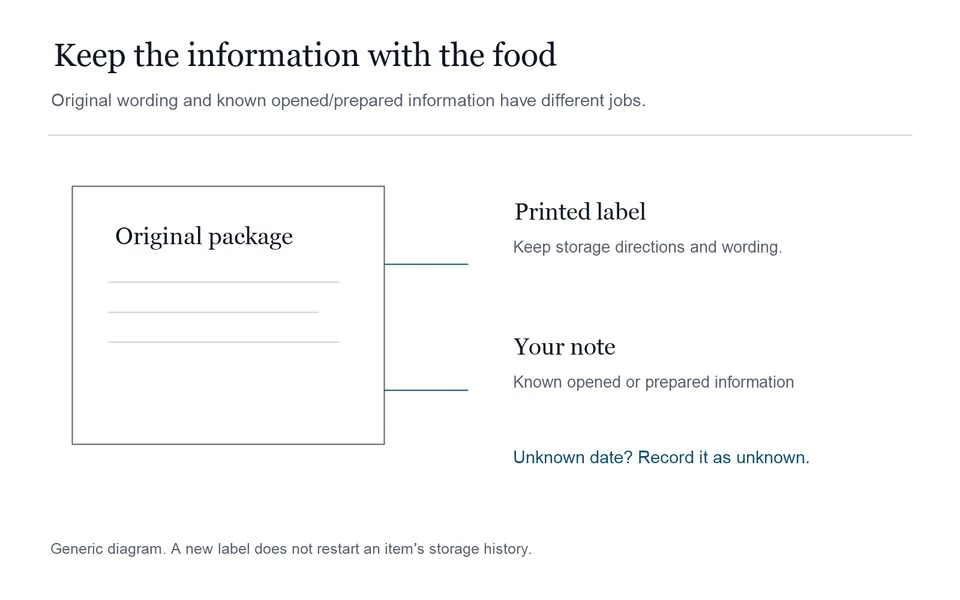
Keep original wording and known preparation information linked to the same item. Unknown dates remain unknown.
Look up the food and its opened state
The FoodSafety.gov Cold Food Storage Chart gives different guidance for different foods. Some entries distinguish an opened package from an unopened one. Find the row that describes the food and its state before recording a storage limit.
Keep the chart's storage conditions in view when using it. A limit copied without its food type or refrigerator conditions can lose the information that made it useful.
A single "use first" date for a whole basket would hide those differences. If you use a front position as a reminder, still check each item's directions and relevant guidance. Position alone cannot tell you whether it is suitable to eat.
The FDA also warns that food can be unsafe even when it does not look, smell or taste spoiled. If its storage history is uncertain, check the appropriate food guidance instead of assigning a reassuring date or tasting it to decide.
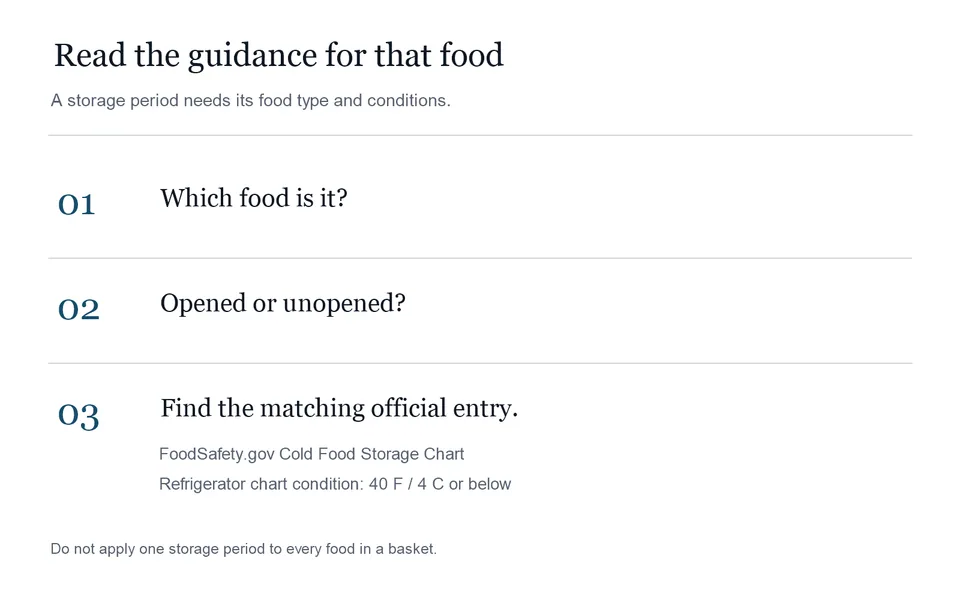
Use the matching official food entry and its conditions. This diagram assigns no blanket storage period.
Write a note that helps you check
The table below shows the information to gather. It does not assign an expiry date to an unidentified food.
Item | Known information | Keep visible | What to check next |
|---|---|---|---|
Opened package of sliced deli meat | The actual opening date, if known | Original label and storage directions | The chart's relevant opened-package entry |
Covered leftovers | Contents and the actual preparation date, if known | A note attached to that container | Guidance for that particular prepared food |
Unidentified container | Contents or preparation history unknown | The unresolved question | Identify it and follow appropriate food-safety guidance; do not invent a date |
These are fictional note examples. Your list may have fewer fields if the package already carries the information you need. Avoid copying every label into a separate inventory that you will have to keep synchronized.
Try the place before adding a basket
Put the items in a position that follows the food and appliance instructions while leaving their information readable. Check that a holder will not cover the labels or crowd the space. Keep foods covered appropriately and keep raw foods separate from foods ready to eat, as the FDA advises.
Take out the item you usually reach for and put it back. If a tall package hides a short one, see whether a different position makes both readable. Do not use the arrangement to override an item's required compartment or storage conditions.
When a package is finished, remove its matching note. When another one is opened, record the new event without copying the previous package's date. If the note is already printed on the package, keep using that information directly.
Sources and scope
The FDA page and FoodSafety.gov chart were checked during drafting on October 20, 2026 in Korea. They provide U.S. consumer guidance. The chart page identifies September 19, 2023 as its last review date.
This is an organization plan for one refrigerated group. It has no household test results, universal shelf placement or blanket storage period. Food-specific directions and the refrigerator's own instructions still need to govern the items you put there.
Evidence and scope
1. FDA: Are You Storing Food Safely?
Claim covered: Keep storage conditions visible while reorganizing
FDA advises refrigeration at or below 40°F (4°C), temperature checks, label directions and space for air circulation.
FDA: Are You Storing Food Safely?. United States household food-storage guidance. Checked: .
An organizing diagram cannot establish that a particular food is safe.
2. FoodSafety.gov: Cold Food Storage Chart
Claim covered: Match the food and its opened state to the chart
FoodSafety.gov lists food-specific storage guidance and separates opened and unopened packages for some foods.
FoodSafety.gov: Cold Food Storage Chart. United States household food-storage guidance. Checked: .
Do not transfer a limit from one food or package state to another.
3. Editorial application
Claim covered: Keep original information with the food
The proposed placement and notes are editorial examples, not new expiry dates or safety certifications.
TidyNot editorial suggestion. English edition; adapt to the actual home and item. Checked: .
No measured time saving or tested household outcome is claimed.