Put a short checklist where the task happens and write each item as an action whose completion can be checked. For a routine desk handoff, an item such as “open the reference link” is easier to verify than “everything ready.” Walk through the sequence once to find unclear wording or a missing step. This is a proposed usability check, not a measured reliability guarantee.
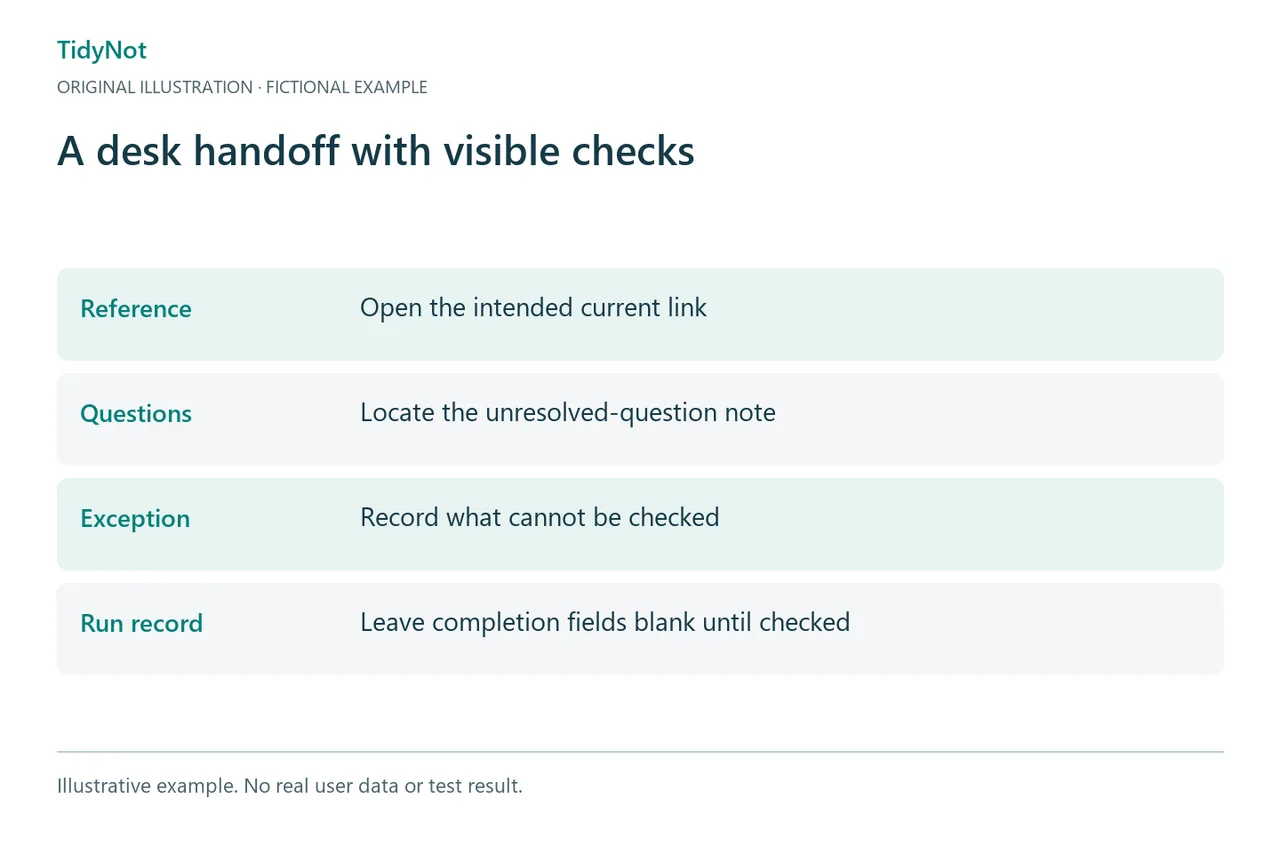
This fictional checklist records no completed handoff.
Pick one ordinary moment of use
For a fictional desk handoff, the person taking over needs the current reference link and a note about unresolved questions. Keep this checklist at that handoff point. A general list buried in another project may be accurate and still be absent when the person needs it.
Degani and Wiener studied checklist concepts and organizational use in aviation. Their abstract makes design and context relevant questions, but it does not validate this desk example or give us a universal item count. Norman’s publisher overview supplies a separate perspective on visible cues and feedback. Source 11.1 Source 11.2
Draft a checklist around the moment of use
Design choice | Question to answer | Draft check |
|---|---|---|
Placement | Where will the person need it? | Reachable at the handoff point |
Wording | What action or state is observable? | Use a concrete verb and object |
Sequence | What must happen before this item? | Walk through in the intended order |
Exception | What happens when a check fails? | Name the person or next step to consult |
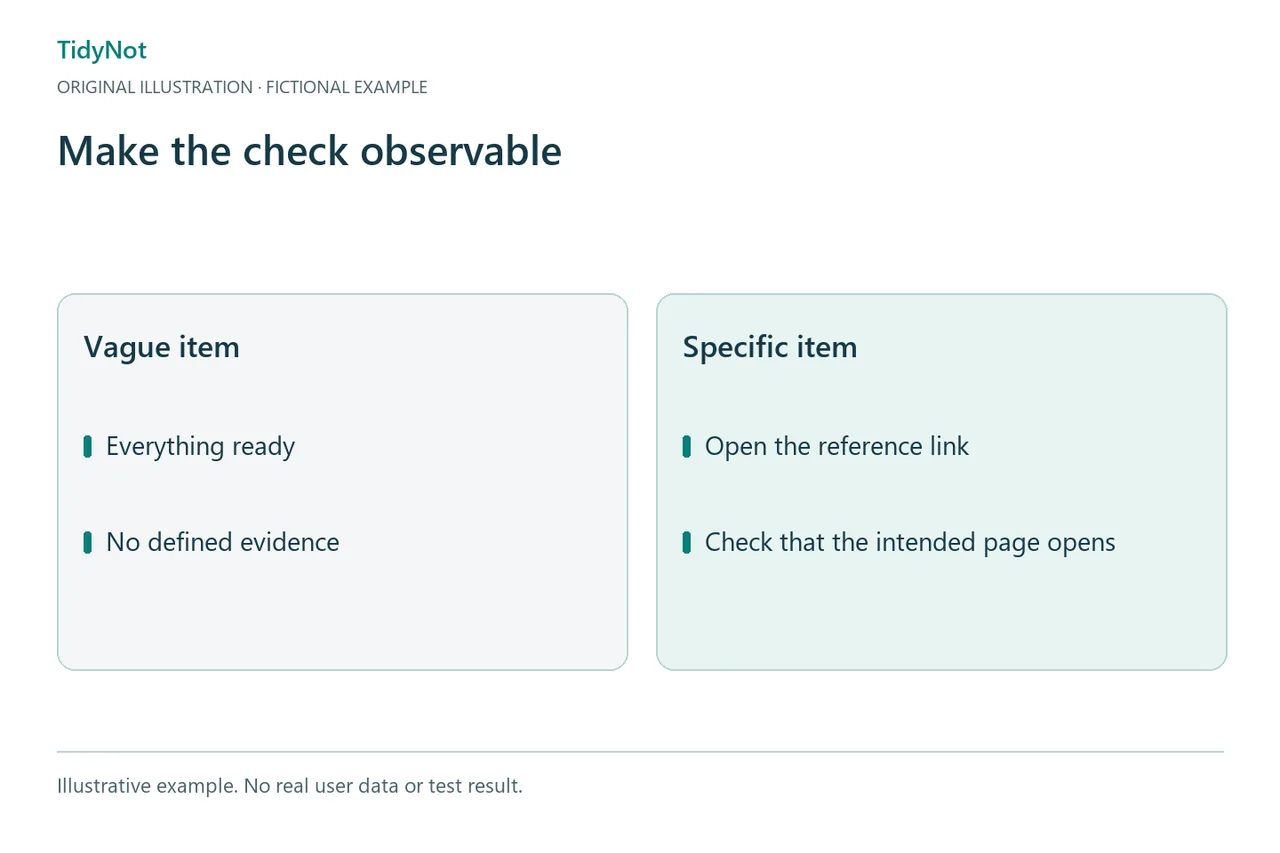
Choose evidence appropriate to the task.
Write the evidence beside the action
Replace "everything ready" with something the person can inspect, such as "open the current reference link." The check is whether the intended reference opens, not whether someone has drawn a tick. Another item might say "read the unresolved-question note" and identify where that note lives.
Keep a reusable blank checklist separate from each run’s record. The blank describes what to do. A dated run records what someone actually checked, including an exception. Do not prefill completion marks in an example that nobody has performed.
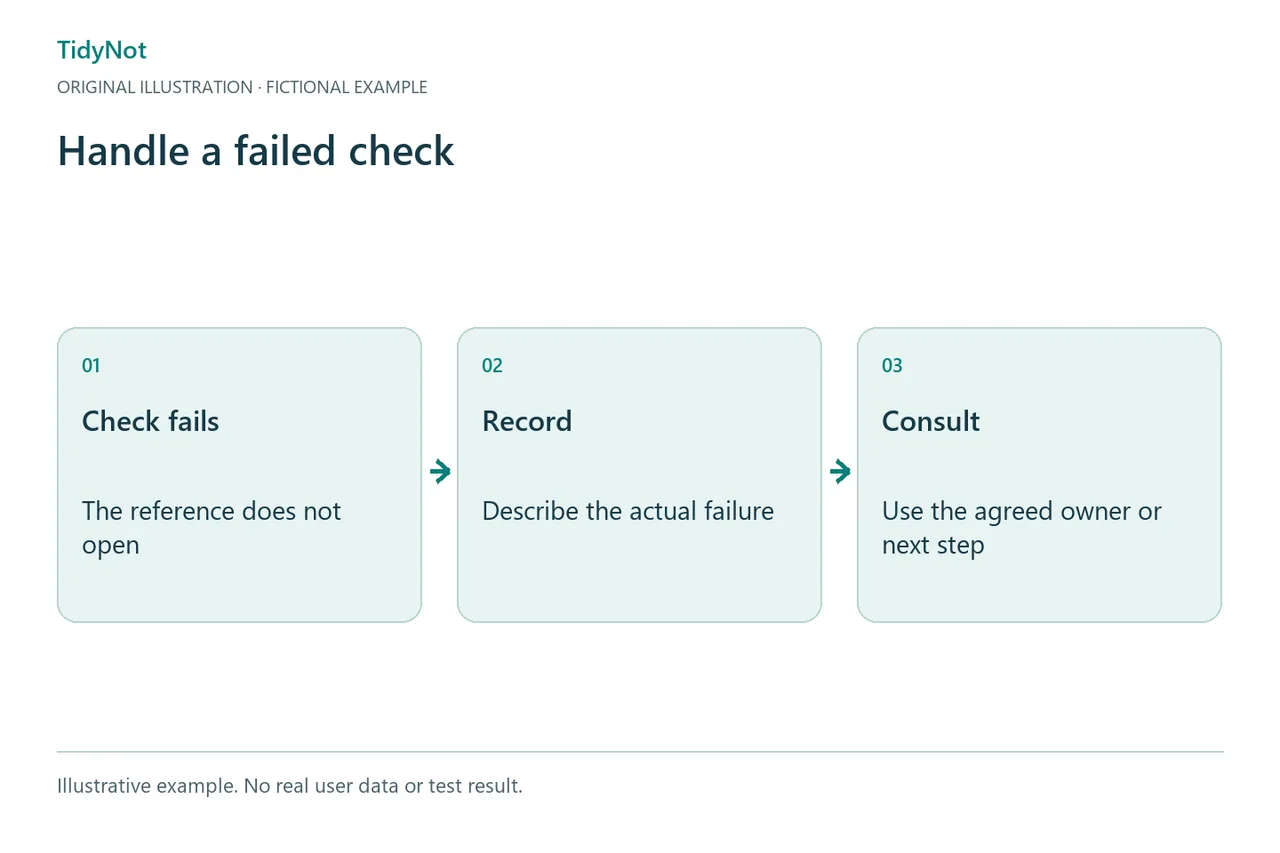
A tick alone does not resolve a failed check.
Walk through the sequence before relying on it
For the proposed desk task, imagine arriving without the previous person nearby. Can you find the list, understand its first action and identify what to inspect? Follow the remaining actions in their intended order. If one item depends on information that appears later, revise the sequence.
If a link fails, the checklist needs a next step, such as recording the failure and asking the designated reference owner. Name a real owner only when that responsibility has been agreed. It is unsuitable as a substitute for an organization’s required procedures.
Separate a task list from a completion check
“Prepare the shared desk” names work to do. “Shared desk is clear of the previous task’s papers” names something to check. Choose wording that matches the purpose of your list, and revise it if two readers interpret a completed item differently.
Try it with your own information
Build a checklist with observable checks
Replace vague commands with something a person can inspect; keep a blank master separate from each run.
An invented worked example
Use this scenario to see how the decisions fit together, then replace its details with your own observations.
Vague: “Sort out the desk.” Observable: “Open the current handover file from the named shared location.”
Vague: “Everything ready.” Observable: “Unresolved items list names the missing answer and who will be asked.”
Exception: the shared link fails. Record “not checked—access unavailable” and an owner for follow-up; do not tick the item because the file probably exists.
No account needed. Open the worksheet, enter your own notes, then download a text copy. You can also download it blank to complete elsewhere.
Open and download your worksheet
Sources and scope
[11.1] Asaf Degani and Earl L. Wiener. Cockpit Checklists: Concepts, Design, and Use. Human Factors 35(2), 345–359, 1993-06. https://doi.org/10.1177/001872089303500209 Read scope: NASA NTRS original-paper abstract and journal bibliographic record; full guidelines not read. Limits: Aviation field study, not a trial of personal checklists. No unviewed design rule or safety-benefit claim.
[11.2] Don Norman. The Design of Everyday Things: Revised and Expanded Edition. Basic Books, 2013-11-05. https://www.basicbooks.com/titles/don-norman/the-design-of-everyday-things/9780465050659/ Read scope: Publisher description and edition metadata; book body not read. Limits: Design framework, not a test of household storage labels. No unread page citation.
Source relationship: Independent aviation study and design-book overview; context transfer is explicit and the household/desk example is untested.
The images are original explanatory illustrations of fictional examples. They are not photographs, product screenshots or evidence of a completed practical test.
Evidence and scope
1. Asaf Degani and Earl L. Wiener. Cockpit Checklists: Concepts, Design, and Use. Human Factors 35(2), 345–359, 1993-06.
Claim covered: Aviation checklist research does not validate a desk routine
Degani and Wiener studied checklist concepts and organizational use in aviation. Their abstract makes design and context relevant questions, but it does not validate this desk example or give us a universal item count. Norman’s publisher overview supplies a separate perspective on visible cues and feedback. Source 11.1 Source 11.2
Asaf Degani and Earl L. Wiener. Cockpit Checklists: Concepts, Design, and Use. Human Factors 35(2), 345–359, 1993-06.. English edition; source-specific context. Checked: .
NASA NTRS original-paper abstract and journal bibliographic record; full guidelines not read. Aviation field study, not a trial of personal checklists. No unviewed design rule or safety-benefit claim.
2. Editorial application
Claim covered: A practical step to try in your own setting
“Prepare the shared desk” names work to do. “Shared desk is clear of the previous task’s papers” names something to check. Choose wording that matches the purpose of your list, and revise it if two readers interpret a completed item differently.
TidyNot editorial suggestion. English edition; fictional example. Checked: .
TidyNot editorial proposal. No completed practical trial, measured benefit or universal outcome is claimed.