Before adding another basic to a shopping list, choose one unworn garment and record why you passed over it. Use an actual occasion you remember. "I never wear this" is a starting observation; the reason behind it helps you decide what to do next.
The publisher’s introduction to Anuschka Rees’s The Curated Closet describes building a wardrobe around personal style and everyday needs.[S08] Use that as a planning perspective, then look at the clothes and situations you actually have. The book description does not establish a required wardrobe size or a saving you should expect.
Start with one identifiable piece
Give the garment a name you will recognize later: "navy cardigan with the loose cuff" is more useful than "knitwear." Note the last time you considered wearing it and what happened instead. If you cannot remember a real occasion, leave that field open rather than inventing one.
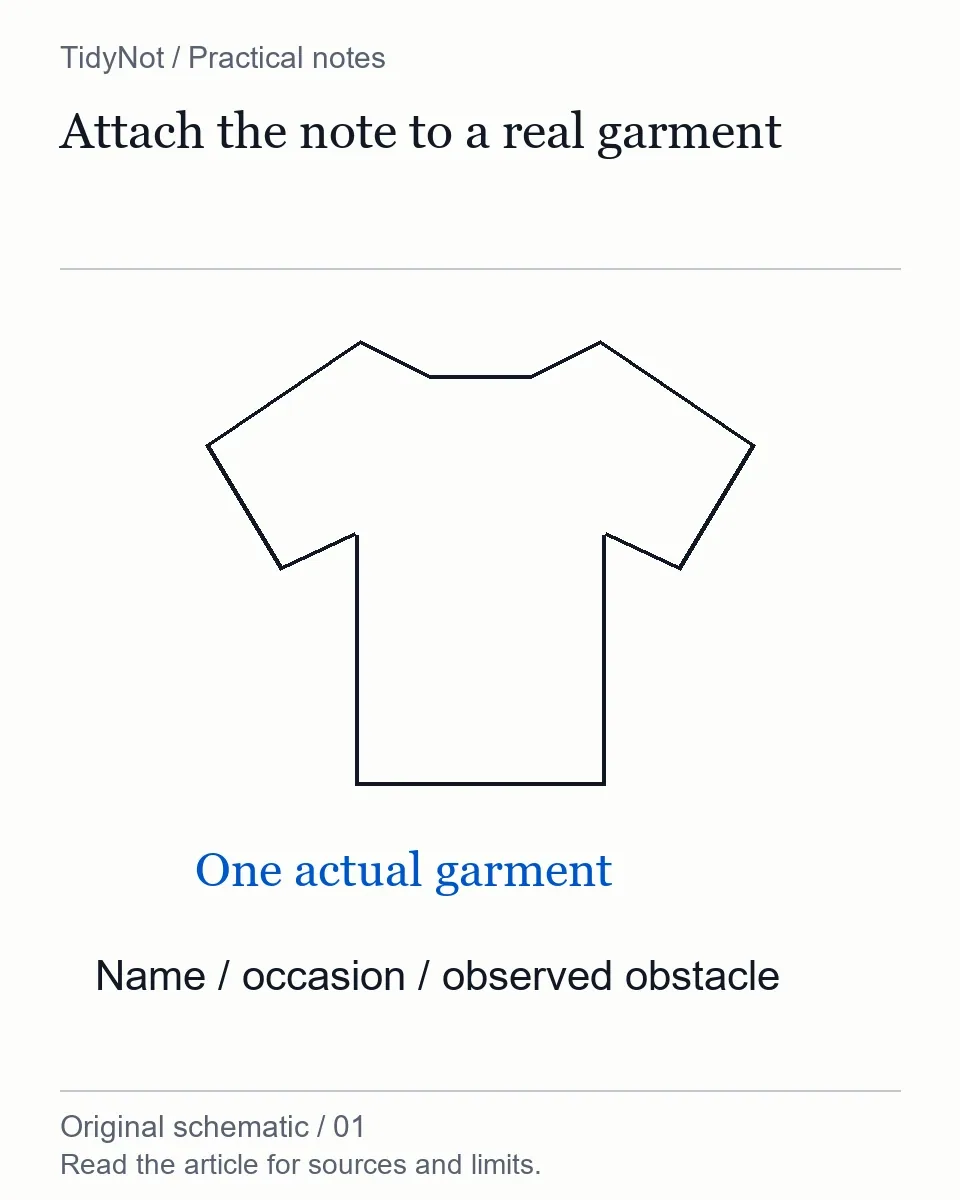
Attach the note to a real garment. Original TidyNot schematic.
Wardrobe research discussed by OsloMet uses examination of actual garments alongside questions about them.[Q72] This article adapts that object-focused idea into a personal note. It is not a replication of the research method or evidence that the exercise reduces spending or environmental impact.
Record the garment, an actual wearing occasion and the specific obstacle before deciding what to do.
Record | Use a specific observation | Decision to consider |
|---|---|---|
Garment | A recognizable item in your wardrobe | Keep the note attached to the actual piece |
Occasion | A real day when you considered wearing it | Check whether that situation still occurs |
Obstacle | Fit, care, a missing combination or another observed reason | Try an appropriate next step before assuming a purchase is needed |
Describe the obstacle before choosing a remedy
In a constructed example, a shirt might be clean and fit comfortably but need a repair before use. Buying another shirt would leave that repair unresolved. Another garment might belong to an occasion that is no longer part of your life. Those are different decisions, even though both items look equally unworn on a hanger.
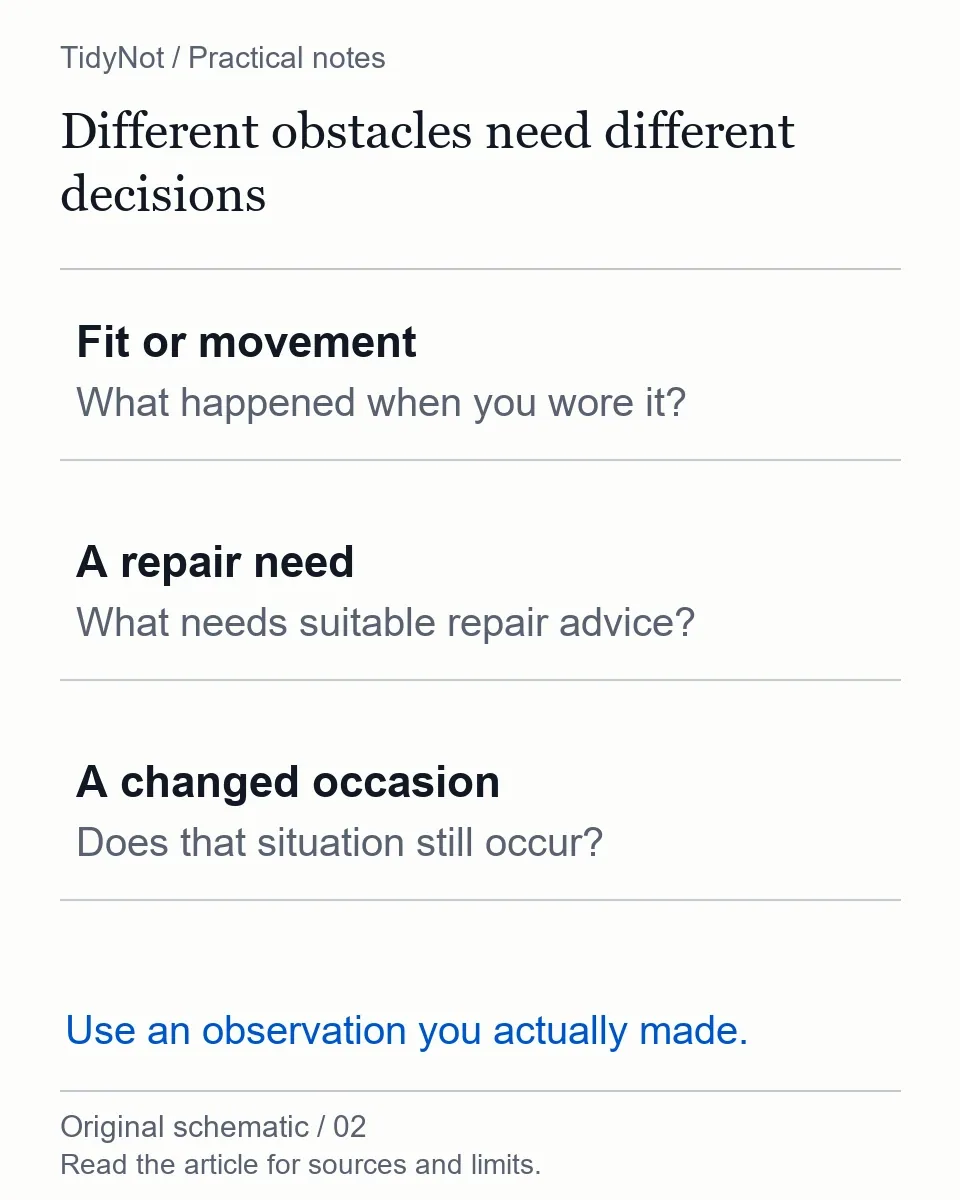
Different obstacles need different decisions. Original TidyNot schematic.
Keep the observation separate from your interpretation. "I chose another top because this cuff caught on the desk" records a concrete problem. "I need a new wardrobe" jumps to a much larger conclusion. Use a reason you have actually observed, and check care or repair options that suit the specific garment.
Give the decision a place to return to
Choose a next step you can evaluate: try an existing combination, seek suitable repair advice, or reconsider whether the item still serves a real occasion. Put the note with the garment record so the same unresolved question does not become a repeated purchase.
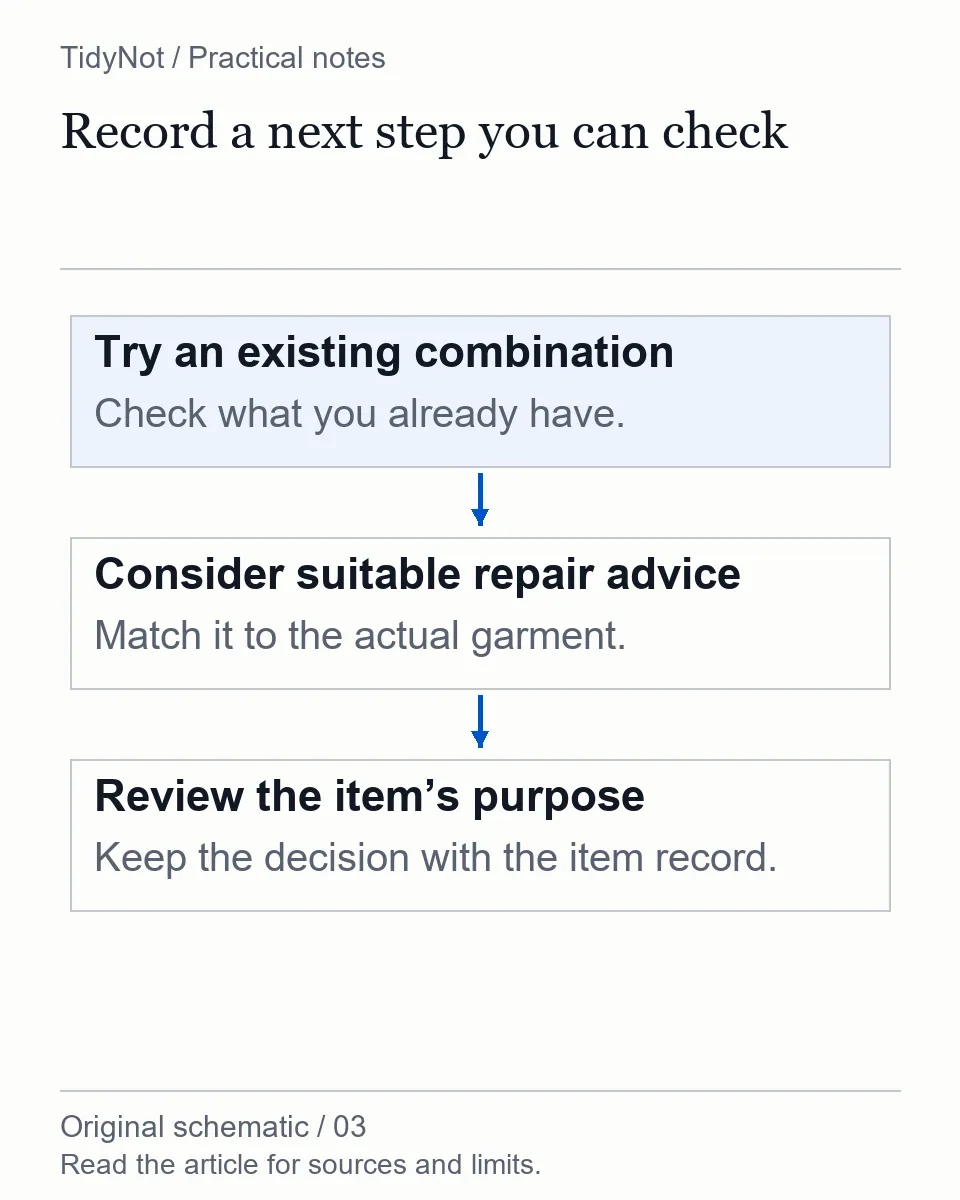
Record a next step you can check. Original TidyNot schematic.
If you do identify a missing item, write which clothes and occasions it would serve before shopping. That gives you a concrete comparison to make. No item quota, purchase or savings target is required for this review.
Try it with your own information
Write one garment decision
Separate an observed problem from a proposed solution before adding a purchase.
An invented worked example
Use this scenario to see how the decisions fit together, then replace its details with your own observations.
Fictional item: navy cardigan with a loose cuff. It was passed over for a visit because the cuff caught on a bag.
Next decision: check the repair option and cost if wanted. The note does not establish that another cardigan is needed.
Different case: a formal jacket fits but no longer matches any planned occasion. A repair would not solve that mismatch.
No account needed. Open the worksheet, enter your own notes, then download a text copy. You can also download it blank to complete elsewhere.
Open and download your worksheet
Sources and reading scope
- Anuschka Rees. The Curated Closet. Ten Speed Press / Penguin Random House; 2016-09-20. https://www.penguinrandomhouse.com/books/532611/the-curated-closet-by-anuschka-rees/. Publisher description and publication metadata read; full book not read. An author/publisher approach, not independent evidence of spending or environmental effects.
- Vilde Haugrønning, Ingun Grimstad Klepp and Anna Schytte Sigaard. Deep diving into wardrobes provides important knowledge on clothes and their environmental impact. OsloMet Clothing Research; 2022-09-08. https://clothingresearch.oslomet.no/2022/09/08/deep-diving-into-wardrobes-provides-important-knowledge-on-clothes-and-their-environmental-impact/. Institutional article’s garment-by-garment questioning and use-context discussion read. Method perspective adapted to a personal note, not a replication or evidence of savings.
Evidence and scope
1. The Curated Closet
Claim covered: The publisher’s introduction to Anuschka Rees’s The Curated Closet describes building a wardrobe around personal style and everyday needs.[S08] Use that as a planning perspective, then look at the clothes and situations you actually have. The book description does not establish a required wardrobe size or a saving you should expect.
Publisher description and publication metadata read; full book not read.
The Curated Closet. English edition. Checked: .
An author/publisher approach, not independent evidence of spending or environmental effects.
2. Deep diving into wardrobes provides important knowledge on clothes and their environmental impact
Claim covered: Wardrobe research discussed by OsloMet uses examination of actual garments alongside questions about them.[Q72] This article adapts that object-focused idea into a personal note. It is not a replication of the research method or evidence that the exercise reduces spending or environmental impact.
Institutional article’s garment-by-garment questioning and use-context discussion read.
Deep diving into wardrobes provides important knowledge on clothes and their environmental impact. English edition. Checked: .
Method perspective adapted to a personal note, not a replication or evidence of savings.
3. Editorial application
Claim covered: Before adding another basic to a shopping list, choose one unworn garment and record why you passed over it. Use an actual occasion you remember. "I never wear this" is a starting observation; the reason behind it helps you decide what to do next.
TidyNot editorial workflow suggestion, distinguished from the linked source statements.
TidyNot editorial suggestion. English edition. Checked: .
An editorial application, not a tested intervention or a guarantee of results.