When two things change together, start by saying what you observed. A shared pattern alone does not show that one change caused the other. Before writing “because,” check how the information was collected, what was compared, and what else changed. If those details are missing, keep the wording modest and record the question you still need answered.

AI-generated editorial illustration; not a photograph of an actual event.
Separate the observation from the explanation
Imagine a team introduces a checklist and records fewer corrections the following month. That is an invented example, not a result TidyNot has observed. “Fewer corrections were recorded after the checklist arrived” describes the sequence. “The checklist reduced corrections” adds a causal explanation. The second sentence needs evidence that the first does not provide.
The Australian Bureau of Statistics explains that correlation describes a relationship, while causation concerns one event bringing about another. A correlation does not automatically establish a cause.2 If nobody has calculated a correlation, “an observed pattern” may be the more accurate description.
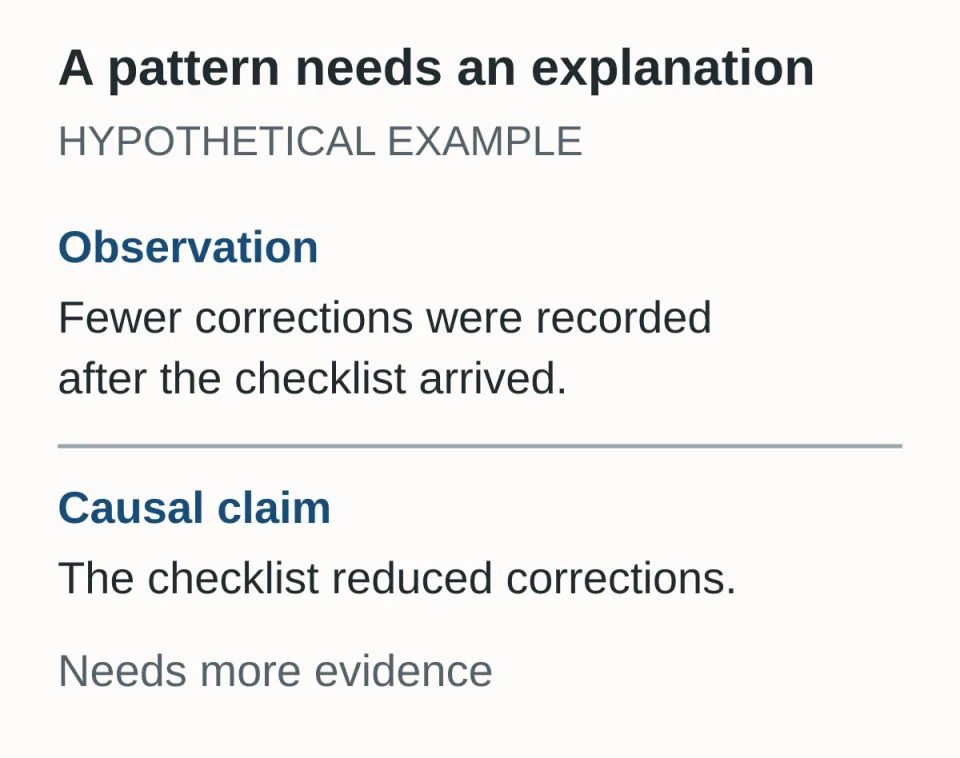
A sequence can be described before its cause is established. Hypothetical example.
Find out what was compared
Start with the source of the information. Was this a record of ordinary activity, a before-and-after comparison, or a study that deliberately changed something? Note who was included and which period was covered. If the method is unclear, write that down. A confident headline cannot fill a missing methods section.
The publisher’s overview of Calling Bullshit introduces questions about comparable numbers, selection bias, and causal claims.1 Use that as a prompt to inspect the comparison, not as proof that this particular claim is false.
In the checklist example, the later month was also quieter. Perhaps fewer items were reviewed. Perhaps the reviewers changed, or a “correction” was counted differently. These are questions to investigate. Listing a possible explanation does not establish that it is the right one.
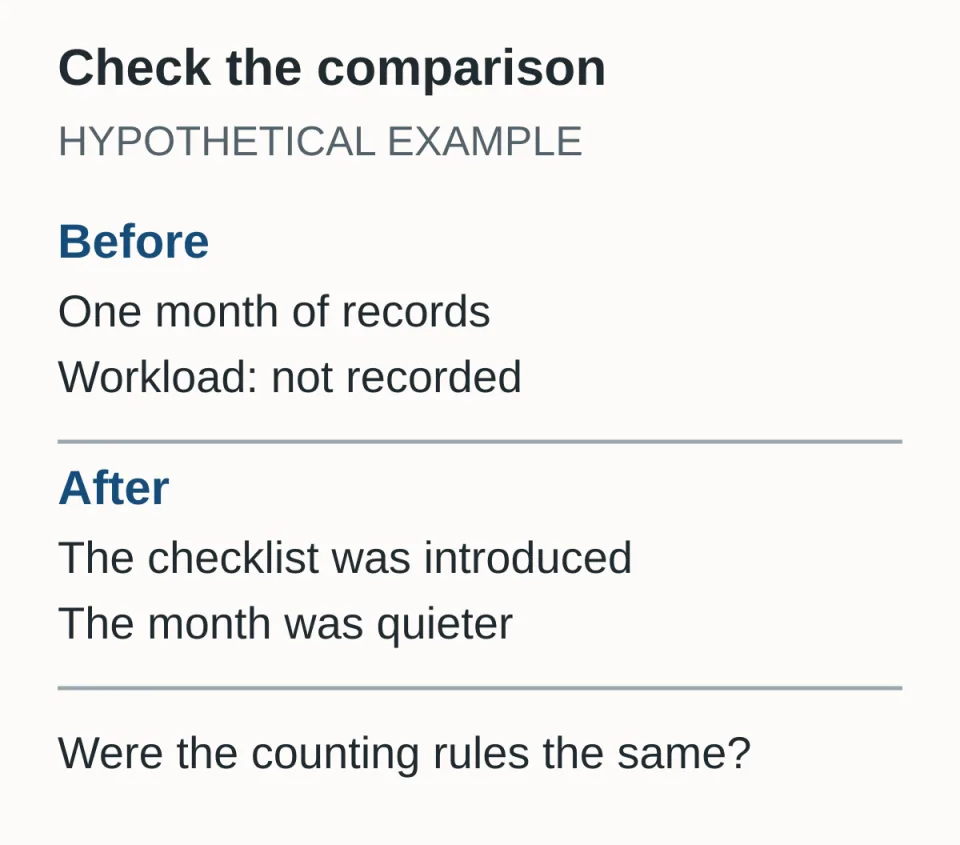
Record the comparison and its gaps before explaining the change. Hypothetical example.
Keep a small claim-check card
The following card is an editorial worksheet filled with hypothetical details. Replace them with facts from your own source. Leave unknowns visible rather than supplying the answer you expect.
Claim-check card: hypothetical checklist example
Check | Illustrative record | What to do with it |
|---|---|---|
Pattern | Fewer corrections were recorded after the checklist began. | Describe the sequence. |
Comparison | One month before and one after; no comparison group reported. | Call it a before-and-after record. |
Other change | The later month was quieter. | Check workload before comparing totals. |
Missing detail | The count of reviewed items is absent. | Do not invent a correction rate. |
Next question | Were reviewers and counting rules the same? | Look for the relevant methods detail. |
On a narrow screen, scroll the table horizontally.
Match the sentence to the evidence
A careful sentence can still be useful: “Fewer corrections were recorded after the checklist was introduced, but the available notes do not establish why.” It tells the reader what changed without pretending the explanation is settled.
Choose the verb deliberately. “Occurred after” describes timing. “Was associated with” describes a relationship. “Caused” and “reduced” make stronger claims. Avoid using cautious words in the body while leaving an unsupported causal claim in the title or image caption.
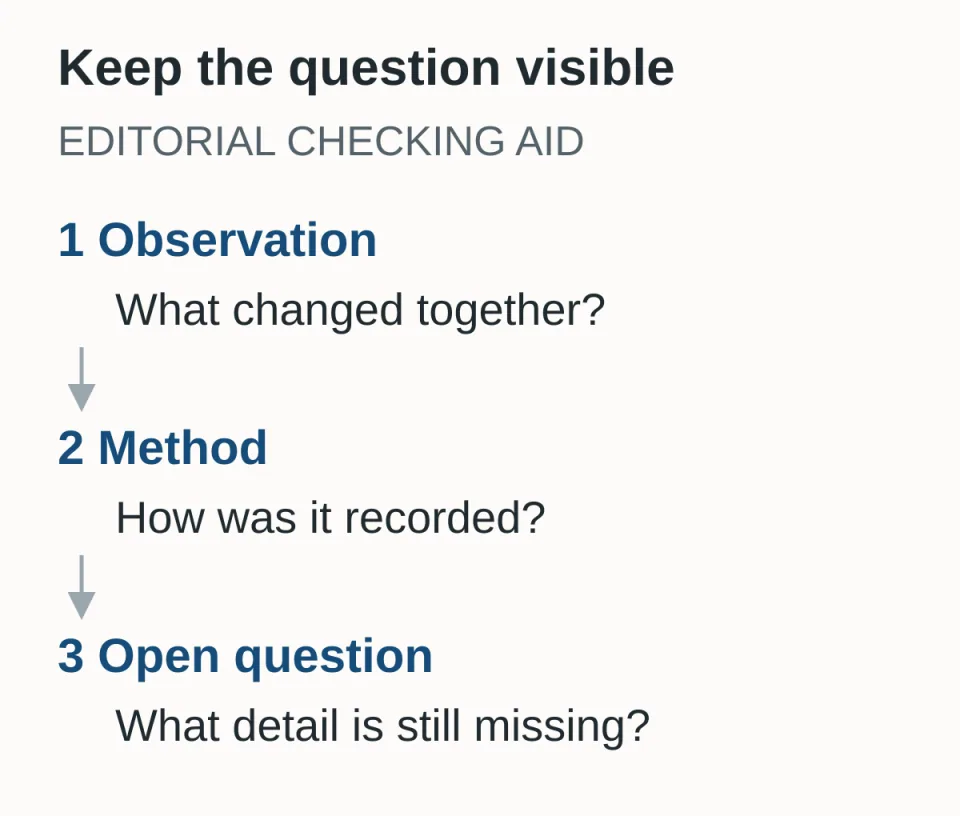
Keep the observation, method, and open question together.
End with the question that matters next
Ask which missing detail would most change your interpretation. For this example, comparable workload and counting rules are sensible places to start. A polished chart or a second article repeating the same numbers would not answer those questions.
This small card is a way to keep your notes honest, not a complete method for causal inference. Observational research can contribute to causal explanations, and an experiment still needs careful assessment. The immediate task is simpler: preserve what the source shows, distinguish it from what you think it means, and make the remaining uncertainty easy to see.
Source notes
- Carl T. Bergstrom and Jevin D. West, Calling Bullshit, Random House. Read: publisher Book Description and format dates only; full book not read. Framing, not independent evidence for the worksheet. Checked 24 October 2026 UTC / 25 October KST.
- Australian Bureau of Statistics, Correlation and causation, released 2 February 2023. Read: definitions and the distinction between correlation and cause/effect. Explanatory guidance, not an analysis of this invented example. Checked 24 October 2026 UTC / 25 October KST.
All diagrams are original editorial SVG illustrations. Examples are fictional where marked. No use test, outcome measurement, or venue assessment is implied.
Evidence and scope
1. Correlation and causation — Australian Bureau of Statistics
Claim covered: The Australian Bureau of Statistics explains that correlation describes a relationship, while causation concerns one event bringing about another. A correlation does not automatically establish a cause.2 If nobody has calculated a correlation, “an observed pattern” may be the more accurate description.
Correlation describes association and does not automatically establish causation.
Correlation and causation — Australian Bureau of Statistics. English edition; source jurisdiction as stated. Checked: .
Explanatory guidance, not analysis of the article’s hypothetical example.
2. Editorial application
Claim covered: When two things change together, start by saying what you observed. A shared pattern alone does not show that one change caused the other. Before writing “because,” check how the information was collected, what was compared, and what else changed. If those details are missing, keep the wording modest and record the question you still need answered.
TidyNot practical application, separated from the original source’s claims.
TidyNot editorial suggestion. English edition. Checked: .
Explanatory guidance, not analysis of the article’s hypothetical example.