To choose audio for a reading task, check what you can explain from the text as well as whether you like the sound. For one noncritical passage, record the audio setting, answer a few checkable questions, and note any interruptions. That gives you a practical choice for the next passage without pretending to discover your permanent ideal soundtrack.
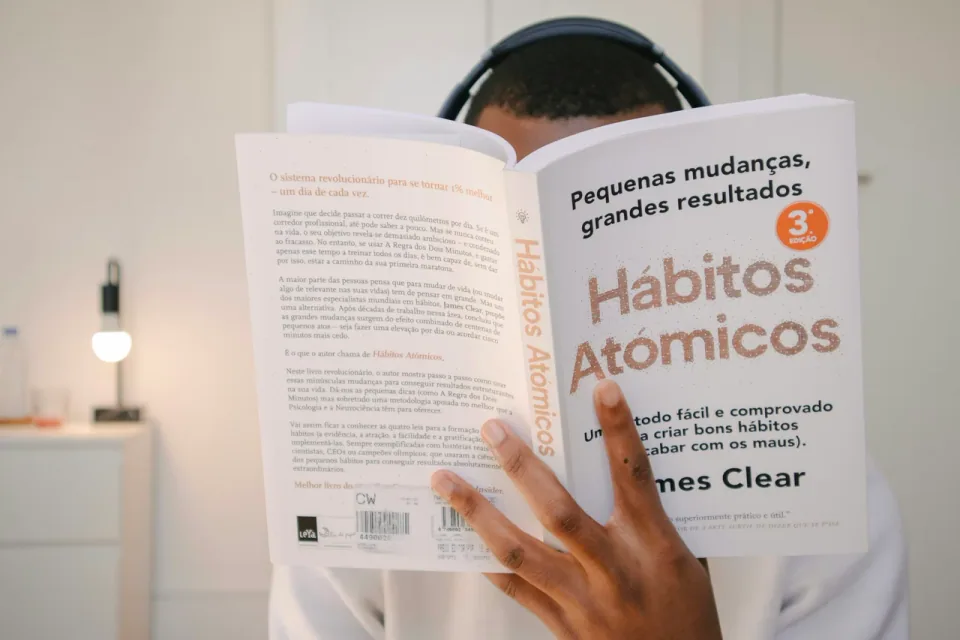
Define what this reading needs to accomplish
Choose a short piece whose meaning you can check, such as a hobby guide or explanatory article. Write the specific job: “Explain the author’s main claim and its two stated reasons.” Avoid using an important safety, legal, or medical decision as a casual audio comparison.
Before reading, prepare two or three questions from headings or existing review prompts. Keep the answers out of view during the check. Questions should require something identifiable in the passage, not simply “Did I understand it?”
If you are reading for pleasure, enjoyment may be the main purpose. You do not need to turn every novel into a scored exercise. This card is for occasions when understanding particular information matters and you want a more concrete basis for choosing your setting.
Describe the sound you actually have
On a small card, write the passage, purpose, audio, background interruptions, answer check, preference, and next choice. Describe the audio plainly: no added audio, instrumental track, song with lyrics, or spoken content. Note whether nearby conversation or other sound remains.
If lyrics keep drawing your attention away from the words, try an available quieter setting or instrumental option. You do not need a new subscription, specialist playlist, or perfect silent room. Choose something you can use without interfering with responsibilities or awareness of your surroundings.
In Souza and Barbosa’s study, college students completed a reading-comprehension task under silence, instrumental music, and music with lyrics. Reading accuracy was higher in the instrumental than the lyrical condition; instrumental music did not show a credible benefit over silence. 1 This does not establish that every instrumental track helps or that silence always wins.
An earlier meta-analysis found small average reading costs from background sound, with intelligible speech and lyrical music among the more distracting conditions. That broader pattern supports checking the task, not prescribing one soundtrack for everyone. 2
Check meaning separately from enjoyment
Read the selected passage in your chosen setting. Then look away from it and answer the prepared questions in your own words. Reopen the passage and compare each response with the relevant sentence or section. Mark missing conditions, unsupported claims, or details you confused.
Keep the preference entry separate: “liked the music” is a valid observation, but it is not the same result as “identified both reasons accurately.” Conversely, disliking a setting does not by itself show that comprehension was worse.
An invented card entry might say: “Setting: familiar song with lyrics. Check: main claim accurate; one reason missing. Preference: enjoyable. Interruption: delivery at the door. Next choice: finish the remaining passage without added audio and check that reason again.” The entry supports a practical next step, not a conclusion about what caused the missing answer.
Make a modest choice instead of declaring a winner
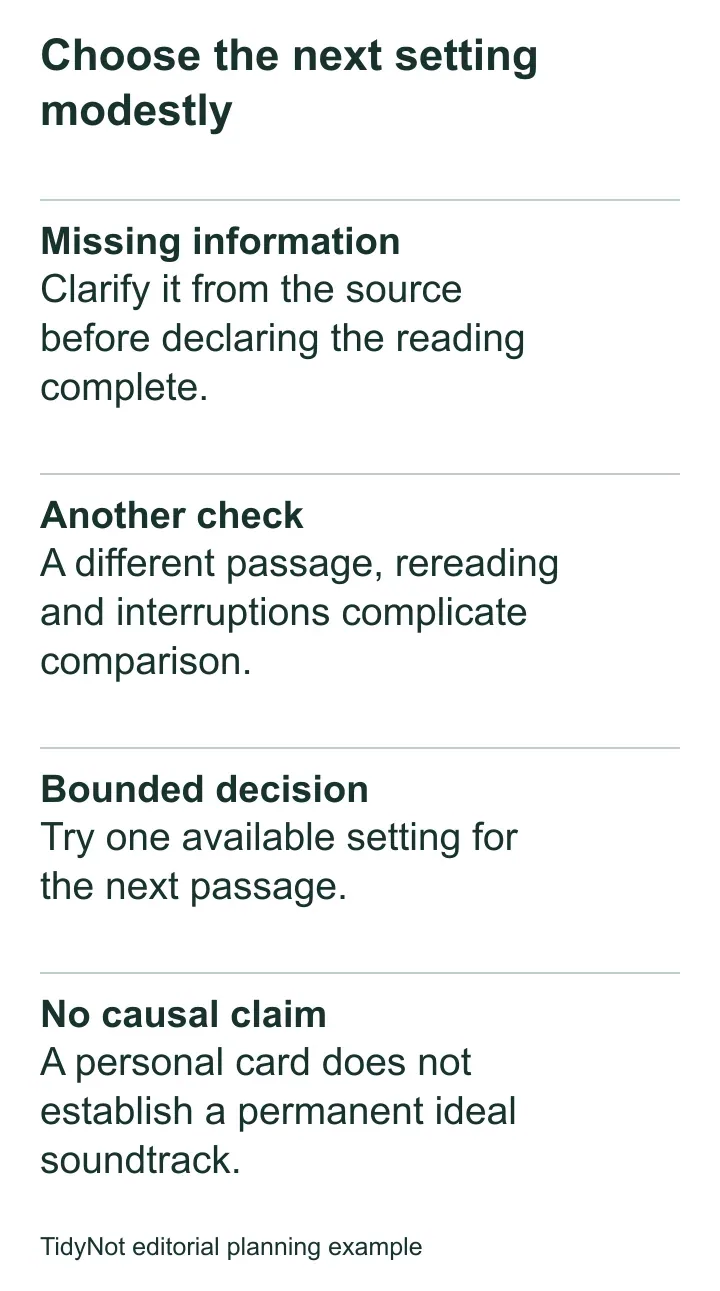
If you try another setting, record it as another observation. Different passages have different difficulty, and rereading the same passage gives you prior exposure. Changes in tiredness, interruptions, and the music itself also complicate comparison. Two personal checks are not a controlled experiment.
If you miss something important, clarify it from the source before moving on. Changing the soundtrack does not complete that reading task. You can keep the selected setting while admitting that you still need another explanation or a slower pass through the material.
Choose the next available setting using both the task requirements and what you observed. Write a bounded decision such as “For the next dense section, try no added audio.” Avoid “I can only learn in silence” or “lo-fi improves my memory.” The study used particular tasks and audio, and this card is an editorial tool, not a validated personal test. 1
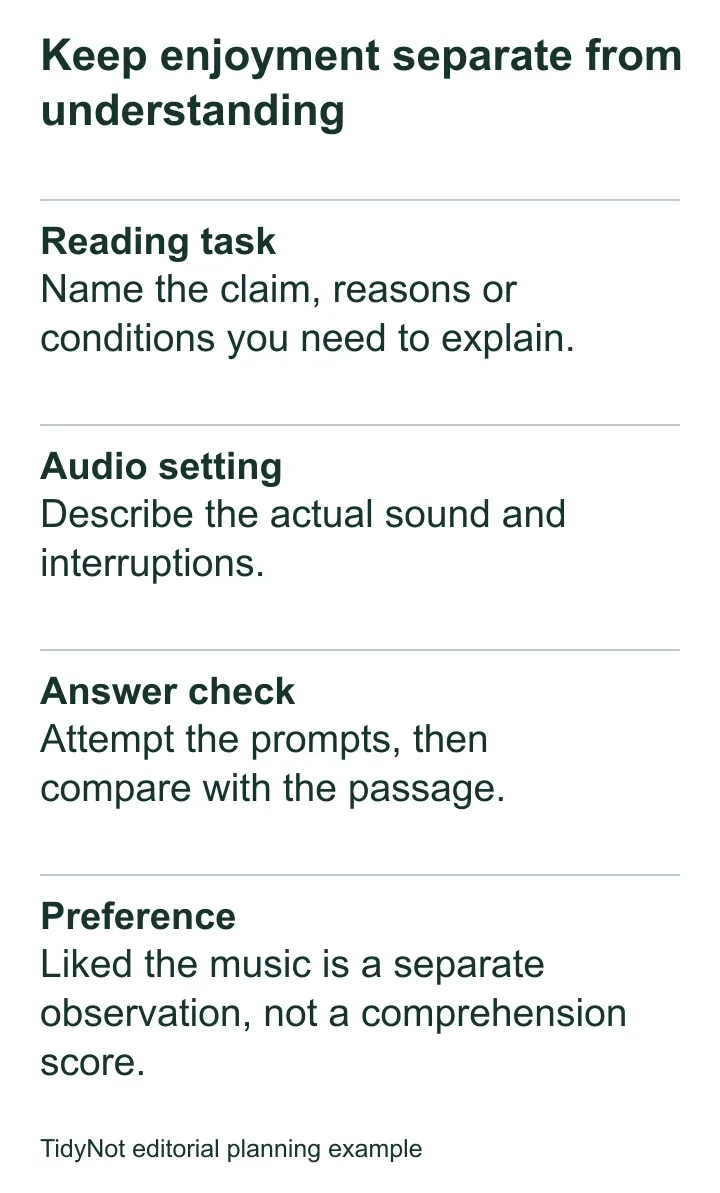
A simple check sheet
Keep separate | What to write |
|---|---|
Setting | Actual audio and interruptions |
Understanding | Answers checked against the passage |
Preference | Whether you liked the sound |
Next choice | One setting for the next passage, not a causal verdict |
Music while reading: quick answers
Is instrumental music proven better than silence?
Not by the cited study. Its reading results favored instrumental over lyrical music, while the instrumental-versus-silence benefit was not credible. A preferred soundtrack and a demonstrated comprehension benefit are different claims. 1
What can one personal reading check tell me?
It can guide a modest next choice for that passage. It does not isolate a cause or establish your permanent learning style. Check answers against the text, keep preference separate, and record interruptions.
What else should I record about headphones?
Note the headphones used, whether a noise-canceling setting was on, and which background sounds remained. These are observations to keep alongside the audio entry; changing several conditions at once makes a music-only explanation less defensible. No headphone type is recommended as superior here.
Final check
- State the purpose of one noncritical reading task.
- Record the actual audio and interruptions.
- Check answers against the passage and record enjoyment separately.
- Choose a setting for the next task without claiming a causal result.
When this task is done
You have a completed card linking one audio setting to an actual understanding check and a specific next choice. Missing information in the passage is corrected or explicitly left pending; preference is not substituted for evidence of comprehension.
Sources
- Souza & Barbosa (2023), Should We Turn off the Music? Music with Lyrics Interferes with Cognitive Tasks. Checked 2026-10-22. Original within-participant study of music conditions with college students; reading task materials, reading accuracy comparisons, subjective ratings, and discussion of instrumental-versus-silence limits. Particular audio and task conditions limit generalization. Lyrical and instrumental tracks differed beyond the presence of speech. No credible instrumental benefit is not proof of exact equivalence. Casual personal comparisons cannot establish causation.
- Vasilev, Kirkby & Angele (2018), Auditory Distraction During Reading: A Bayesian Meta-Analysis of a Continuing Controversy. Checked 2026-11-01 KST. Abstract and opening scope read from the authors’ university repository. Research synthesis, not validation of this personal reading card; no individual benefit is guaranteed.
Evidence and scope
1. journalofcognition.org — editor-verified original source
Claim covered: In Souza and Barbosa’s study, college students completed a reading-comprehension task under silence, instrumental music, and music with lyrics. Reading accuracy was higher in the instrumental than the lyrical condition; instrumental music did not show a credible benefit over silence. 1 This does not establish that every instrumental track helps or that silence always wins.
Instrumental reading accuracy was higher than lyrical accuracy; an instrumental benefit over silence was not credible. Audio conditions differed, so the personal card does not isolate causation.
journalofcognition.org — editor-verified original source. Use only the locale/version and evidence scope stated in the manuscript and source notes.. Checked: .
2. eprints.bournemouth.ac.uk — editor-verified original source
Claim covered: An earlier meta-analysis found small average reading costs from background sound, with intelligible speech and lyrical music among the more distracting conditions. That broader pattern supports checking the task, not prescribing one soundtrack for everyone. 2
The meta-analysis reports small average negative reading-comprehension effects from background sound. It does not validate this editorial personal reading card.
eprints.bournemouth.ac.uk — editor-verified original source. Use only the locale/version and evidence scope stated in the manuscript and source notes.. Checked: .
3. journalofcognition.org — editor-verified original source
Claim covered: Choose the next available setting using both the task requirements and what you observed. Write a bounded decision such as “For the next dense section, try no added audio.” Avoid “I can only learn in silence” or “lo-fi improves my memory.” The study used particular tasks and audio, and this card is an editorial tool, not a validated personal test. 1
Instrumental reading accuracy was higher than lyrical accuracy; an instrumental benefit over silence was not credible. Audio conditions differed, so the personal card does not isolate causation.
journalofcognition.org — editor-verified original source. Use only the locale/version and evidence scope stated in the manuscript and source notes.. Checked: .
4. journalofcognition.org — editor-verified original source
Claim covered: Not by the cited study. Its reading results favored instrumental over lyrical music, while the instrumental-versus-silence benefit was not credible. A preferred soundtrack and a demonstrated comprehension benefit are different claims. 1
Instrumental reading accuracy was higher than lyrical accuracy; an instrumental benefit over silence was not credible. Audio conditions differed, so the personal card does not isolate causation.
journalofcognition.org — editor-verified original source. Use only the locale/version and evidence scope stated in the manuscript and source notes.. Checked: .
5. journalofcognition.org — editor-verified original source
Claim covered: Souza & Barbosa (2023), Should We Turn off the Music? Music with Lyrics Interferes with Cognitive Tasks. Checked 2026-10-22. Original within-participant study of music conditions with college students; reading task materials, reading accuracy comparisons, subjective ratings, and discussion of instrumental-versus-silence limits. Particular audio and task conditions limit generalization. Lyrical and instrumental tracks differed beyond the presence of speech. No credible instrumental benefit is not proof of exact equivalence. Casual personal comparisons cannot establish causation.
Instrumental reading accuracy was higher than lyrical accuracy; an instrumental benefit over silence was not credible. Audio conditions differed, so the personal card does not isolate causation.
journalofcognition.org — editor-verified original source. Use only the locale/version and evidence scope stated in the manuscript and source notes.. Checked: .
6. eprints.bournemouth.ac.uk — editor-verified original source
Claim covered: Vasilev, Kirkby & Angele (2018), Auditory Distraction During Reading: A Bayesian Meta-Analysis of a Continuing Controversy. Checked 2026-11-01 KST. Abstract and opening scope read from the authors’ university repository. Research synthesis, not validation of this personal reading card; no individual benefit is guaranteed.
The meta-analysis reports small average negative reading-comprehension effects from background sound. It does not validate this editorial personal reading card.
eprints.bournemouth.ac.uk — editor-verified original source. Use only the locale/version and evidence scope stated in the manuscript and source notes.. Checked: .
7. Editorial application
Claim covered: TidyNot practical checklist, examples and step sequence.
Practical editorial suggestions distinguished from sourced factual claims.
TidyNot editorial suggestion. General readers within the manuscript stated scope.. Checked: .
No personal test, measured benefit, provider implementation or safety guarantee is claimed.