Before turning a research-backed productivity tip into a standing rule, open the cited paper’s current publisher page. Look for notices and later studies that address the same claim. A familiar title or a much-shared summary can outlast a change in the evidence.
A deadline study offers a concrete example. In September 2026, Psychological Science published a retraction notice for Ariely and Wertenbroch’s 2002 paper on procrastination, deadlines and performance. The notice cites reliability concerns and says both authors agreed to the retraction.[Q59]
Separate a notice from a new experiment
The notice establishes the original paper’s publication status. It is a different kind of document from a study testing a result. In a 2026 replication, Kyle Hyndman and Alberto Bisin reported that they did not reproduce Study 2’s findings in a proofreading task with adult participants at a US public university.[S43]
Those documents do not provide two independent positive demonstrations that a deadline technique works. They also do not establish that every deadline is ineffective. Keep the precise task and the reported result attached to the claim you are checking.
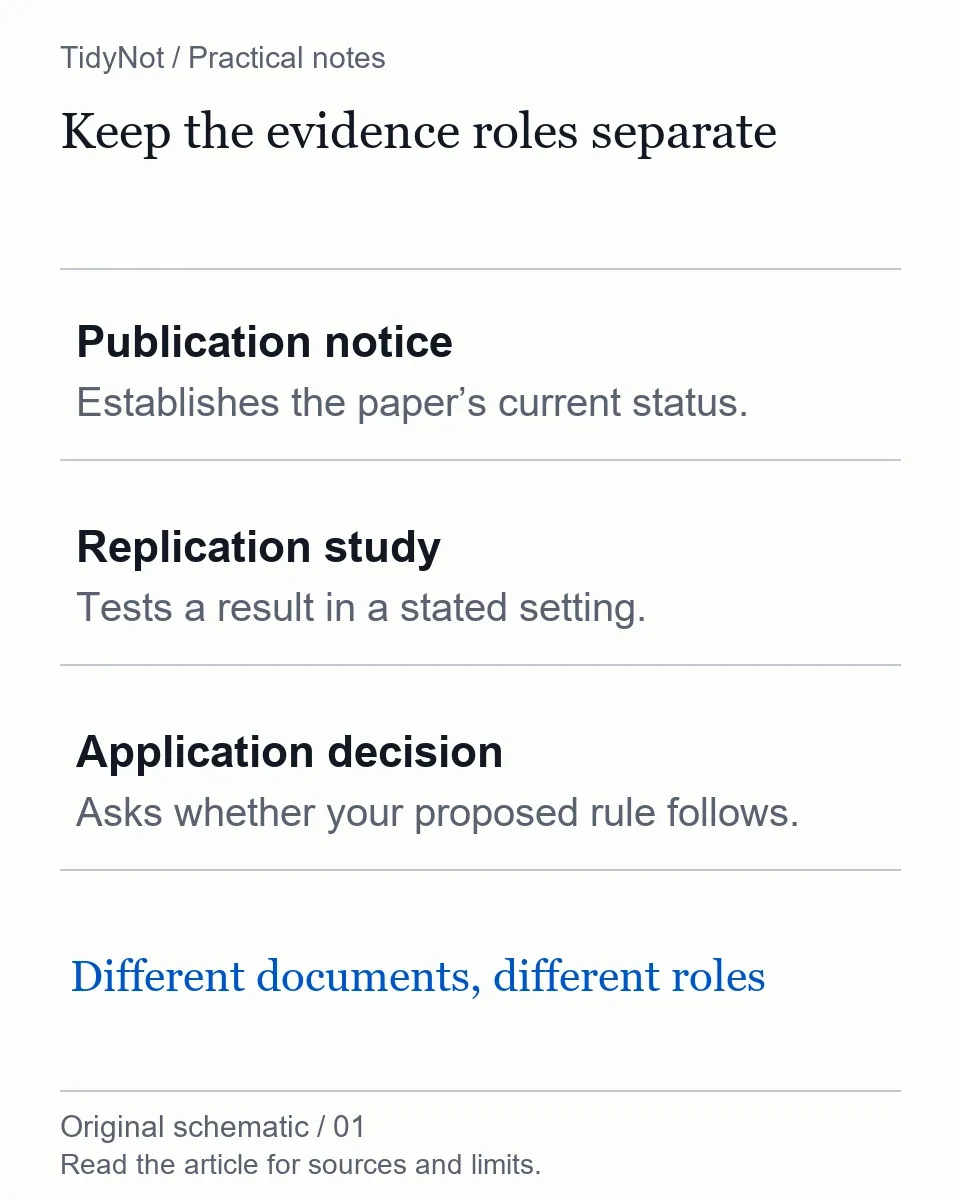
Keep the evidence roles separate. Original TidyNot schematic.
Separate the original claim, current publication status, replication and proposed application.
Question | Record | What it can establish |
|---|---|---|
Is the original article still current? | Publisher notice and date | Publication status |
What did later researchers test? | Task, participants and reported result | Evidence within that study’s scope |
Does this justify my rule? | Your setting and the missing comparison | An application decision, not a new finding |
Make an evidence note you can revisit
For one tip you are considering, save its exact claim in your own words and the source it relies on. Add the current notice, any relevant replication and the date you checked. If you have read only an abstract, say so. A missing method or inaccessible paper is a gap to resolve before making a strong research claim.
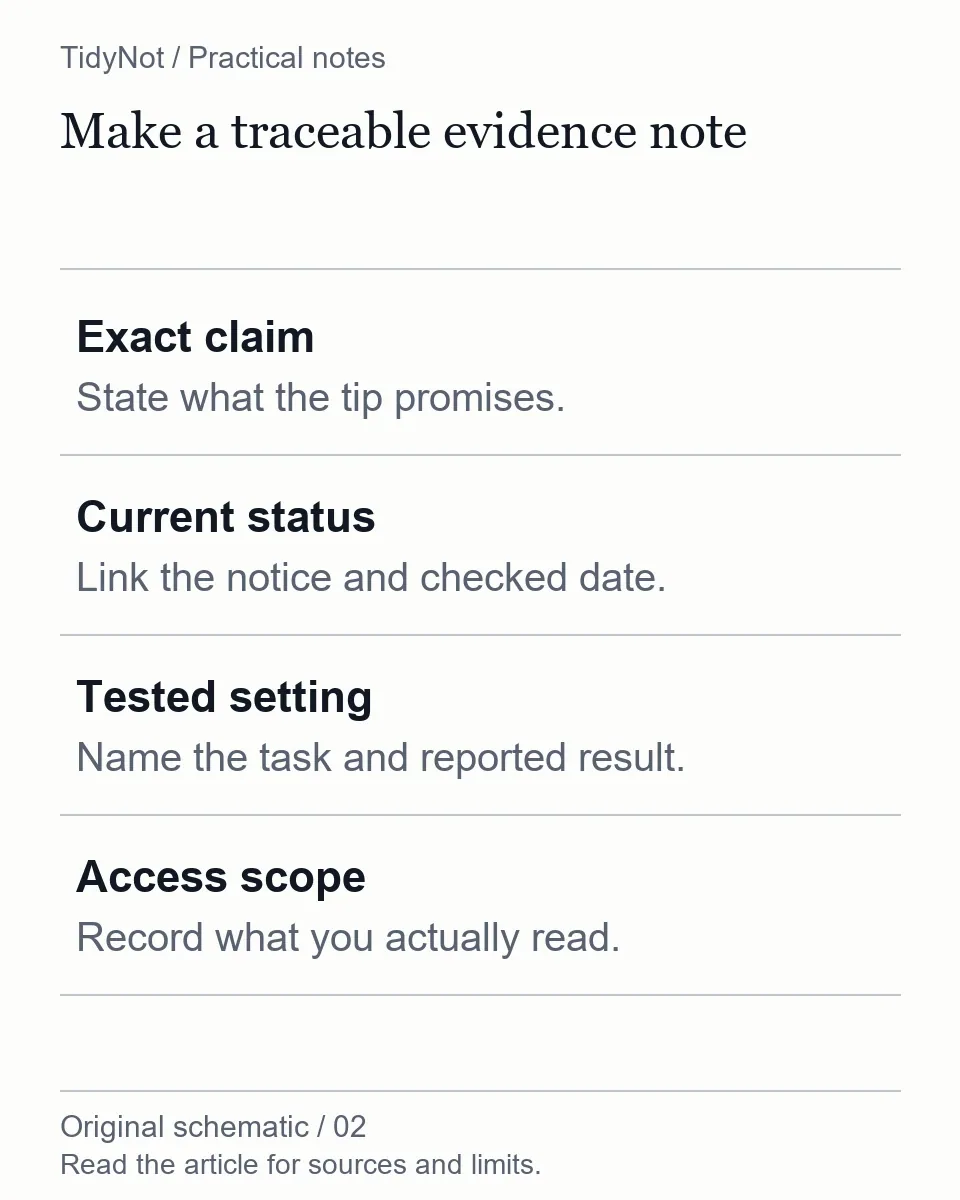
Make a traceable evidence note. Original TidyNot schematic.
Then write your practical question separately. Perhaps a team needs a handover date so another person can begin. That scheduling need can be explained directly. It does not require presenting a disputed psychological effect as settled evidence.
Update the wording where the tip is used
Search your own guide or notes for the old claim. Replace an unsupported promise with a statement of the actual arrangement and its reason. For example: "We agreed on this handover date because the next reviewer needs the file." This is an illustrative wording choice, not a result from the studies.
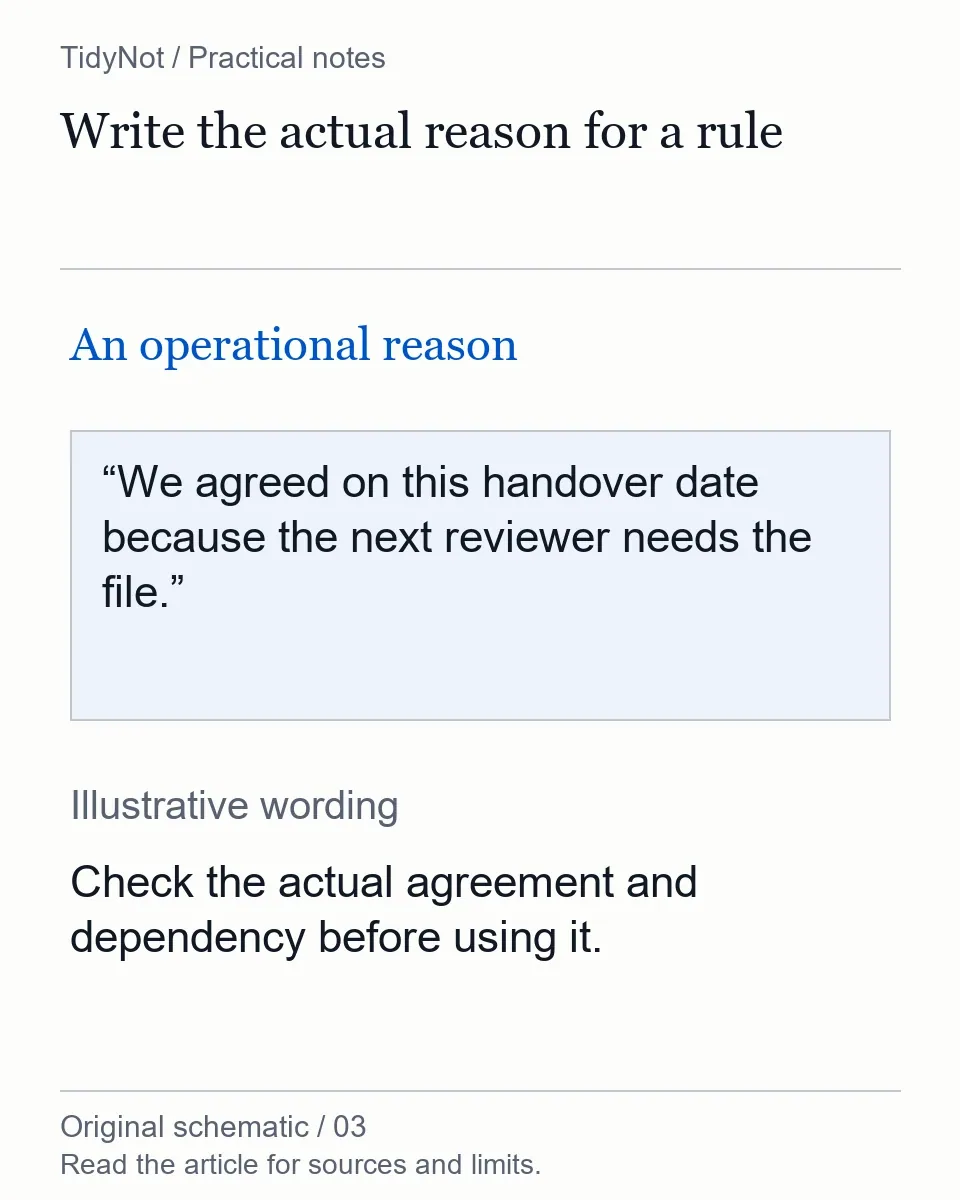
Write the actual reason for a rule. Original TidyNot schematic.
Keep the status check with the advice so the next editor can find it. If a later correction or relevant study appears, review the recommendation against that material before repeating the original claim.
Try it with your own information
Record the status behind a research claim
Separate what a study investigated from whether its current record supports repeating the claim.
An invented worked example
Use this scenario to see how the decisions fit together, then replace its details with your own observations.
Claim to assess: “This method always improves performance.” First record which population, task and comparison the source actually examined.
If a publisher marks an article retracted, keep that status beside the citation. A later article repeating it is not a new independent experiment.
If only an abstract was readable, write “abstract only” and leave questions about the full method open. Do not turn limited access into a full-paper review.
No account needed. Open the worksheet, enter your own notes, then download a text copy. You can also download it blank to complete elsewhere.
Open and download your worksheet
Sources and reading scope
- Kyle Hyndman and Alberto Bisin. Replication of “Procrastination, Deadlines, and Performance: Self-Control by Precommitment”. Psychological Science; 2026-07-15 first online. https://journals.sagepub.com/doi/10.1177/09567976261460772. Original publisher abstract and introduction checked on 2026-10-24. Replication of a proofreading task; not a finding about all deadlines.
- Psychological Science, journal notice. Retraction: Procrastination, Deadlines, and Performance: Self-Control by Precommitment. Psychological Science 37(9), 665; 2026-09-02 online. https://journals.sagepub.com/doi/full/10.1177/09567976261488042. Formal publisher retraction notice, date, target article and authors’ agreement read. Establishes publication status. It is not another independent experiment or a finding about all deadlines.
Evidence and scope
1. Retraction: Procrastination, Deadlines, and Performance: Self-Control by Precommitment
Claim covered: A deadline study offers a concrete example. In September 2026, Psychological Science published a retraction notice for Ariely and Wertenbroch’s 2002 paper on procrastination, deadlines and performance. The notice cites reliability concerns and says both authors agreed to the retraction.[Q59]
Formal publisher retraction notice, date, target article and authors’ agreement read.
Retraction: Procrastination, Deadlines, and Performance: Self-Control by Precommitment. English edition. Checked: .
Establishes publication status. It is not another independent experiment or a finding about all deadlines.
2. Replication of “Procrastination, Deadlines, and Performance: Self-Control by Precommitment”
Claim covered: The notice establishes the original paper’s publication status. It is a different kind of document from a study testing a result. In a 2026 replication, Kyle Hyndman and Alberto Bisin reported that they did not reproduce Study 2’s findings in a proofreading task with adult participants at a US public university.[S43]
Original publisher abstract and introduction checked on 2026-10-24. Replication of a proofreading task; not a finding about all deadlines.
Replication of “Procrastination, Deadlines, and Performance: Self-Control by Precommitment”. English edition. Checked: .
Replication of Study 2’s proofreading setting, not a test of every kind of deadline. The DOI redirect failed; the canonical publisher page worked.
3. Editorial application
Claim covered: Before turning a research-backed productivity tip into a standing rule, open the cited paper’s current publisher page. Look for notices and later studies that address the same claim. A familiar title or a much-shared summary can outlast a change in the evidence.
TidyNot editorial workflow suggestion, distinguished from the linked source statements.
TidyNot editorial suggestion. English edition. Checked: .
An editorial application, not a tested intervention or a guarantee of results.