
AI-generated editorial illustration; not a photograph of an actual event.
Make a request someone can answer
“Keep me accountable” can mean anything from receiving a weekly message to chasing every missed session. Instead, ask whether the person wants to receive a particular update for an agreed period. Give them room to decline or suggest something smaller. An enthusiastic conversation is not yet agreement on the details.
Gretchen Rubin includes accountability in her public habit-strategy overview.1 It is one author’s framework, not evidence that every person needs a partner or the same kind of pressure.
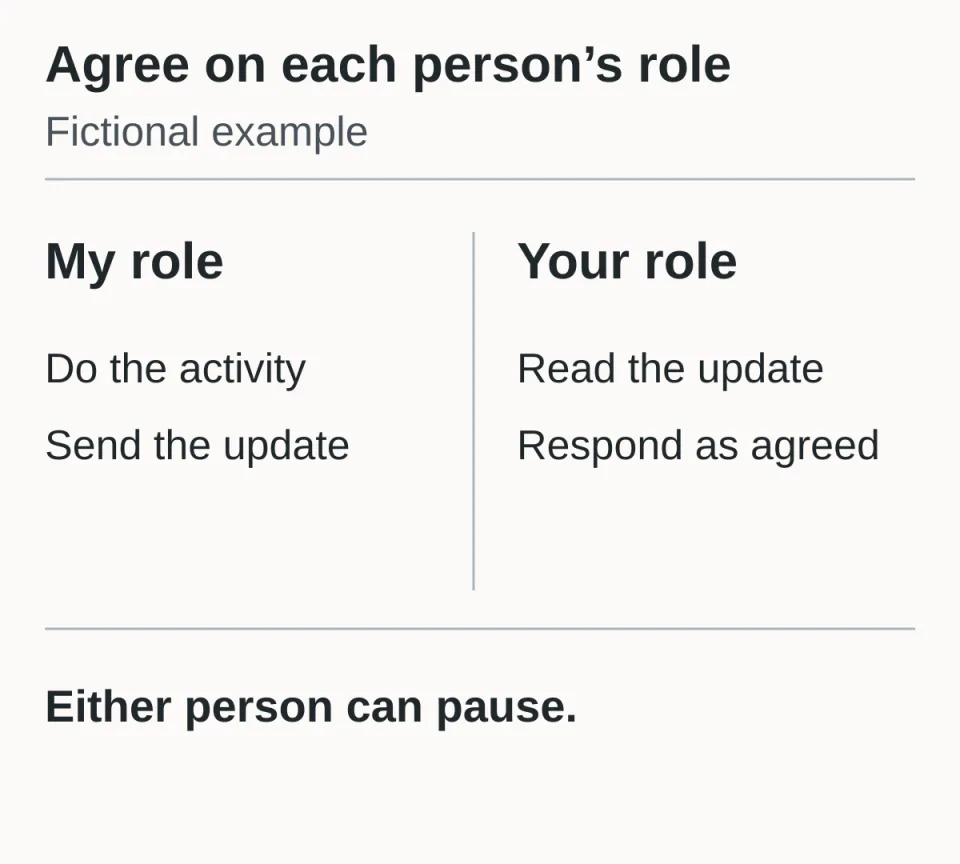
Agree on the roles before the first check-in. Illustrative arrangement.
Choose an update, not a performance
Start with something you can report honestly. For two planned reading sessions, “one completed” says more than “I was good this week.” Allow “not done” and “the plan changed” as useful information. Avoid requiring proof, screenshots, or private details unless both people genuinely want that arrangement.
A meta-analysis of goal-progress monitoring reports stronger effects in studies involving recorded progress and reported or public outcomes.2 That finding does not identify the best partner or cadence for you, and it does not justify unwanted monitoring. The agreement below is an editorial example, not a protocol tested by that study.
Part | Illustrative agreement | Boundary |
|---|---|---|
Activity | Two 20-minute reading sessions this week. | I choose and do the activity. |
Update | Send a short Friday progress message. | “Not done” is an acceptable report. |
Response | Acknowledge it and ask what I want to try next. | Advice is optional, not automatic. |
Missing update | One Saturday reminder is welcome. | No repeated chasing or public call-out. |
Privacy | Keep the update between us. | No forwarding or public scoreboard. |
Review | Try it for two weeks, then discuss. | Either person may stop sooner. |
Fictional agreement. The duration, frequency, and trial length are choices in the example, not research-established recommendations.
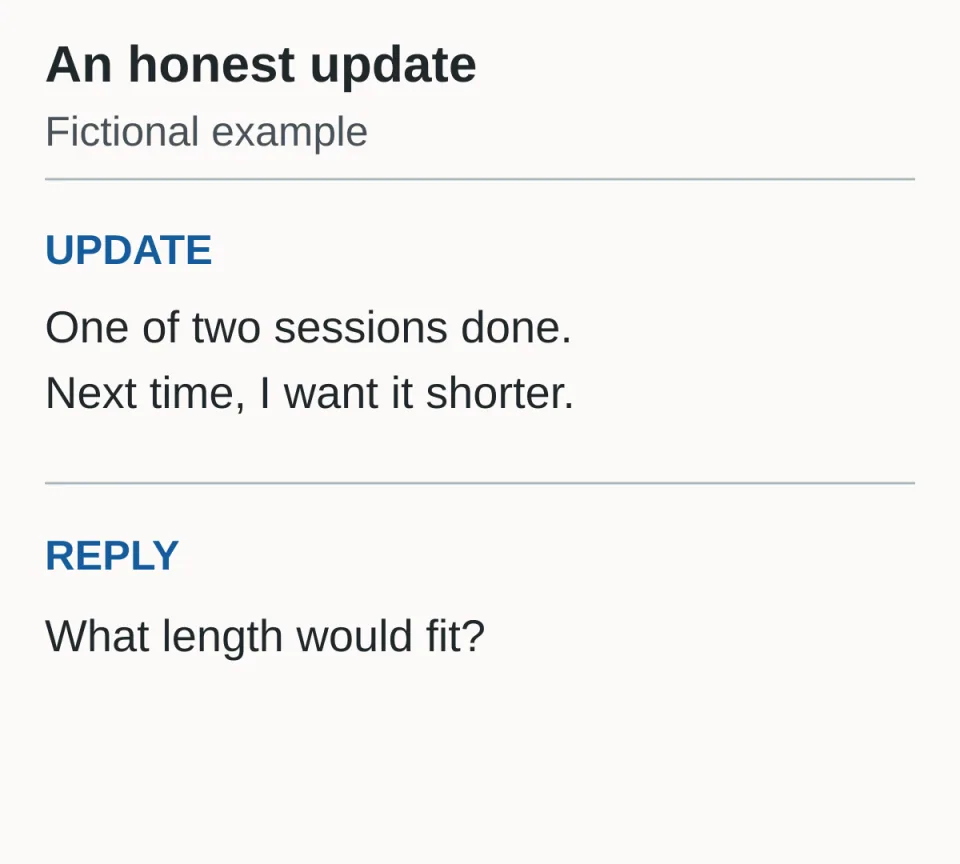
An honest report can lead to a smaller next step. Fictional exchange.
Decide what happens after silence
A missed update tells you only that the update did not arrive. It does not establish whether the activity happened or why someone was unavailable. Agree in advance whether a reminder is welcome and how many. Without that agreement, do not assume that silence calls for escalating contact.
The receiving person also needs limits. They may be happy to read a message but unable to respond immediately. Say whether a delayed reply is fine and whether the sender should continue without it. Do not make one person’s next action depend on a response the other person never promised.
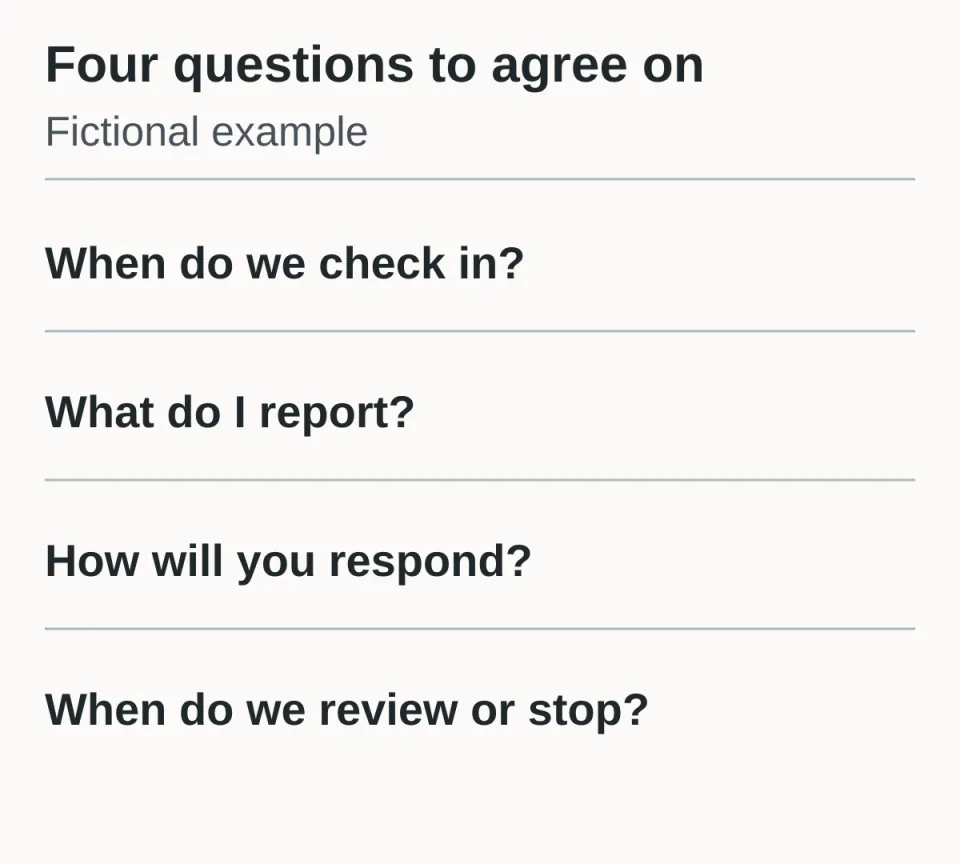
Keep four practical questions easy to find.
Review the arrangement itself
After the agreed trial, ask whether the exchange is useful and manageable for both people. Perhaps the report needs to be shorter, the activity needs to change, or the arrangement should end. Keep that conversation separate from judging the person’s character.
Before starting, finish one sentence together: “I will do and report ___; you are agreeing to ___.” If the second half keeps expanding into supervision, penalties, or rescuing the task, return to the smallest role both people actually want.
Sources and reading scope
Checked October 25, 2026, Asia/Seoul (October 24 UTC).
- Gretchen Rubin, “The 21 Strategies for Habit Formation,” July 9, 2014. Read the author overview and publisher description of Better Than Before; full book not read. The author article was current in retrieval; publisher crawl was four days earlier.
- Harkin et al., Psychological Bulletin 142(2), 2016; online October 19, 2015. Read the abstract and bibliography only. No partner-specific or frequency-specific recommendation is claimed.
Current recheck: the PubMed extraction was incomplete; the same paper’s abstract and bibliographic header were checked in the official APA PDF. Full paper not reviewed in this recheck.
Evidence and scope
1. The 21 Strategies for Habit Formation — Gretchen Rubin
Claim covered: Gretchen Rubin includes accountability in her public habit-strategy overview.1 It is one author’s framework, not evidence that every person needs a partner or the same kind of pressure.
The author explicitly includes accountability in her public habit-strategy overview.
The 21 Strategies for Habit Formation — Gretchen Rubin. English edition; source jurisdiction as stated. Checked: .
Author framework, not evidence of universal benefit or consent to monitoring; the article’s meta-analysis reference retains its previously recorded abstract-only scope.
2. Editorial application
Claim covered: An accountability check-in is easier to agree to when both people know what it involves. Say what you plan to do, what update you will send, and what response would help. Decide together whether reminders are welcome, what stays private, and how to pause or stop. You remain responsible for the activity; the other person takes on only the role they have agreed to.
TidyNot practical application, separated from the original source’s claims.
TidyNot editorial suggestion. English edition. Checked: .
Author framework, not evidence of universal benefit or consent to monitoring; the article’s meta-analysis reference retains its previously recorded abstract-only scope.