Write down the person, the specific response you need and when you will check the item again. Record an agreed deadline in a separate field; if none was agreed, leave it unknown. This keeps your reminder to follow up from looking like a promise the other person made. A reply closes the item only when it supplies the information or action you were waiting for.
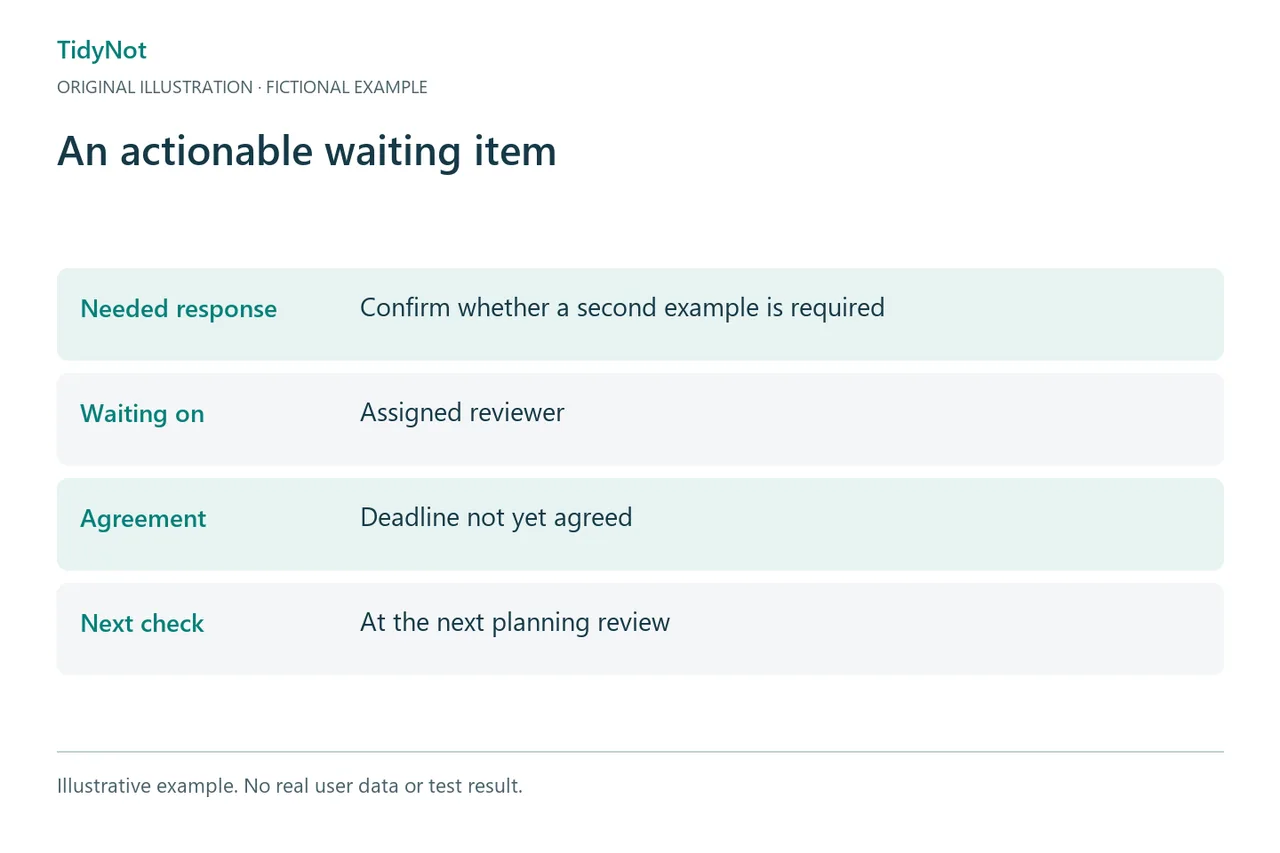
Fictional example. The next check does not become the reviewer’s deadline.
Name the response that would move the work
"Waiting for Alex" is difficult to act on. In a fictional project, a clearer entry is "Waiting for the reviewer to confirm whether the draft needs a second example." The person and the needed response belong together. If the work depends on an event instead of a person, describe the event and the evidence that would show it happened.
GTD’s waiting-for advice treats these open commitments as items worth tracking. Personal Kanban offers a separate practitioner perspective on making the state of work visible. Neither framework establishes that the fields proposed here will produce a particular improvement. Source 7.1 Source 7.2
A waiting record with distinct dates
Waiting item | Person or role | Agreed deadline | Your next check | Closure evidence |
|---|---|---|---|---|
Confirmation of a delivery date | Supplier contact | Unknown until agreed | Chosen follow-up date | Explicit date confirmation |
Review of a draft | Assigned reviewer | Only the agreed date | Chosen review check | Review returned or task renegotiated |
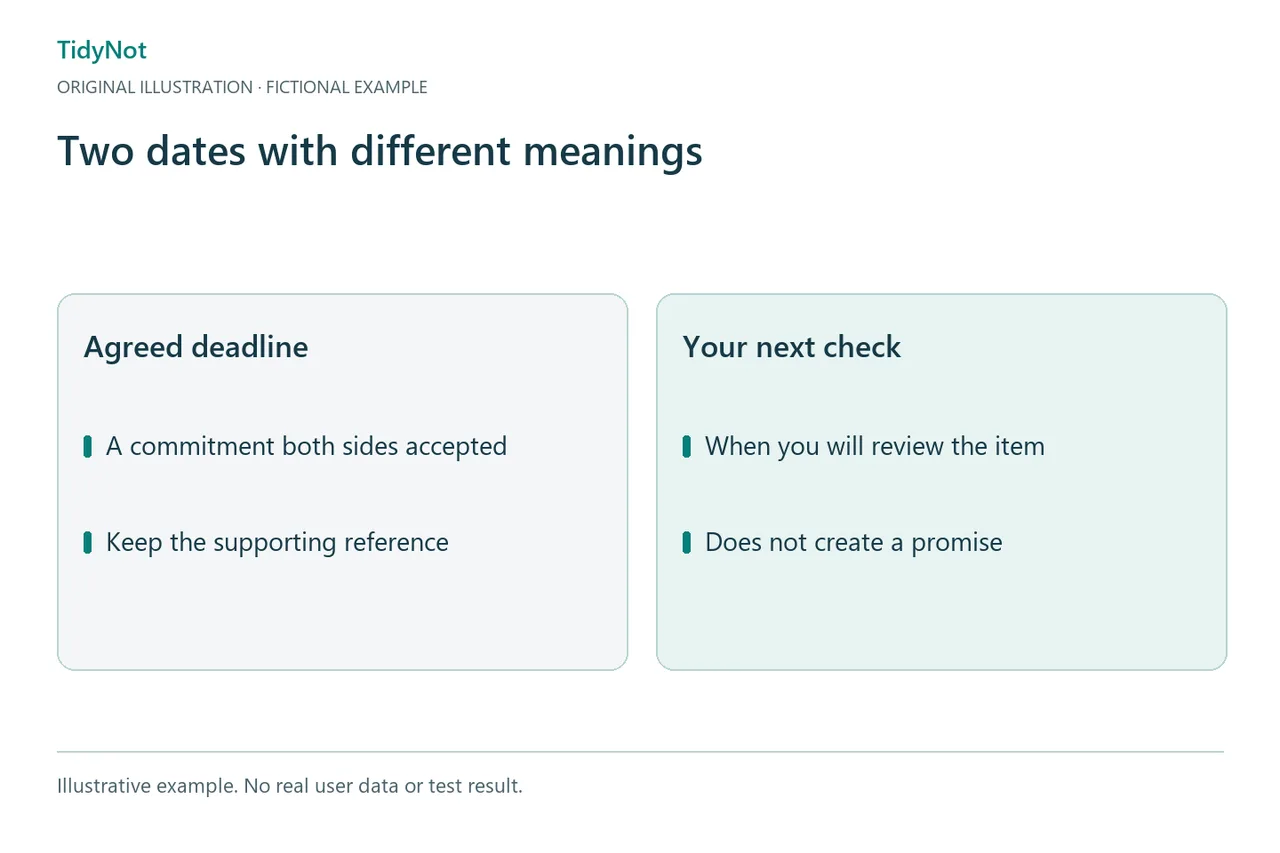
Keep these fields separate even when they happen to fall on the same day.
Keep the two dates honest
An agreed deadline records a commitment. Your next-check date records when you intend to look again. Copying the second into the first gives the other person a deadline they may never have accepted. Leave the commitment unknown until there is evidence of an agreement.
For example, a fictional supplier may have acknowledged a request without giving a delivery date. The entry can say "Delivery date confirmation needed; agreed deadline unknown; check at the next planning review." Link the last relevant request if you have permission to retain it. Avoid copying an entire conversation into a broadly shared list.
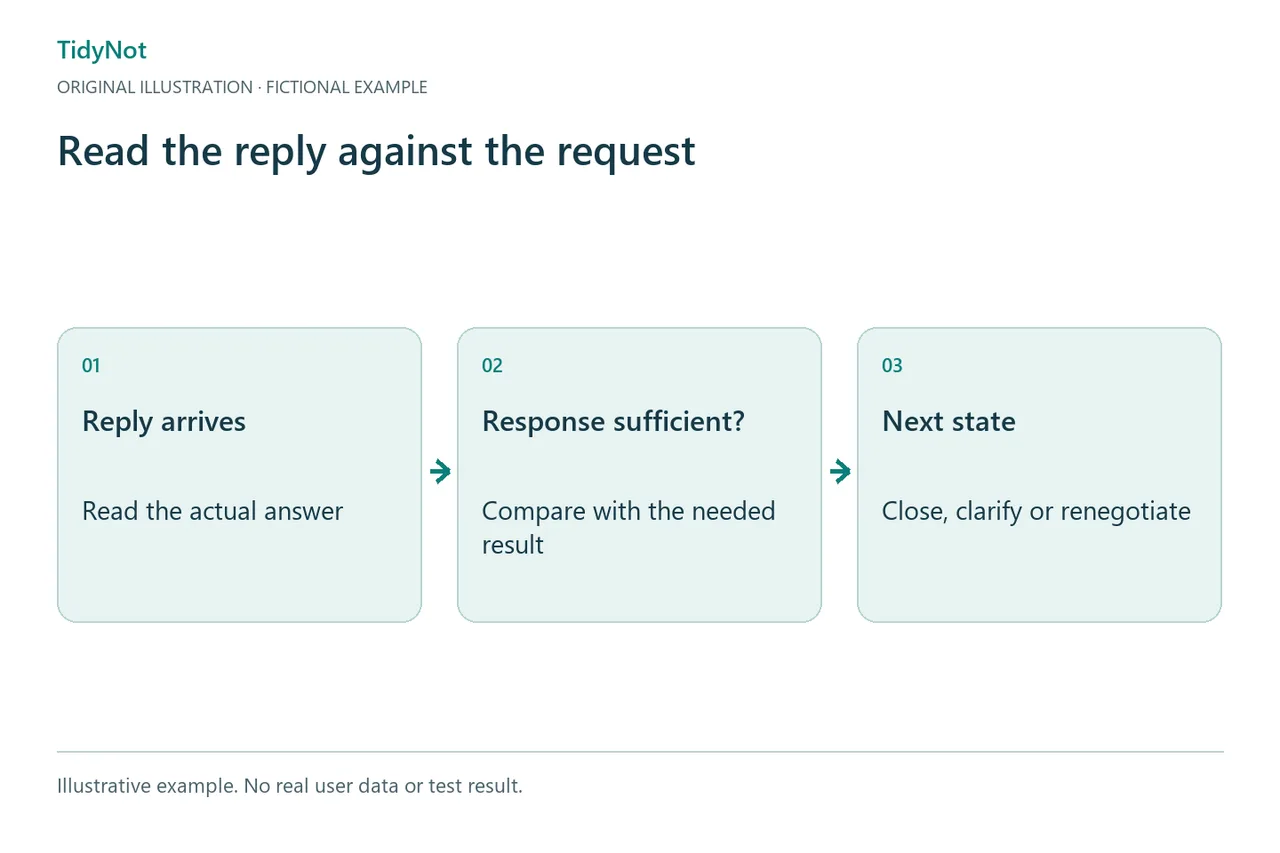
Arrival of a message and resolution of a dependency are separate checks.
Close the waiting item on evidence
When a reply arrives, compare it with what the entry actually asks for. "Received, thanks" may acknowledge the request without supplying the answer. Keep the item open if the dependency remains unresolved, and write the next action that follows from the reply.
If the response changes the task, record the new agreement instead of quietly replacing the original request. If the work is cancelled, mark why the waiting item ended. A closed entry should explain what changed.
Name the next check without rewriting the agreement
In the waiting record, keep “agreed delivery” and “my next check” as separate fields. If no delivery date was agreed, write “not agreed” instead of assigning one to the other person. Record a changed agreement separately from your own follow-up plan.
Try it with your own information
Write a waiting record that survives a missed reply
Separate the other person’s commitment from the time you choose to check again.
An invented worked example
Use this scenario to see how the decisions fit together, then replace its details with your own observations.
Fictional request: venue manager to confirm whether a table is available for a workshop.
Agreed response deadline: none. My follow-up: Tuesday afternoon. Workshop decision needed: Thursday. Tuesday is a personal reminder, not a deadline the manager accepted.
If Tuesday brings no reply: send one specific question through the agreed channel. Keep status “awaiting confirmation”; do not write “table booked”.
No account needed. Open the worksheet, enter your own notes, then download a text copy. You can also download it blank to complete elsewhere.
Open and download your worksheet
Sources and scope
[7.1] GTD team. “Waiting For” Advice. Getting Things Done, 2011-01-10. https://gettingthingsdone.com/2011/01/waiting-for-advice/ Read scope: Main article read; reader comments excluded as evidence. Limits: Practitioner advice, not a controlled study. TidyNot fields and review rules are editorial suggestions.
[7.2] Jim Benson and Tonianne DeMaria Barry. Personal Kanban: Mapping Work | Navigating Life. Modus Cooperandi; author book announcement, 2011-02-03 announcement. https://personalkanban.com/pk/product-announcing-personal-kanban-mapping-work-navigating-life/ Read scope: Author book announcement and public method description read; full book not read. Limits: An author/publisher framework, not independent evidence of effects. The waiting record is an editorial application.
Source relationship: Two independent practitioner frameworks. They are guidance, not two empirical demonstrations of better follow-up.
The images are original explanatory illustrations of fictional examples. They are not photographs, product screenshots or evidence of a completed practical test.
Evidence and scope
1. GTD team. “Waiting For” Advice. Getting Things Done, 2011-01-10.
Claim covered: Waiting-for advice separates expected replies from actions you own
GTD’s waiting-for advice treats these open commitments as items worth tracking. Personal Kanban offers a separate practitioner perspective on making the state of work visible. Neither framework establishes that the fields proposed here will produce a particular improvement. Source 7.1 Source 7.2
GTD team. “Waiting For” Advice. Getting Things Done, 2011-01-10.. English edition; source-specific context. Checked: .
Main article read; reader comments excluded as evidence. Practitioner advice, not a controlled study. TidyNot fields and review rules are editorial suggestions.
2. Editorial application
Claim covered: A practical step to try in your own setting
In the waiting record, keep “agreed delivery” and “my next check” as separate fields. If no delivery date was agreed, write “not agreed” instead of assigning one to the other person. Record a changed agreement separately from your own follow-up plan.
TidyNot editorial suggestion. English edition; fictional example. Checked: .
TidyNot editorial proposal. No completed practical trial, measured benefit or universal outcome is claimed.