Use an external reminder for an intention that must come back at a particular time or situation, and write the action in the reminder itself. Before adding an alert, decide whether a quiet review list would serve the same purpose. Check what would happen if you missed the cue and whether the alert will interrupt another task. These are selection questions, not a rule to create more notifications.
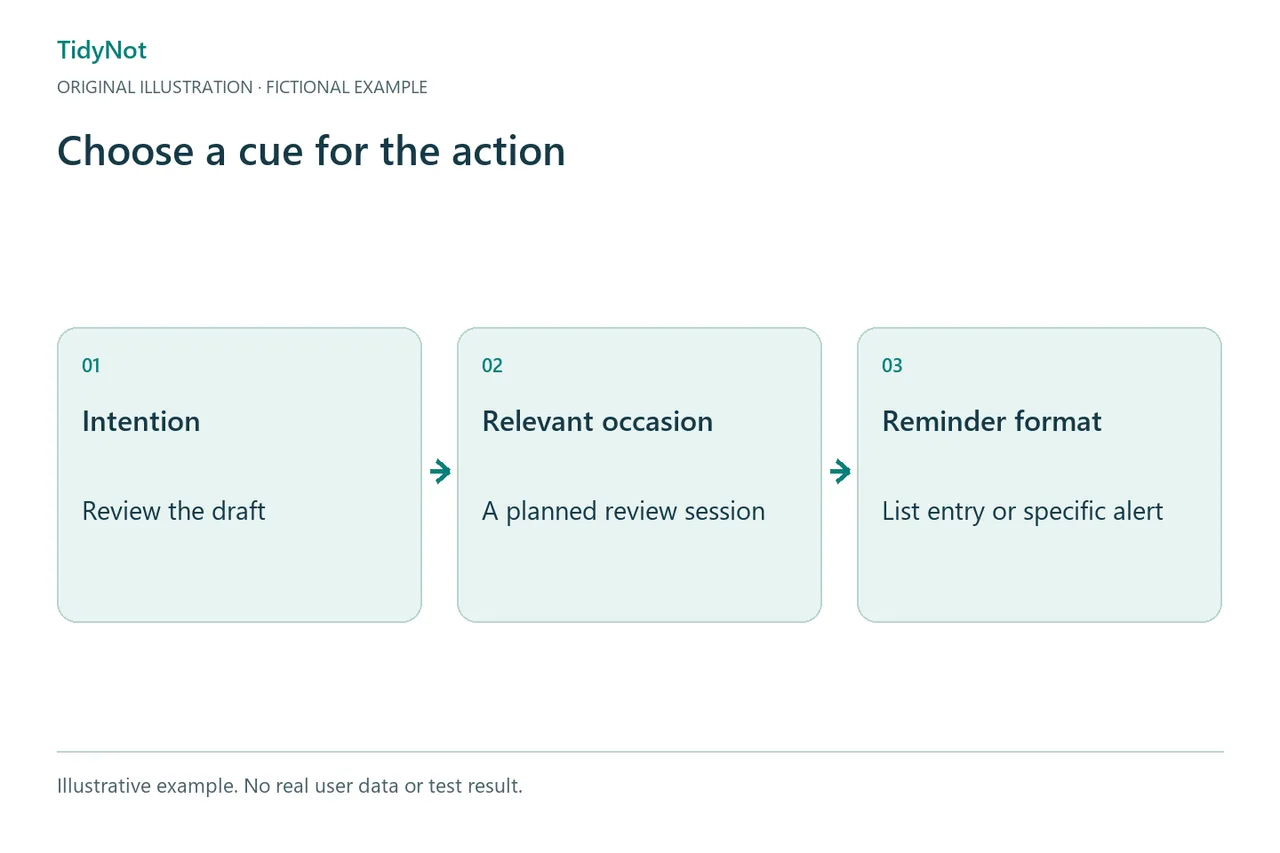
Start with an action and occasion before choosing a format.
Write the action you want to remember
For an ordinary administrative task, write what you would do when the reminder appears. "Renewal" might mean reading an offer, comparing terms or submitting a form. "Review the renewal terms before deciding" gives the future reader a usable action without pretending the decision is already made.
Gilbert’s experiments examined how people offloaded delayed intentions under different demands. They support discussing external reminders as a choice, while leaving open how a particular everyday task will go. The research does not supply a universal number of reminders to create. Source 8.1
Choose a reminder format for one intention
Intention | Useful cue | Possible format | Cost or limitation to check |
|---|---|---|---|
Act at a known time | The relevant time | One specific reminder | An alert may interrupt other work |
Review a low-urgency option | A planned review session | Quiet list entry | It depends on actually reviewing the list |
Act when a dependency resolves | Confirmed response | Waiting record plus review | Do not treat an expected reply as received |
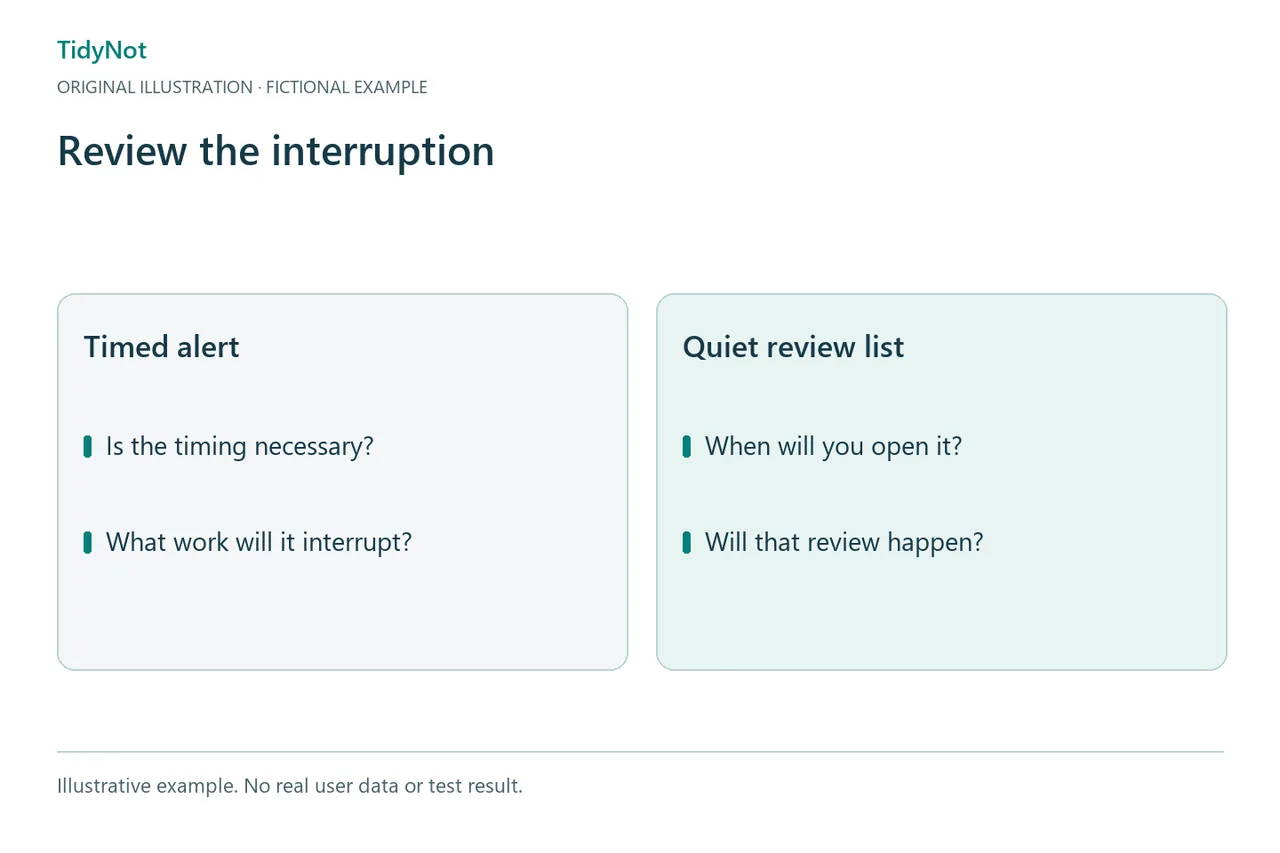
These are selection questions, not measured recommendations for an alert count.
Choose a cue you are likely to meet
A known appointment time may call for a time cue. A low-urgency idea may belong in a review list you already consult. A task that depends on a reply can remain with the waiting record until the reply actually supplies what you need. Write down the occasion that would make the action relevant.
Now consider the cost of an alert at that moment. Stothart and colleagues found disruption from phone notifications in an attention task even when participants did not use the phone. That result concerns a particular experiment, rather than every kind of reminder or every reader. Source 8.2
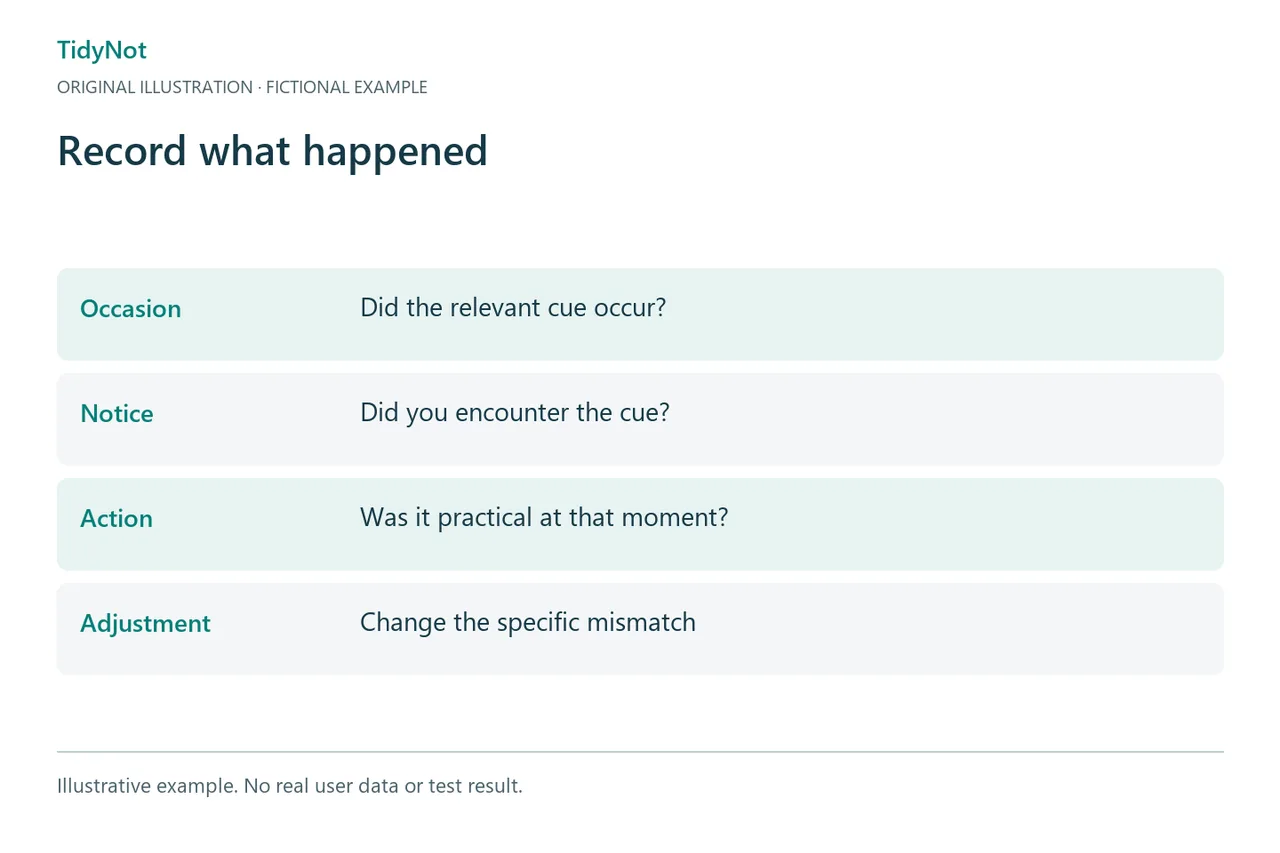
No trial outcome is filled in or implied.
Review an alert before adding another
In a fictional example, a desk note and two calendar alerts all say "look at the draft." Check whether each cue has a distinct purpose. One may be a review prompt and another an actual agreed appointment, or the entries may simply repeat the same instruction. Keep that distinction visible before changing a real reminder.
A useful review note records whether the cue occurred, whether you noticed it and whether the action was practical then. Missing an occasion and finding the action impossible are different problems.
Check whether the reminder was actually delivered
For one ordinary, low-risk task, check whether the notification appeared where you expected it. If it appeared but the next action was unclear, rewrite the reminder. If it did not appear, inspect the app’s notification settings and current help instructions before adding more alerts.
Try it with your own information
Choose a cue for one action
Work backward from an action you can recognize. Delivery, noticing and doing are separate events.
An invented worked example
Use this scenario to see how the decisions fit together, then replace its details with your own observations.
Task: bring a borrowed game to a friend when leaving home. Cue: a reminder at the departure time I have actually planned.
Quiet-review alternative: “decide which game to borrow next” belongs in a review list because it has no agreed departure deadline.
Afterward: “notification appeared, but game was still on the shelf” means the cue was delivered, not that the task was completed. Change the arrangement before adding more alerts.
No account needed. Open the worksheet, enter your own notes, then download a text copy. You can also download it blank to complete elsewhere.
Open and download your worksheet
Sources and scope
[8.1] Sam J. Gilbert. Strategic offloading of delayed intentions into the external environment. Quarterly Journal of Experimental Psychology 68(5), 971–992, 2015; online 2014-11-18. https://doi.org/10.1080/17470218.2014.972963 Read scope: Open PMC paper: abstract and task/context discussion. Limits: Brief intention tasks; relation to a later everyday intention was weak. No claim that more notifications are always better.
[8.2] Cary Stothart, Ainsley Mitchum and Courtney Yehnert. The attentional cost of receiving a cell phone notification. Journal of Experimental Psychology: Human Perception and Performance 41(4), 893–897, 2015. https://pubmed.ncbi.nlm.nih.gov/26121498/ Read scope: Original abstract and bibliographic record read. Limits: A specific attention task, not evidence of identical effects for all reminders, jobs or individuals.
Source relationship: Independent experimental programs on prospective remembering and notification costs; complementary outcomes, no direct head-to-head test of this table.
The images are original explanatory illustrations of fictional examples. They are not photographs, product screenshots or evidence of a completed practical test.
Evidence and scope
1. Sam J. Gilbert. Strategic offloading of delayed intentions into the external environment. Quarterly Journal of Experimental Psychology 68(5), 971–992, 2015; online 2014-11-18.
Claim covered: Reminder research has a specific experimental scope
Gilbert’s experiments examined how people offloaded delayed intentions under different demands. They support discussing external reminders as a choice, while leaving open how a particular everyday task will go. The research does not supply a universal number of reminders to create. Source 8.1
Sam J. Gilbert. Strategic offloading of delayed intentions into the external environment. Quarterly Journal of Experimental Psychology 68(5), 971–992, 2015; online 2014-11-18.. English edition; source-specific context. Checked: .
Open PMC paper: abstract and task/context discussion. Brief intention tasks; relation to a later everyday intention was weak. No claim that more notifications are always better.
2. Editorial application
Claim covered: A practical step to try in your own setting
For one ordinary, low-risk task, check whether the notification appeared where you expected it. If it appeared but the next action was unclear, rewrite the reminder. If it did not appear, inspect the app’s notification settings and current help instructions before adding more alerts.
TidyNot editorial suggestion. English edition; fictional example. Checked: .
TidyNot editorial proposal. No completed practical trial, measured benefit or universal outcome is claimed.