Choose a small first action and attach it to an occasion you can recognize. For example, “after opening my notebook, write the next task on one line” is a draft routine you could try. Check whether the action is practical in that setting before adding reminders or extra steps. Keep the cue and action clear when reviewing what happened.
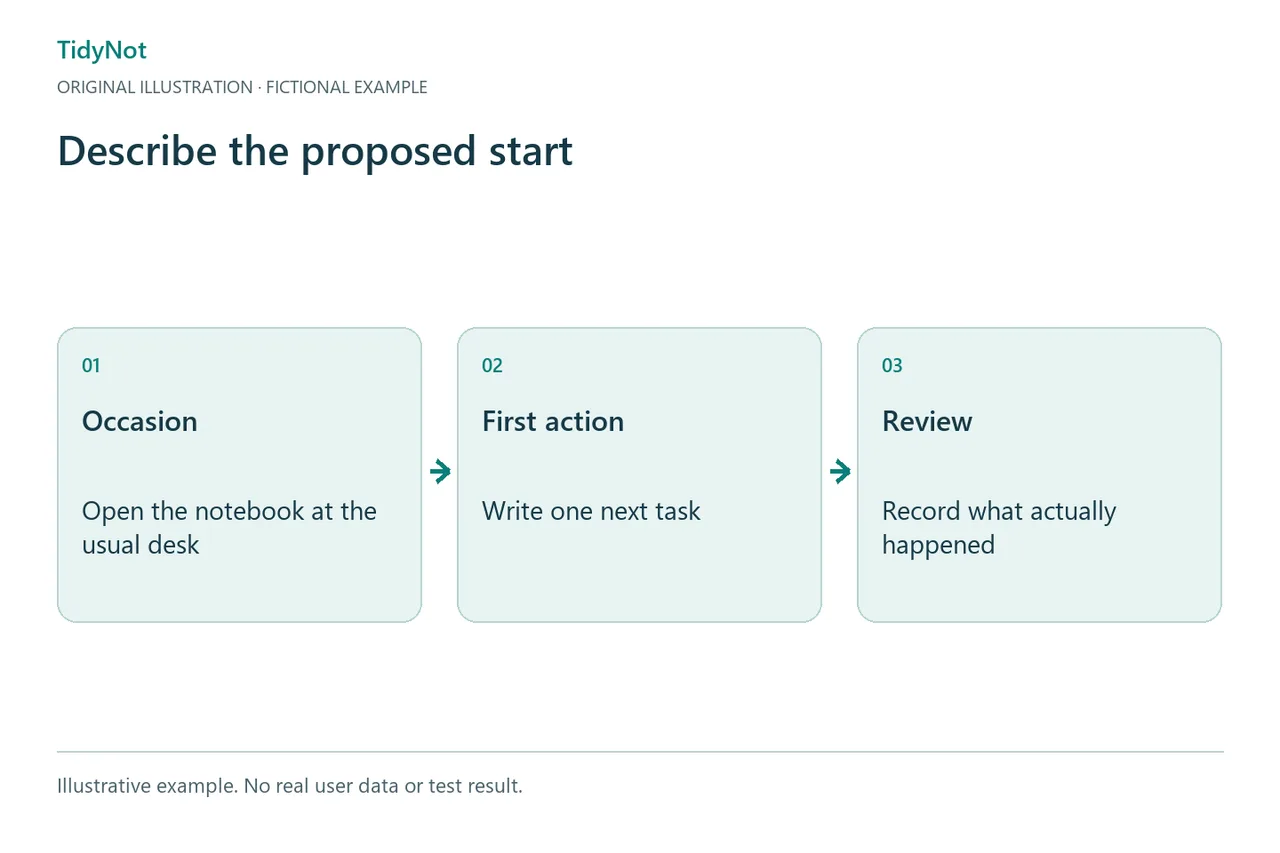
A fictional routine proposal, with no completed trial implied.
Choose an action you can recognize when it happens
"Be more organized" does not tell you what to do when you sit down. In the fictional example, the first action is to write one next task in the notebook you just opened. That is a proposal small enough to describe clearly. Whether it fits your own setting still needs an actual attempt.
Fogg’s public model considers motivation, ability and a prompt. We use that author framework to ask whether the first action is practical and whether its occasion is clear. We have not reproduced the model’s graphic or treated the author’s explanation as an independent test of this notebook routine. Source 12.1
Describe the proposed start before trying it
Routine part | Example | What to review |
|---|---|---|
Recognizable cue | Opening the notebook | Did the occasion occur? |
Small starting action | Write one next task | Was that action practical? |
Setting | The notebook’s usual working place | Was the same context available? |
Review note | Record what actually happened | Avoid a fixed habit-formation deadline |
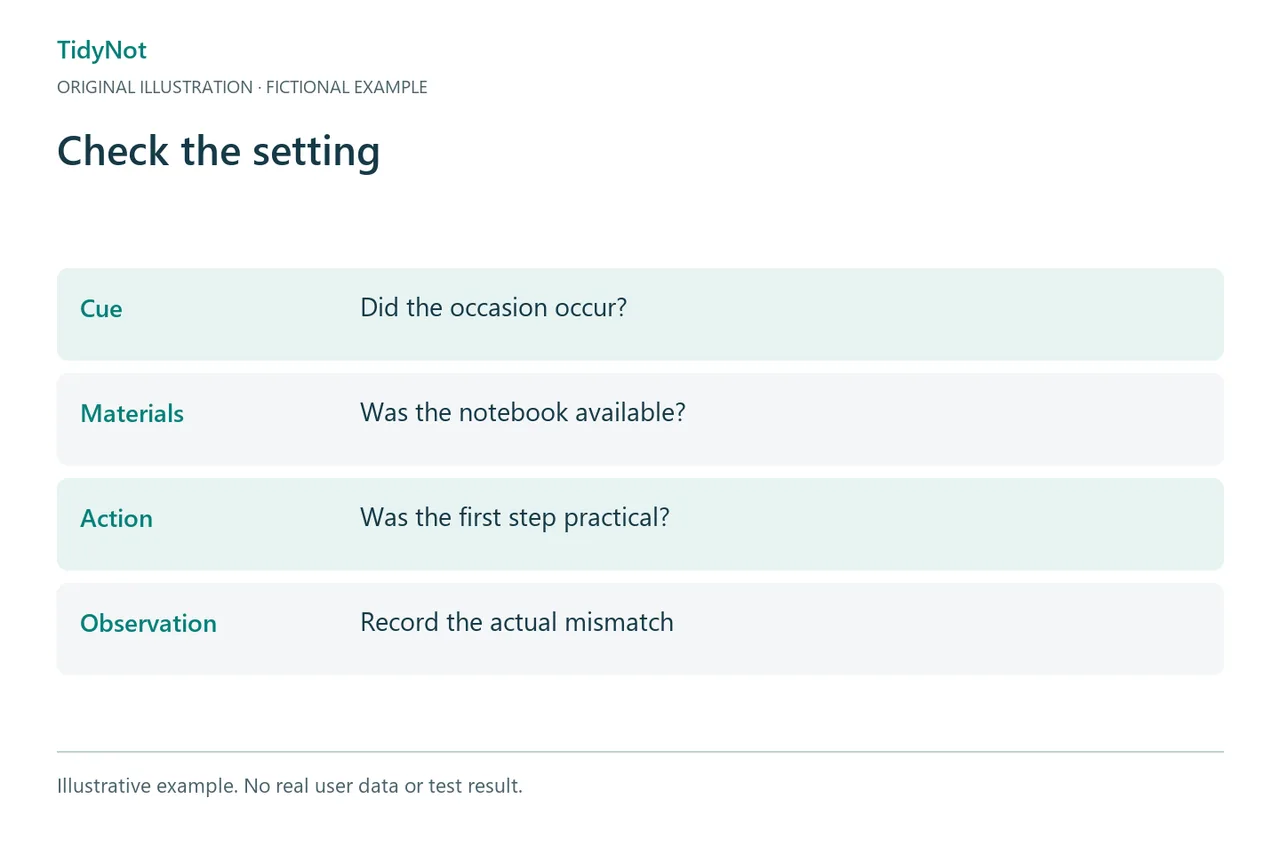
The fields separate problems that need different adjustments.
Attach the action to an occasion that really occurs
Describe the cue in ordinary language: "after opening the notebook at my usual desk." Ask whether that occasion happens on the days when the action matters. If the notebook is rarely opened, naming it as a cue will not make the occasion appear.
Lally and colleagues followed repeated actions in a consistent context and tracked self-reported automaticity. Their observational work involved different everyday behaviors from this notebook example. It is a reason to keep context visible in the record, without promising that this routine becomes a habit by a fixed date. Source 12.2
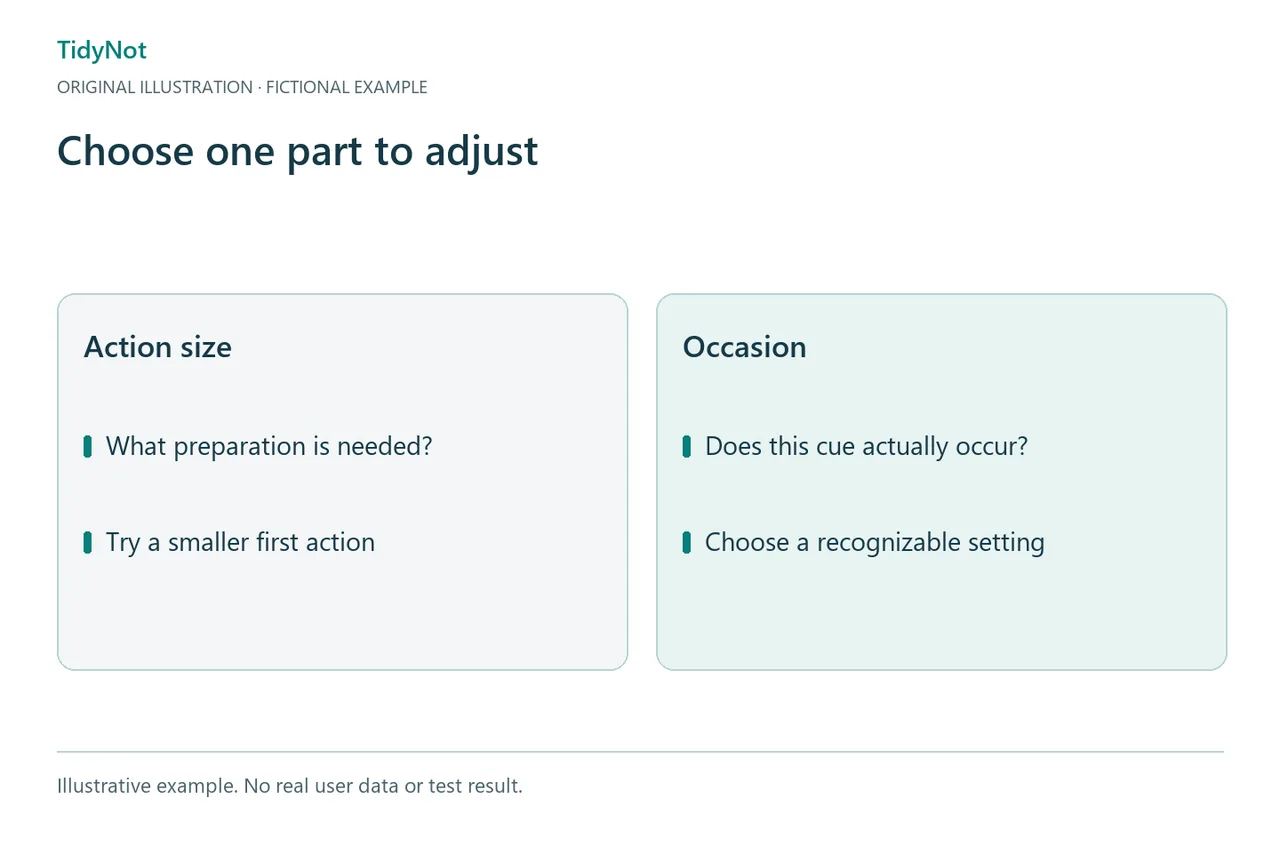
Record the change instead of assigning a habit-formation deadline.
Change the part that caused the mismatch
Leave a short observation field beside the proposed routine. Did the occasion occur? Was the notebook available? Was writing one next task practical then? A missed occasion and an action that needs too much preparation call for different adjustments.
If you try a change, keep a note of which part you changed. You might alter the size of the first action or choose another recognizable occasion. Changing both at once can leave your record unclear about what was different.
Keep the review free of a deadline for habit formation
Review whether the cue occurred and whether the first action was practical. A missed day does not, by itself, tell you which part failed. Avoid assigning a universal number of days or a success percentage to this untested routine.
Try it with your own information
Diagnose one missed start
Record the cue and the first action separately so a missed opportunity leads to a useful adjustment.
An invented worked example
Use this scenario to see how the decisions fit together, then replace its details with your own observations.
Proposed action: after putting the breakfast cup away, open the notebook at today’s task.
Possible record A: breakfast happened elsewhere, so the cue did not occur. Try a cue that is actually present in that setting.
Possible record B: cup put away, notebook in another room. Put the notebook where the action begins before deciding that the action needs a stronger reminder.
No account needed. Open the worksheet, enter your own notes, then download a text copy. You can also download it blank to complete elsewhere.
Open and download your worksheet
Sources and scope
[12.1] BJ Fogg. BJ Fogg — Behavior Scientist & Author of Tiny Habits. Author’s official website, Undated; checked 2026-10-20. https://www.bjfogg.com/ Read scope: Author’s explanation of motivation, ability and prompt read. Limits: Author’s model statement; universal claims on the page are not adopted. No model graphic copied.
[12.2] Phillippa Lally, Cornelia H. M. van Jaarsveld, Henry W. W. Potts and Jane Wardle. How are habits formed: Modelling habit formation in the real world. European Journal of Social Psychology 40, 998–1009, 2010 issue; first online 2009-07-16. https://doi.org/10.1002/ejsp.674 Read scope: Original journal abstract and author/date record; full paper not read. Limits: Observational/self-report study of eating, drinking or activity behaviors; not proof that an administrative habit forms in a fixed number of days.
Source relationship: Author framework plus an independent observational habit study; the study is not validation of the particular tiny-action example.
The images are original explanatory illustrations of fictional examples. They are not photographs, product screenshots or evidence of a completed practical test.
Evidence and scope
1. BJ Fogg. BJ Fogg — Behavior Scientist & Author of Tiny Habits. Author’s official website, Undated; checked 2026-10-20.
Claim covered: Fogg’s model considers motivation, ability and a prompt
Fogg’s public model considers motivation, ability and a prompt. We use that author framework to ask whether the first action is practical and whether its occasion is clear. We have not reproduced the model’s graphic or treated the author’s explanation as an independent test of this notebook routine. Source 12.1
BJ Fogg. BJ Fogg — Behavior Scientist & Author of Tiny Habits. Author’s official website, Undated; checked 2026-10-20.. English edition; source-specific context. Checked: .
Author’s explanation of motivation, ability and prompt read. Author’s model statement; universal claims on the page are not adopted. No model graphic copied.
2. Editorial application
Claim covered: A practical step to try in your own setting
Review whether the cue occurred and whether the first action was practical. A missed day does not, by itself, tell you which part failed. Avoid assigning a universal number of days or a success percentage to this untested routine.
TidyNot editorial suggestion. English edition; fictional example. Checked: .
TidyNot editorial proposal. No completed practical trial, measured benefit or universal outcome is claimed.