List the steps in a routine and ask what each one contributes to its current purpose. Choose one optional step to leave out for a limited trial, while keeping required checks and the central action intact. Record what changes before deciding to remove it permanently. Treat subtraction as an option to examine; an extra step can also serve a real need.
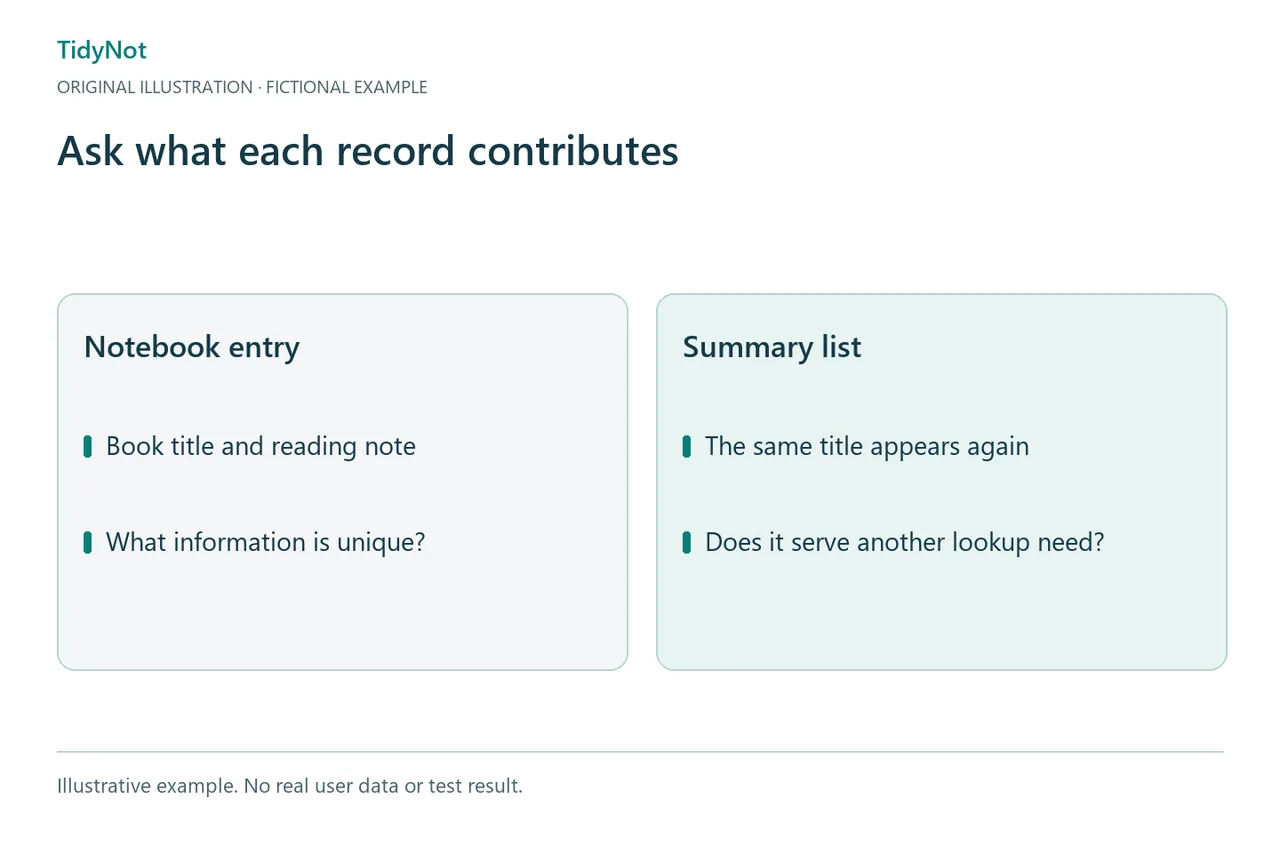
Fictional personal reading log; duplication alone does not establish that a step is useless.
Write what each step contributes
Take a low-risk personal reading log. In the fictional example, you write the same book title in a notebook and again in a private summary list. Before dropping either entry, describe what you use each one for. One may hold a detail the other does not, or both may simply repeat the same information.
Adams and colleagues studied overlooked subtractive options in constrained problems. Science News reports that same research and is a related account, not another independent experiment. These sources justify considering a subtraction; they do not establish that removing a step improves every routine. Source 16.1 Source 16.2
Check a proposed subtraction before keeping it
Step under review | Purpose it serves | Trial decision | What to observe |
|---|---|---|---|
Optional status copied in two places | May duplicate the same information | Try one maintained record | Whether any needed information is lost |
Cue for the central action | Helps identify the occasion | Keep it during this trial | Whether the action can still start as intended |
Required safety or compliance check | Meets an external requirement | Outside this trial’s scope | Do not remove it on this article’s advice |
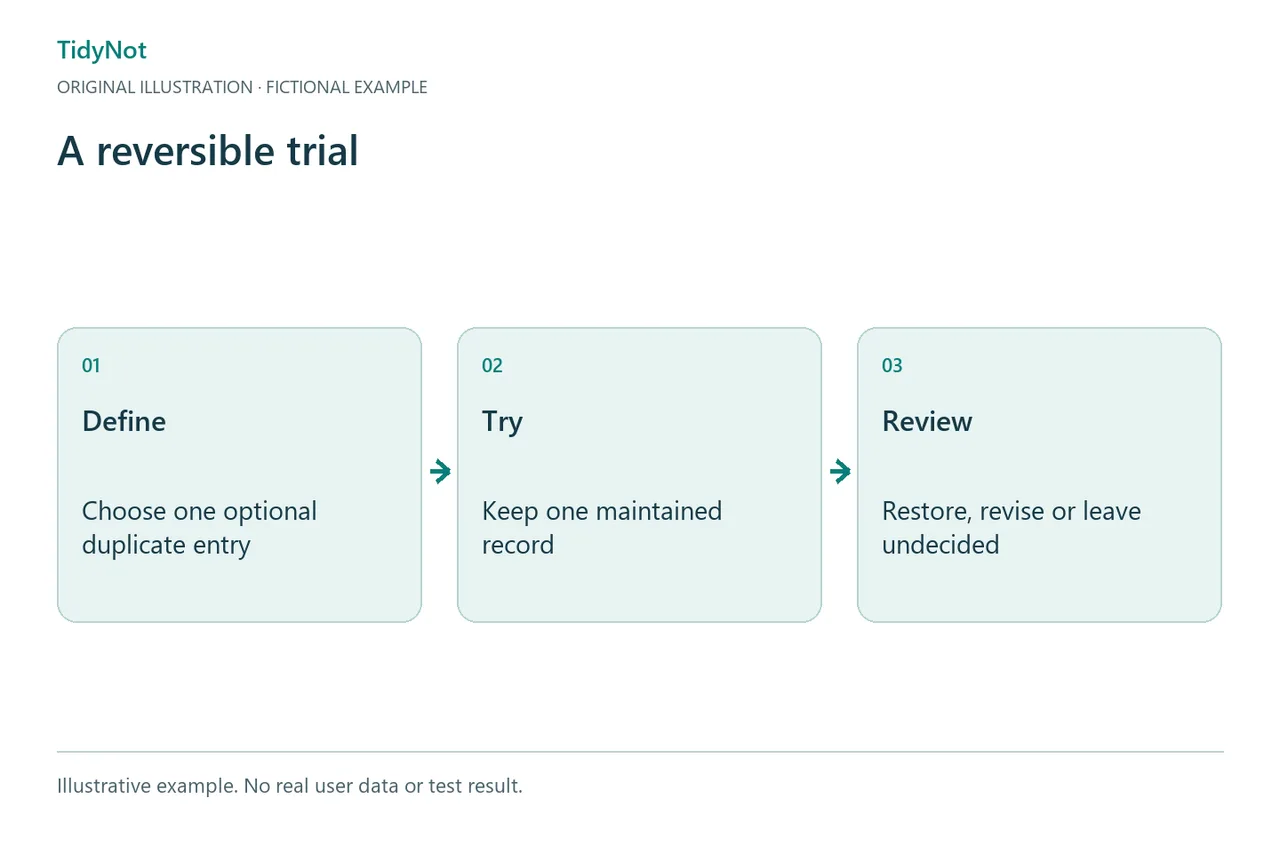
Required checks are outside this example.
Set a limit and a way back
For the proposed reading-log trial, keep one maintained title record and leave the duplicate entry out for a clearly described review period. State what would make you restore it, such as discovering that the summary list served a separate lookup need. Decide where any necessary information will remain before stopping an entry.
Keep required checks outside the trial. This article concerns an optional personal recording step, not a safety, security, legal or organizational procedure. A task assigned by someone else also needs agreement before changing it.
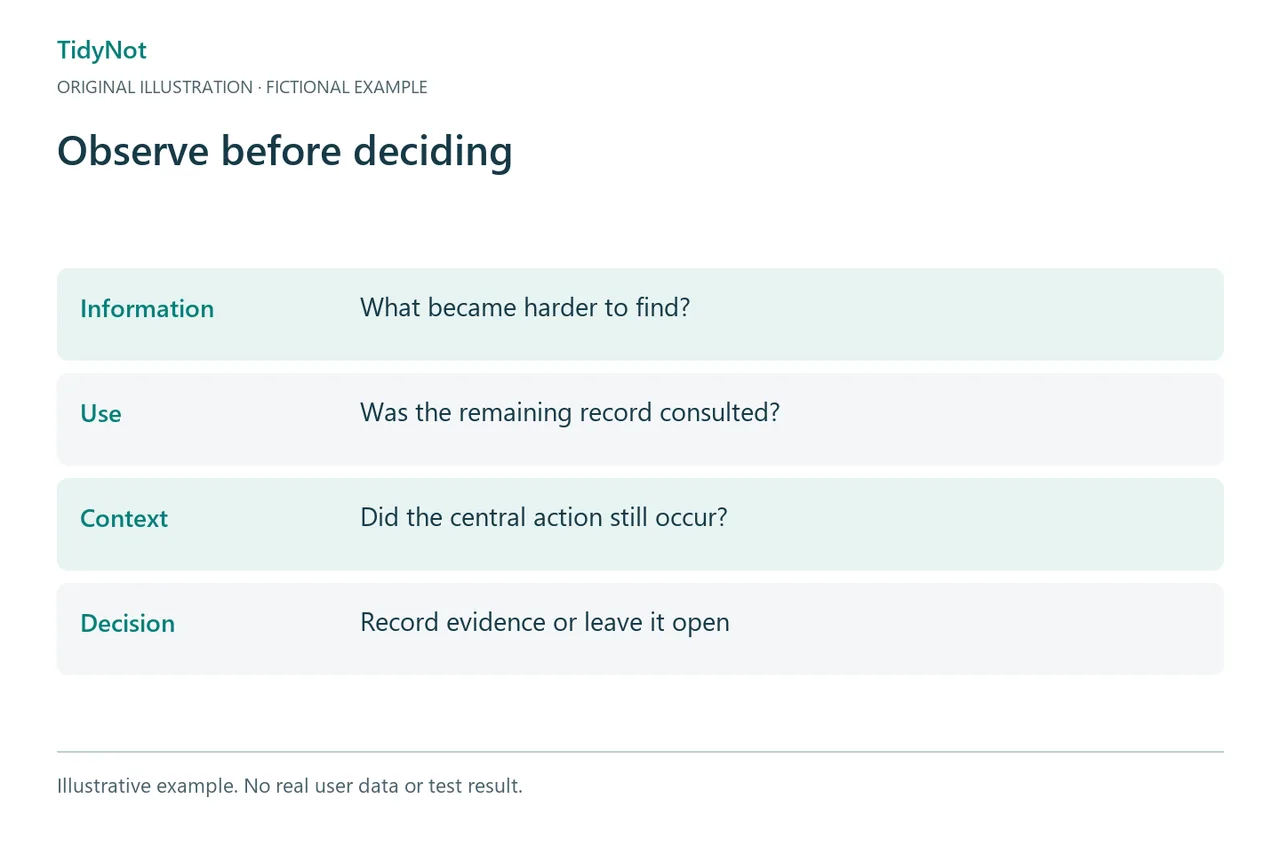
No trial result or time saving is filled in.
Observe the loss as well as the convenience
Leave fields for what information became harder to find, whether the remaining record was used and whether the central reading-note action still occurred. Lally’s separate observational work concerns repeating actions in context. It does not test deletion, but it helps explain why the occasion for the remaining action is worth recording. Source 16.3
Complete those fields only after an actual attempt. If the omitted step had a useful function, restore it or design another way to keep that function. If the evidence is unclear, leave the decision open.
Check where the removed work goes
Before dropping an optional step, ask whether another person would have to perform it later. Keep required safety, access, retention and quality checks intact. If the trial makes the result harder to use, restore the step and record what happened.
Try it with your own information
Plan a reversible omission
Choose an optional duplicate step and specify what would make you restore it.
An invented worked example
Use this scenario to see how the decisions fit together, then replace its details with your own observations.
Fictional routine: copy each reading title into both a notebook and a private summary. Keep the notebook; try omitting the second copy for one review cycle.
Before omitting it: check whether anyone else relies on the summary or whether it preserves information absent from the notebook.
Restore trigger: at review, a needed detail cannot be recovered from the retained record. Restore that function; do not conclude that all logging is unnecessary.
No account needed. Open the worksheet, enter your own notes, then download a text copy. You can also download it blank to complete elsewhere.
Open and download your worksheet
Sources and scope
[16.1] Gabrielle S. Adams, Benjamin A. Converse, Andrew H. Hales and Leidy E. Klotz. People systematically overlook subtractive changes. Nature 592, 258–261, 2021-04-07. https://doi.org/10.1038/s41586-021-03380-y Read scope: Original Nature abstract and visible experimental captions; subscription body not accessed. Limits: Constrained experimental problems; does not establish that removing a real routine is always beneficial.
[16.2] Sujata Gupta. People add by default even when subtraction makes more sense. Science News, 2021-04-07. https://www.sciencenews.org/article/psychology-numbers-people-add-default-subtract-better Read scope: Article body and linked original Nature abstract read together. Limits: News discussion of clutter/schedules goes beyond direct task evidence; use the original experimental scope.
[16.3] Phillippa Lally, Cornelia H. M. van Jaarsveld, Henry W. W. Potts and Jane Wardle. How are habits formed: Modelling habit formation in the real world. European Journal of Social Psychology 40, 998–1009, 2010 issue; first online 2009-07-16. https://doi.org/10.1002/ejsp.674 Read scope: Original journal abstract and author/date record; full paper not read. Limits: Observational/self-report study of eating, drinking or activity behaviors; not proof that an administrative habit forms in a fixed number of days.
Source relationship: Three substantive documents; N04 and R09 share one evidence family. R08 is independent complementary evidence about repetition, not a replication of subtraction results.
The images are original explanatory illustrations of fictional examples. They are not photographs, product screenshots or evidence of a completed practical test.
Evidence and scope
1. Gabrielle S. Adams, Benjamin A. Converse, Andrew H. Hales and Leidy E. Klotz. People systematically overlook subtractive changes. Nature 592, 258–261, 2021-04-07.
Claim covered: Subtraction experiments do not establish that deletion always helps
Adams and colleagues studied overlooked subtractive options in constrained problems. Science News reports that same research and is a related account, not another independent experiment. These sources justify considering a subtraction; they do not establish that removing a step improves every routine. Source 16.1 Source 16.2
Gabrielle S. Adams, Benjamin A. Converse, Andrew H. Hales and Leidy E. Klotz. People systematically overlook subtractive changes. Nature 592, 258–261, 2021-04-07.. English edition; source-specific context. Checked: .
Original Nature abstract and visible experimental captions; subscription body not accessed. Constrained experimental problems; does not establish that removing a real routine is always beneficial.
2. Editorial application
Claim covered: A practical step to try in your own setting
Before dropping an optional step, ask whether another person would have to perform it later. Keep required safety, access, retention and quality checks intact. If the trial makes the result harder to use, restore the step and record what happened.
TidyNot editorial suggestion. English edition; fictional example. Checked: .
TidyNot editorial proposal. No completed practical trial, measured benefit or universal outcome is claimed.