A new week, birthday or other meaningful date can be a useful occasion to review a plan. Give that occasion a concrete next action and a way to review what happened. The date alone does not tell you how the action will continue on an ordinary day.
In their fresh-start paper, Hengchen Dai, Katherine Milkman and Jason Riis examined goal-related activity around temporal landmarks in three archival field studies.[S44] That evidence concerns activity near a fresh start. It does not establish that the resulting motivation will last indefinitely.
Choose the action you want to repeat
Write what a person would actually see you do. "Get organized" leaves many possibilities open. "Put the day’s loose papers in the tray when I close the laptop" describes an action and a setting. This desk example is an editorial illustration, not an intervention tested by the cited studies.
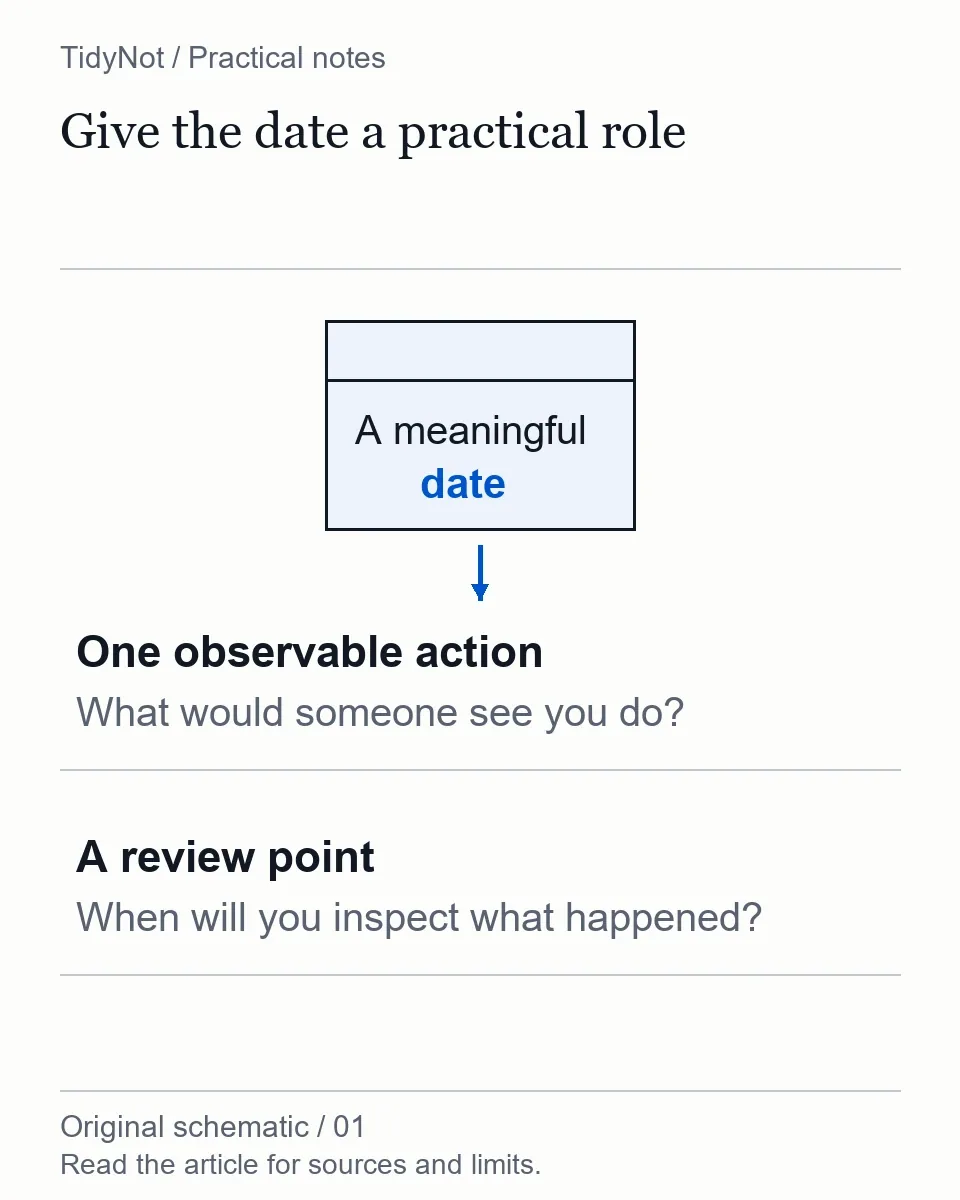
Give the date a practical role. Original TidyNot schematic.
Keep the first version small enough to inspect. If it contains several separate tasks, choose which one you want to learn about first. You can add detail after seeing whether the proposed situation and action fit your day.
Use the date to define a small action, its context and a later review.
Write down | A constructed example | Review question |
|---|---|---|
Action | Put the day’s loose papers in one tray | Was the action clear enough to do? |
Context | After closing the work laptop | Did that situation actually occur? |
Review point | The next time I review my desk setup | What got in the way, and what should change? |
Separate starting from becoming automatic
Lally and colleagues’ habit-formation study followed changes in self-reported automaticity for repeated everyday behaviors. Its abstract reports variation in how automaticity developed.[R08] How repetition develops is a different question from what makes a start date appealing. It does not supply a fixed deadline for making a desk routine automatic.
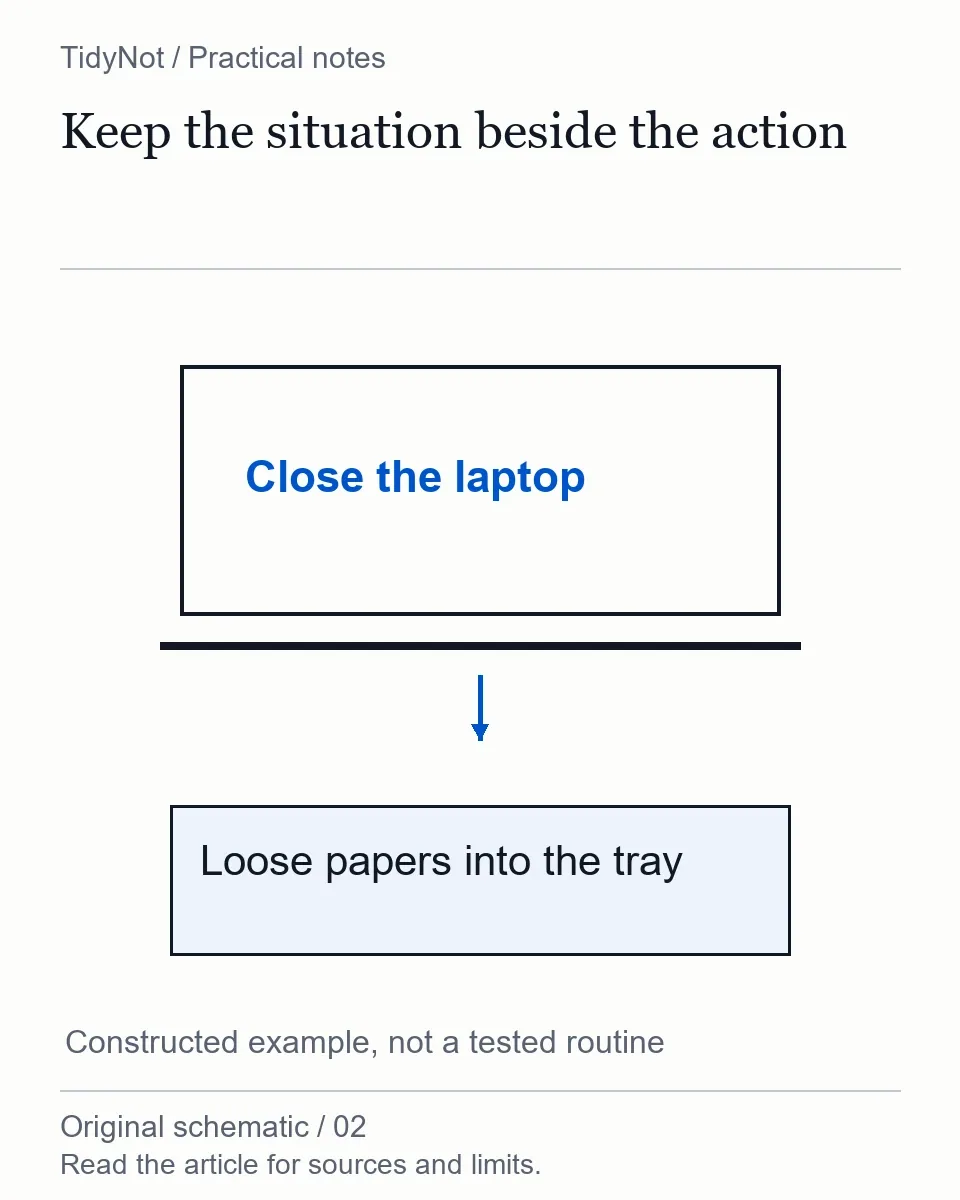
Keep the situation beside the action. Original TidyNot schematic.
At the review point, record whether the planned situation occurred and whether you did the action. If it did not happen, describe the obstacle in ordinary language. Perhaps the laptop stayed open, the tray was out of reach, or the papers needed a decision before they could be put away. These are possibilities to look for, not observations about your routine.
Revise the arrangement you can observe
Change the action or its context when the record gives you a reason. A different cue or a smaller first step may be worth trying, but record it as your next plan rather than a guaranteed solution.
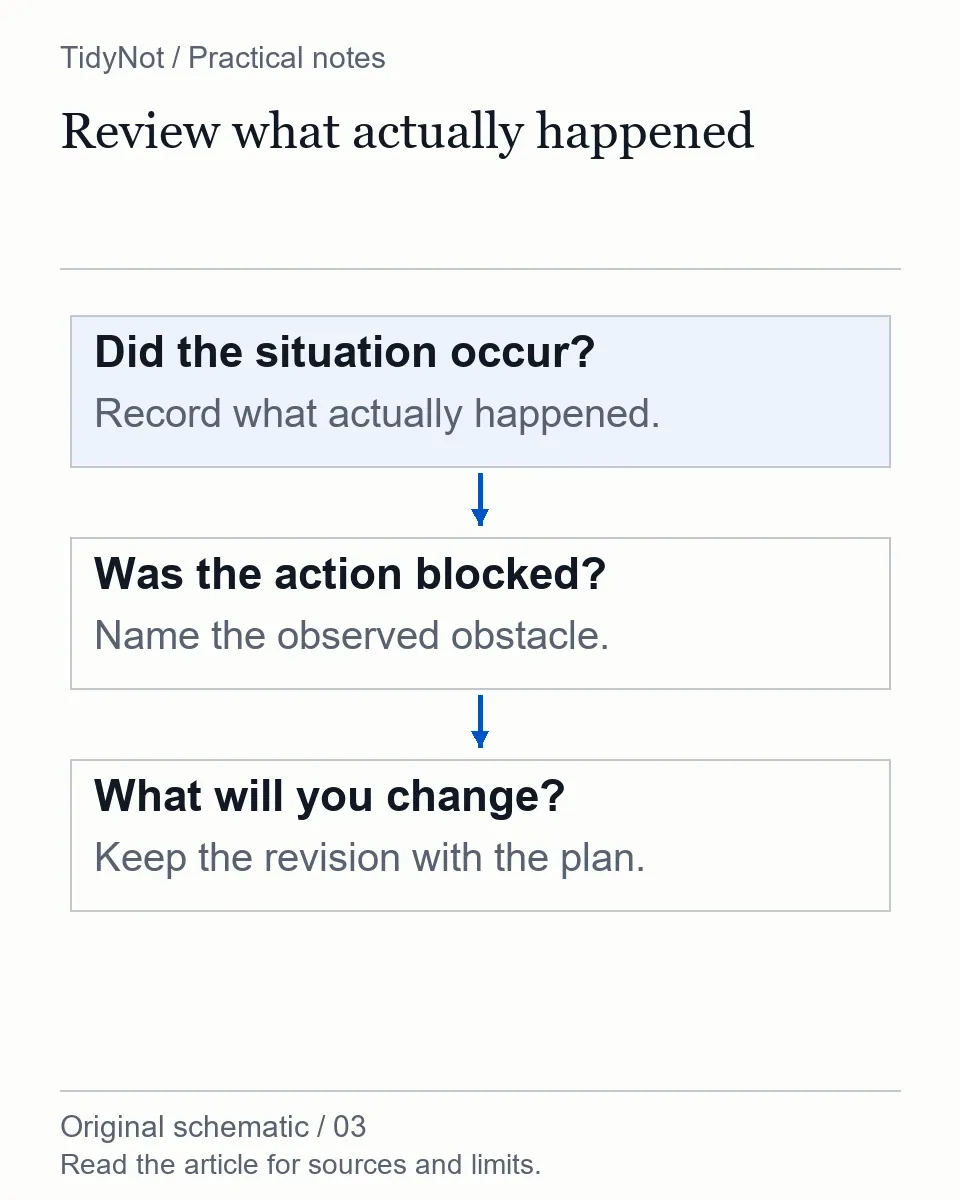
Review what actually happened. Original TidyNot schematic.
Keep the review note beside the plan. It should show what you intended, what actually happened and what you chose to change. That gives the next fresh start something concrete to build on.
What should the calendar review decide?
Constructed example: Alex chooses the first day of the month to review an optional evening-reading plan. This review decides whether the plan still belongs in the coming month; it does not count reading sessions or measure habit formation.
| Situation | Decision and next step |
|---|---|
| The plan still matters, but the next month has a different evening schedule | Revise the setting before continuing. Record the change as a proposal; use the small-action guide to choose a cue that fits that setting. |
| The plan no longer serves a wanted purpose | Choose to stop or defer it explicitly. A new month does not make an unwanted goal worth renewing. Keep required obligations separate from optional plans. |
| The review date passed without a decision | Choose the next available review opportunity. Do not wait for another month to start or erase the earlier plan as though it never existed. |
For the review, write: date chosen; plan being reviewed; still wanted / change / defer / stop; reason; next decision needed. Leave experience and outcome claims blank if the activity has not actually been tried.
These are editorial examples, not reported experiences or tested outcomes.
Try it with your own information
Turn a fresh start into a reviewable plan
Give the date a small job, then decide what an ordinary-day check should record.
An invented worked example
Use this scenario to see how the decisions fit together, then replace its details with your own observations.
Fictional start: Monday. Action: put loose desk papers in the tray after closing the laptop.
Review: at the next desk review, distinguish “laptop not closed” from “cue occurred but tray was full”. Neither record establishes a lasting habit.
Adjustment: clear a usable tray space or choose a different cue based on the recorded obstacle, not because Monday failed to feel motivating.
No account needed. Open the worksheet, enter your own notes, then download a text copy. You can also download it blank to complete elsewhere.
Open and download your worksheet
Sources and reading scope
- Hengchen Dai, Katherine L. Milkman and Jason Riis. The Fresh Start Effect: Temporal Landmarks Motivate Aspirational Behavior. Management Science 60(10), 2563–2582; 2014-06-23 first online. https://pubsonline.informs.org/doi/10.1287/mnsc.2014.1901. Original publisher abstract and bibliographic record read. Three archival field studies on goal activity around temporal landmarks; not proof of sustained motivation or a desk-routine intervention.
- Phillippa Lally, Cornelia H. M. van Jaarsveld, Henry W. W. Potts and Jane Wardle. How are habits formed: Modelling habit formation in the real world. European Journal of Social Psychology 40, 998–1009; 2010 issue; first online 2009-07-16. https://doi.org/10.1002/ejsp.674. Abstract and bibliographic record rechecked on 2026-10-24; full paper not reviewed. The cited finding concerns variation in self-reported automaticity, not a fixed deadline for forming a desk routine.
Evidence and scope
1. The Fresh Start Effect: Temporal Landmarks Motivate Aspirational Behavior
Claim covered: In their fresh-start paper, Hengchen Dai, Katherine Milkman and Jason Riis examined goal-related activity around temporal landmarks in three archival field studies.[S44] That evidence concerns activity near a fresh start. It does not establish that the resulting motivation will last indefinitely.
Original publisher abstract and bibliographic record read.
The Fresh Start Effect: Temporal Landmarks Motivate Aspirational Behavior. English edition. Checked: .
Three archival field studies on goal activity around temporal landmarks; not proof of sustained motivation or a desk-routine intervention.
2. How are habits formed: Modelling habit formation in the real world
Claim covered: Lally and colleagues’ habit-formation study followed changes in self-reported automaticity for repeated everyday behaviors. Its abstract reports variation in how automaticity developed.[R08] How repetition develops is a different question from what makes a start date appealing. It does not supply a fixed deadline for making a desk routine automatic.
Abstract and bibliographic record checked on 2026-10-20; full paper not reviewed. The cited finding concerns variation in self-reported automaticity, not a fixed deadline for forming a desk routine.
How are habits formed: Modelling habit formation in the real world. English edition. Checked: .
Uses only the prior verified abstract scope on variation in self-reported automaticity. No fixed habit deadline. Related UCL blog fetch returned 502 and was not treated as fresh evidence.
3. Editorial application
Claim covered: A new week, birthday or other meaningful date can be a useful occasion to review a plan. Give that occasion a concrete next action and a way to review what happened. The date alone does not tell you how the action will continue on an ordinary day.
TidyNot editorial workflow suggestion, distinguished from the linked source statements.
TidyNot editorial suggestion. English edition. Checked: .
An editorial application, not a tested intervention or a guarantee of results.