Start with the label, not the family memory
A box marked “summer holiday” tells you why a recording matters, not which machine can play it. Write down the format printed on the cassette or container. If it is unclear, photograph the outside and use the provider’s official instructions for identifying it. Do not open the cassette to investigate.
Make a short inventory before deciding what to bring: item name, visible format, number of items and any visible damage. Choose one straightforward item for the first session rather than assuming the whole box can be finished.
Read the current equipment list
DC Public Library’s Memory Lab is a useful example of why this check matters. Its official page describes a DIY service and lists supported formats. When checked on 22 October 2026, the page listed Video8, Hi8 and Digital8 as unavailable. Recheck that list before making plans. It also specifies prerequisites and storage options. Those are conditions at that particular service, not a nationwide offer. [1]
For your chosen provider, separate three questions: “Do you support this format?”, “Is the equipment available now?” and “Can I use it under your eligibility rules?” A general page about digitization does not answer all three. Ask about session limits and whether instruction is included before arranging travel.
Plan where the result will go
Write down the requested output format and the storage device or account you will use. Confirm compatibility with the service, including any capacity limits, rather than buying a drive by guesswork. Ask whether files stay on the workstation and how you should handle them under the provider’s privacy procedure.
Before leaving, open the files you received and check the beginning, a middle section and the end where practical. Confirm that the content belongs to the item you brought; do not run a fragile original again just to compare it. Keep a simple note connecting the filename to its physical source. Retain the original and arrange a separate backup of the digital files; making one new copy is not the same as checking it.
Keep damage outside the DIY plan
If a tape appears damaged, stop and ask about professional assessment instead of trying a household cleaning method. The Library of Congress says magnetic-tape cleaning is delicate and should be carried out by a preservation specialist. [2] This article does not provide repair instructions or guarantee recovery. The useful first result is a verified plan for your particular media, even when that plan is to use a different service.
Check | Record before booking | Why it matters |
|---|---|---|
Format | Exact printed format or identification question | Similar-looking media may need different equipment |
Service | Current support, eligibility and operator | A listed service is not a confirmed appointment |
Output | File format and accepted storage | You need a usable way to take files home |
Condition | Visible damage or uncertainty | Assessment may be needed before playback |
Identify before you book
- Read the label: Exact media format
- Check the service: Current support
- Plan the output: Compatible storage
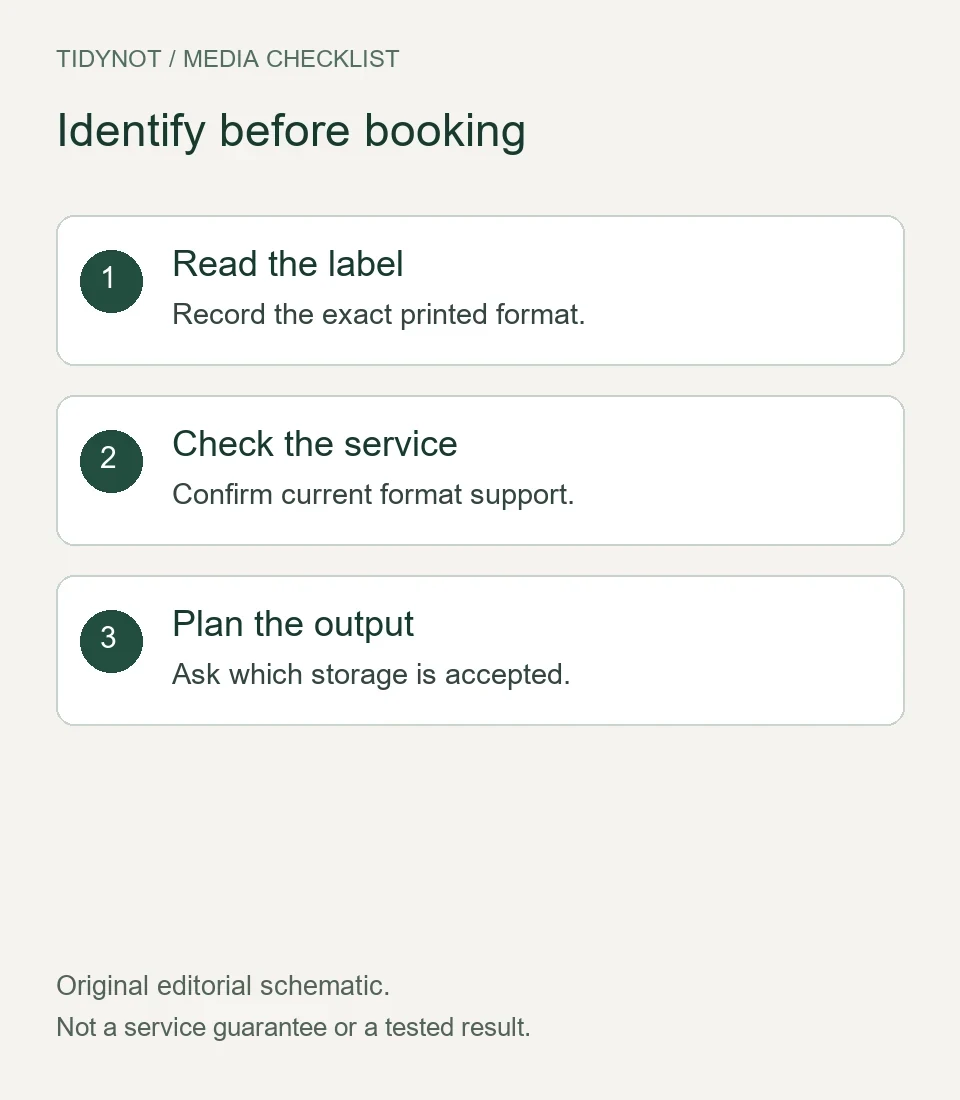
Illustrative editorial layout; not a measured result.
A service match is more than a name
- Format: Supported?
- Equipment: Available now?
- Access: Eligible to use?
- Operator: You or staff?
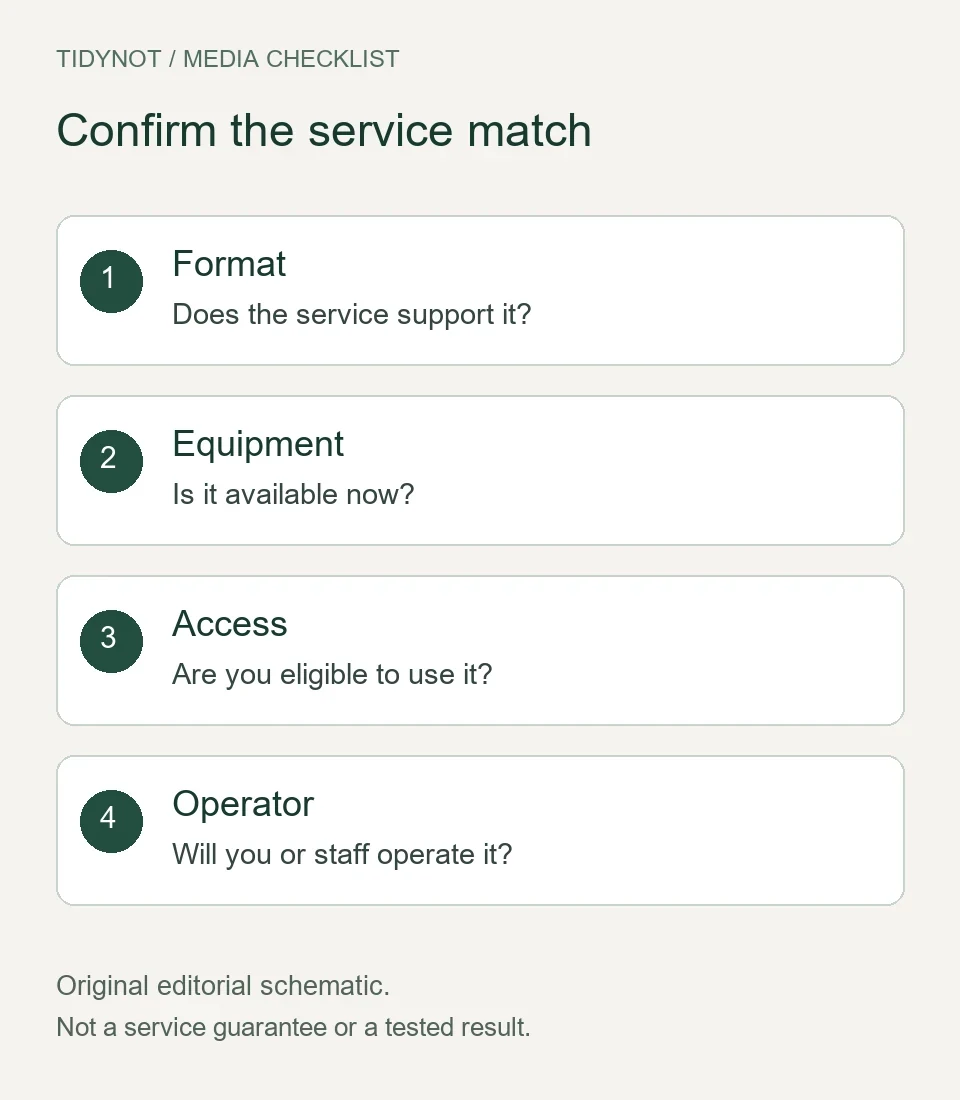
Illustrative editorial layout; not a measured result.
Keep the connection to the original
- Physical item: Source label
- Digital file: Matching filename note
- Checked copy: Open and inspect
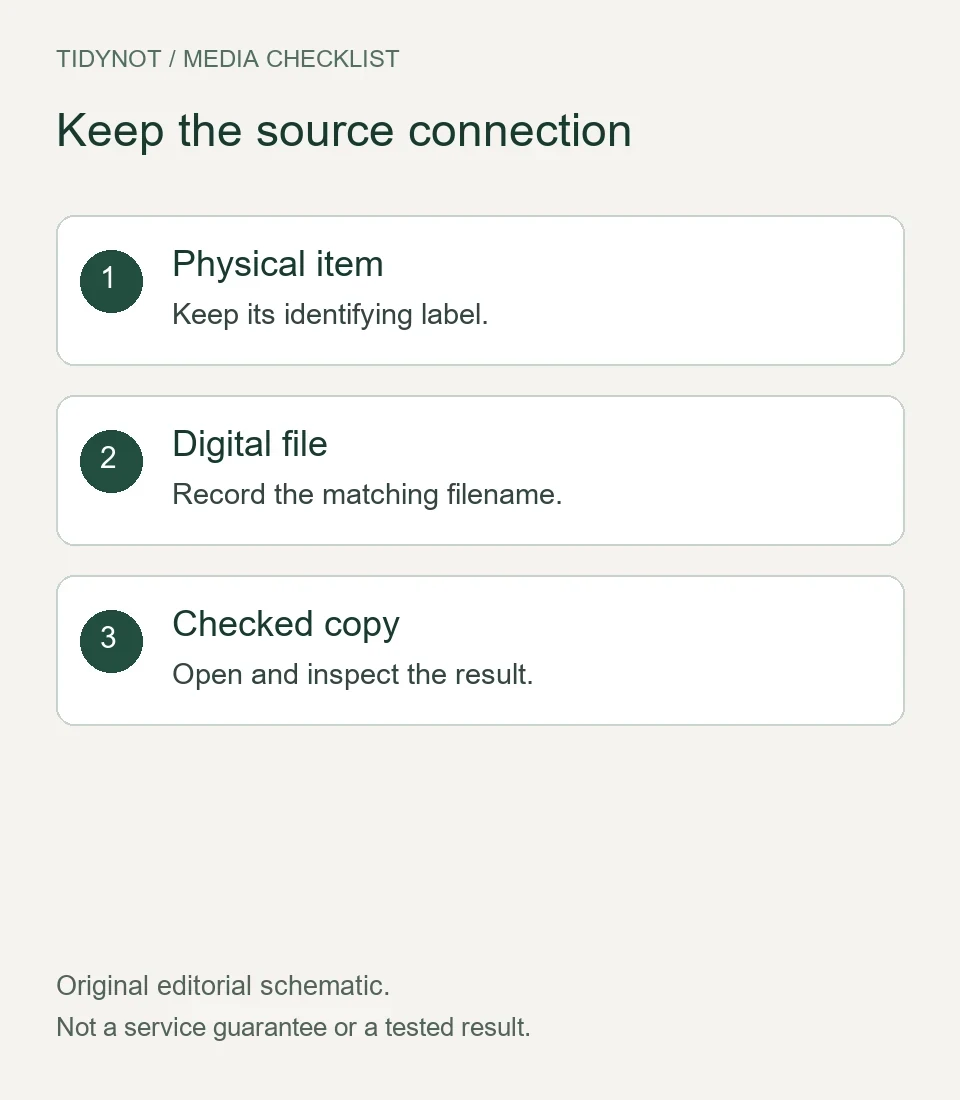
Illustrative editorial layout; not a measured result.
Try it with your own information
Prepare the questions for a transfer provider
Use this as a booking brief. A provider must confirm its current capabilities before you send an irreplaceable tape.
An invented worked example
Use this scenario to see how the decisions fit together, then replace its details with your own observations.
Tape A: shell says Video8; playback condition unknown. Question: can you transfer this exact format, and what happens if it cannot play?
Output requested: an ordinary playable digital file plus return of the original tape. File format, delivery method and price still need confirmation.
Acceptance check: identify the delivered file, play the beginning/middle/end, and record any missing or unreadable section. A download link alone is not acceptance.
No account needed. Open the worksheet, enter your own notes, then download a text copy. You can also download it blank to complete elsewhere.
Open and download your worksheet
Sources and limits
Examples, worksheets and diagram text are TidyNot editorial suggestions, not records of personal testing or measured results. Research findings are limited to the populations, tasks and methods described in the cited sources.
- DC Public Library: Digital Preservation (Memory Lab)
Original preparation check: 2026-10-22. Scope: Official body: DIY model, accepted formats/current unavailability, prerequisites, storage options. Limits: No appointment made; no other provider checked; no conversion or quality test. Review recheck: 2026-10-22T14:21:55Z; A_guidance_direct. Official service page: prerequisites, DIY description, formats and storage. - Library of Congress: Care, Handling, and Storage of Audio Visual Materials
Original preparation check: 2026-10-22. Scope: Official handling and maintenance sections; specialist caution for magnetic tape cleaning. Limits: Not a condition assessment of any user item; no repair advice supplied. Review recheck: 2026-10-22T14:21:55Z; A_guidance_direct. Official handling, storage and cleaning guidance.
Evidence and scope
1. Care, Handling, and Storage of Audio Visual Materials — Library of Congress
Claim covered: If a tape appears damaged, stop and ask about professional assessment instead of trying a household cleaning method. The Library of Congress says magnetic-tape cleaning is delicate and should be carried out by a preservation specialist. [2] This article does not provide repair instructions or guarantee recovery. The useful first result is a verified plan for your particular media, even when that plan is to use a different service.
Magnetic-tape cleaning is delicate and should be undertaken by a preservation specialist.
Care, Handling, and Storage of Audio Visual Materials — Library of Congress. English edition; source jurisdiction as stated. Checked: .
No tape inspected, repaired or converted; current service availability requires a separate check.
2. Editorial application
Claim covered: Before booking a digitizing session, identify the format you have and check whether the service currently accepts it. Then ask who operates the equipment, what you need to bring, and how you will take the files home. A service that handles VHS may not handle the smaller cassette sitting beside it.
TidyNot practical application, separated from the original source’s claims.
TidyNot editorial suggestion. English edition. Checked: .
No tape inspected, repaired or converted; current service availability requires a separate check.
3. Digital Preservation (Memory Lab)
Claim covered: DC Public Library’s Memory Lab is a useful example of why this check matters. Its official page describes a DIY service and lists supported formats. When checked on 22 October 2026, the page listed Video8, Hi8 and Digital8 as unavailable. Recheck that list before making plans. It also specifies prerequisites and storage options. Those are conditions at that particular service, not a nationwide offer. [1]
Current service page read in Korean display; DIY prerequisites and Video8/Hi8/Digital8 unavailable confirmed. Historical22Oct attribution preserved.
Digital Preservation (Memory Lab). United States; current Korean display read. Checked: .
No appointment, equipment test or eligibility confirmation; no nationwide offer.