Record what you can observe, who told you the story, and what remains unknown as separate parts of an heirloom’s record. You do not need a complete history to begin. An attributed recollection is useful even when it cannot be verified, provided that a later reader can distinguish the memory from a documented fact.
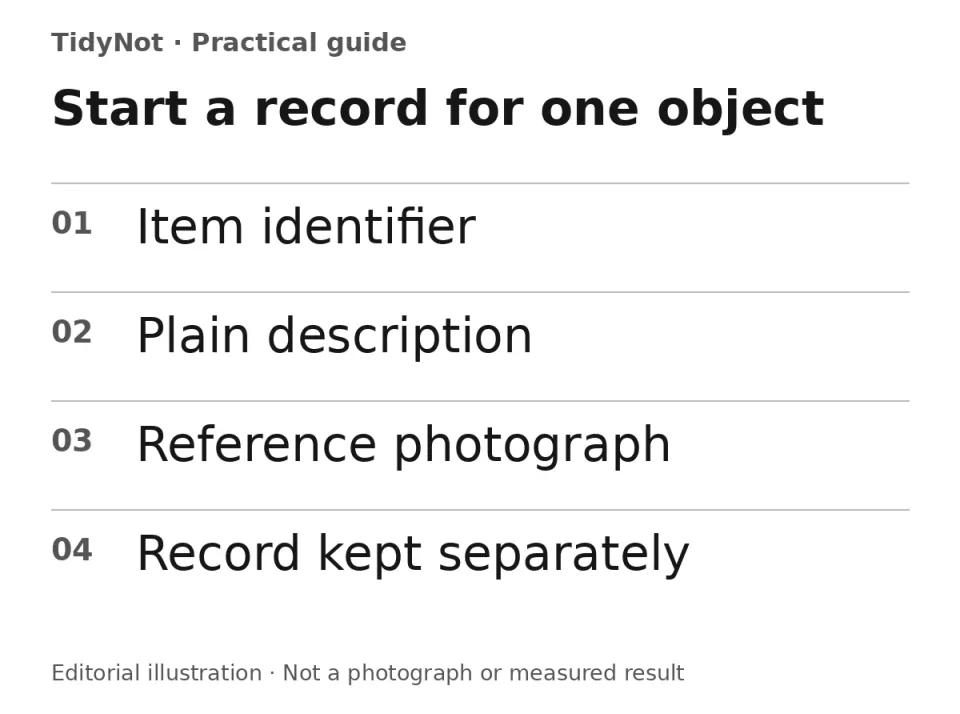
Give the object a record before giving it a history
Choose a simple identifier for your record, such as an item number, and connect it to a photograph and a plain description. Describe visible features rather than assigning an uncertain material, maker, or date. “Small oval brooch with a blue centre” is a safer starting description than a confident claim about a gemstone you have not identified.
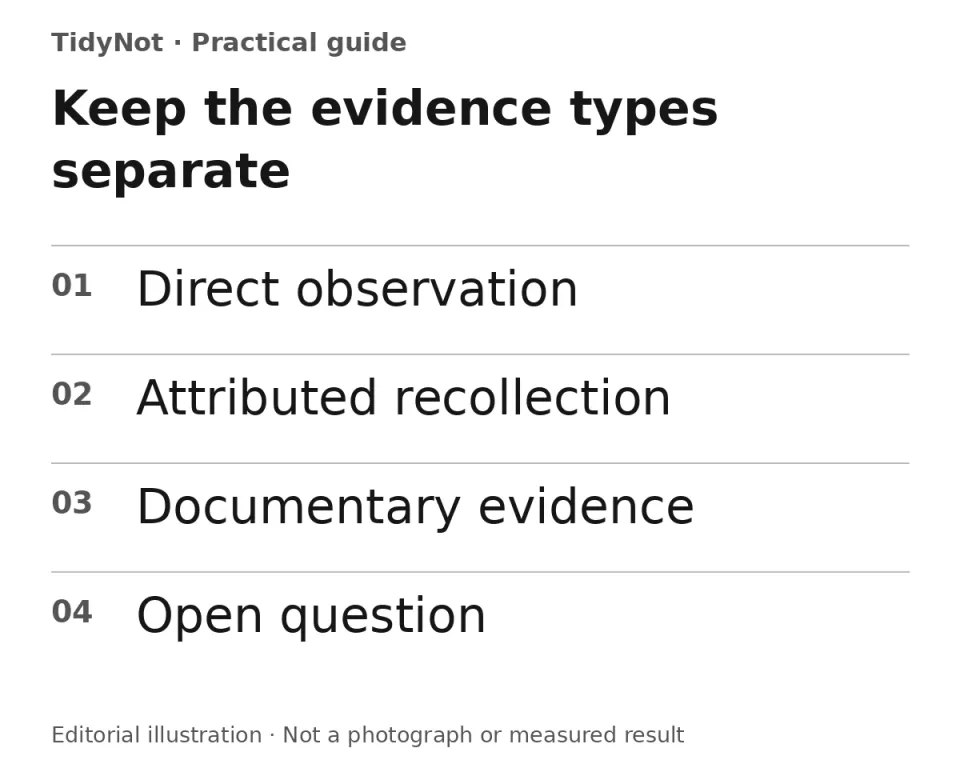
The Smithsonian’s Family Treasures Toolkit encourages recording an object’s history and significance, including ownership, acquisition, and importance. [Q06] The publisher’s description of How to Archive Family Keepsakes includes cataloguing and passing on family items. [S05] The evidence categories below are TidyNot’s editorial proposal, not an authentication method supplied by either source.
Let the person remain attached to the memory
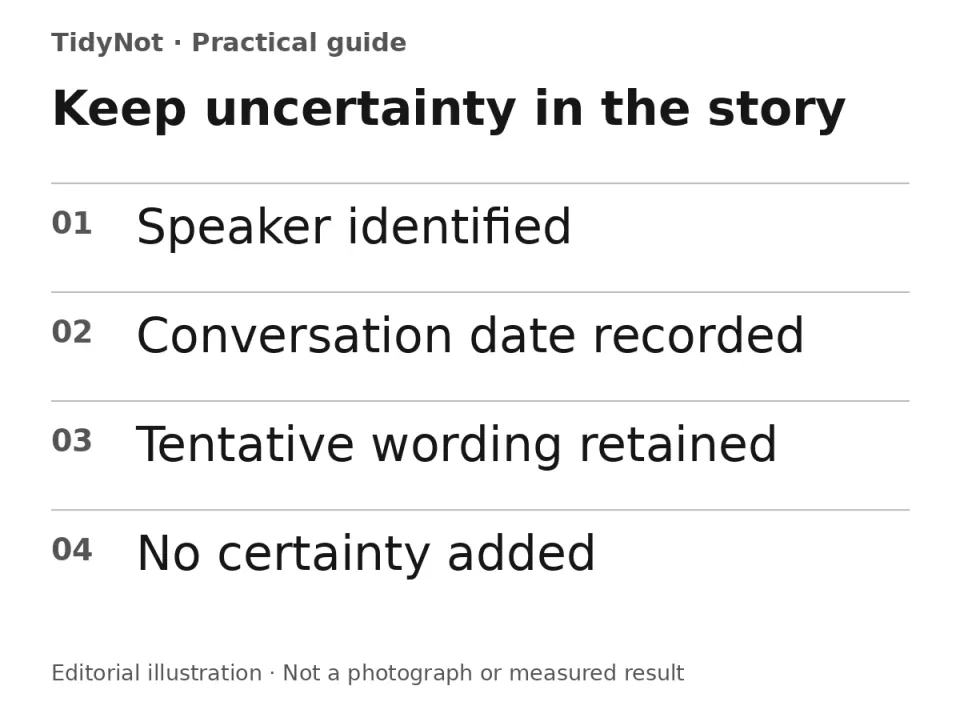
When someone shares a story, note their name, the date of the conversation, and whether they witnessed the event or heard about it from someone else. Keep their uncertainty. “I think she wore it at the wedding” should not become “Worn at the wedding” when you shorten the note.
In an invented example, one relative remembers a brooch belonging to a grandmother while another associates it with a great-aunt. Record both accounts with their speakers. Ask what each person remembers seeing, and whether a photograph or letter might help. Do not resolve the difference by quietly choosing the more detailed story.
Make the link between a claim and its evidence visible
If a dated photograph appears to show the object, record where that photograph is kept and what it actually shows. A similar-looking object is not necessarily the same one. If the identification is tentative, say so. Likewise, a date written on a box may describe the box, an occasion, or a later sorting session rather than the object’s manufacture.
Use precise statements: “The reverse is inscribed with these initials,” “This letter mentions a gift,” or “The owner in the photograph has not been identified.” Copy an inscription as it appears and mark characters you cannot read. Keep interpretations beside the transcription, not inside it. A clear question is more useful than an apparently complete but unsupported answer.
Preserve the unresolved parts when you share the record
Add a short note about why the object matters now. That may be a memory of someone wearing it, an association with a place, or the fact that it was kept through several moves. Personal significance does not have to depend on proving an age, a maker, or a monetary value.
If you later learn more, add the new source and date while keeping a trace of what changed. When passing the object to someone else, include its record and the locations of related photographs or letters. Decide separately whether private family stories should travel with the full record or remain restricted to the people concerned.
For today, completing one honest record is enough: a recognisable object, a story with a speaker, evidence you can locate, and an unanswered question left visibly open. This article concerns documentation. Cleaning, treatment, authentication, valuation, and legal ownership questions need their own appropriate guidance.
Family heirloom records: quick answers
What can I write when the owner or date is uncertain? Keep a plain observation, the attributed story and its uncertainty, any locatable documentary source, and the open question separate.
Does a relative’s memory prove an object’s history? No. Preserve who told you the story and when, without changing a tentative recollection into a verified identification.
For a narrow display or a plain-text copy, use this record order:
- Observation: visible detail, photograph and literal inscription.
- Recollection: speaker, conversation date and uncertainty.
- Document: location and relevant passage.
- Tentative link: reason and competing explanation.
- Open question: what remains unknown and a possible next source.
This linear record is an editorial alternative to the table.
Record type | Example wording | What to keep with it |
|---|---|---|
Direct observation | “Initials appear on the reverse” | Photograph and literal transcription |
Attributed recollection | “A relative remembers…” | Speaker, date, and uncertainty |
Documentary evidence | “A dated letter mentions a gift” | Document location and relevant passage |
Tentative identification | “This may be the item in the photo” | Reason and competing possibilities |
Unanswered question | “Original owner not yet known” | Possible source to check next |
Evidence and limits
Research-supported statements and practical editorial examples are distinguished below. Examples, checklists and diagram sequences are editorial suggestions unless an individual source explicitly supports them.S05 · How to Archive Family Keepsakes — Denise May Levenick, Family Tree Books, 16 August 2012
Checked: 2026-10-23 KST · Rechecked within stated scope
Supports: Publisher description and bibliographic details; cataloguing, preservation, and transfer are listed topics.
Limits: Book text not read. Description does not substantiate a particular identification, valuation, or preservation treatment.Q06 · Family Treasures Toolkit for Individuals — Smithsonian NMAAHC
Checked: 2026-10-23 KST · Rechecked within stated scope
Supports: The section Record the History and Significance of Your Treasure, on the page labelled 2; eight-page PDF file.
Limits: Guidance for recording context, not proof that a recollection is factually correct. The filename identifies a 2026-02-10 revision; that is not today’s check date.
Evidence and scope
1. nmaahc.si.edu — editor-verified original source
Claim covered: Research-supported statements and practical editorial examples are distinguished below. Examples, checklists and diagram sequences are editorial suggestions unless an individual source explicitly supports them.S05 · How to Archive Family Keepsakes — Denise May Levenick, Family Tree Books, 16 August 2012 Checked: 2026-10-23 KST · Rechecked within stated scope Supports: Publisher description and bibliographic details; cataloguing, preservation, and transfer are listed topics. Limits: Book text not read. Description does not substantiate a particular identification, valuation, or preservation treatment.Q06 · Family Treasures Toolkit for Individuals — Smithsonian NMAAHC Checked: 2026-10-23 KST · Rechecked within stated scope Supports: The section Record the History and Significance of Your Treasure, on the page labelled 2; eight-page PDF file. Limits: Guidance for recording context, not proof that a recollection is factually correct. The filename identifies a 2026-02-10 revision; that is not today’s check date.
The toolkit asks about ownership, acquisition and significance and encourages recording stories. It does not authenticate a family recollection or value an object.
nmaahc.si.edu — editor-verified original source. Use only the locale/version and evidence scope stated in the manuscript and source notes.. Checked: .
2. Editorial application
Claim covered: TidyNot practical checklist, examples and step sequence.
Practical editorial suggestions distinguished from sourced factual claims.
TidyNot editorial suggestion. General readers within the manuscript stated scope.. Checked: .
No personal test, measured benefit, provider implementation or safety guarantee is claimed.