Organize saved vegetable seeds by preserving each batch’s identity before it goes into storage. Label the crop, variety, and collection date you actually know, keep batches separate, and record where they are stored. This task begins after crop-appropriate harvesting and drying; it does not teach seed extraction or treatment.
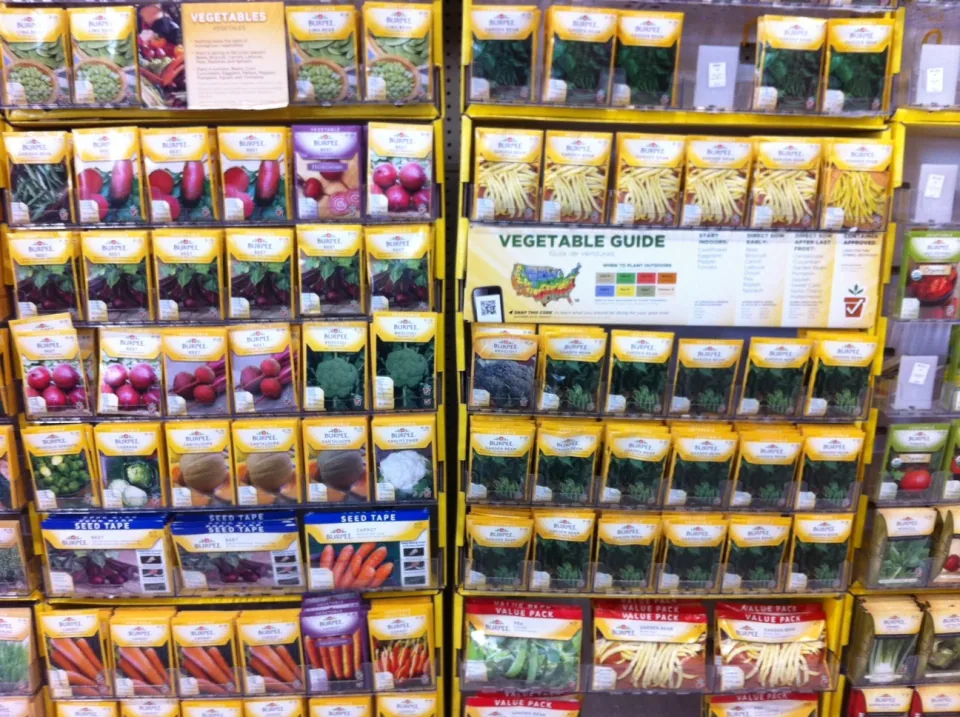
Commercial vegetable-seed packets illustrate keeping seed identity visible. These are shop packets, not a demonstration of saved-seed storage. Photo: ParentingPatch / Wikimedia Commons. CC BY-SA 3.0. CC BY-SA 3.0
Keep each batch connected to its history
Gather one season’s already-dried seed batches and the notes that belong to them. Work on one batch at a time, leaving the others closed or contained so that loose seeds and labels do not become separated.
Use garden labels, harvest notes, or a reliable collection record to identify the crop and variety. Record the collection date at the level you know: a full date if documented, or a month or year clearly labeled as such. Do not turn a remembered season into an invented exact day.
If a variety name is missing, write “Variety unknown.” If two collections came from different plants or dates, retain separate batch identities even when their seeds look alike. A clear unknown is more useful next spring than a confident but unsupported name.
Exclude seed known to come from diseased plants from this storage-ready group. University of Minnesota Extension advises saving seed from healthy plants. Uncertain plant-health history calls for crop-specific advice, not a clean-looking packet as reassurance. 1
Make labels before filling the storage packets
Prepare one label for each batch. Write crop, variety, collection date, and a short batch identifier such as “2026-B3.” Add an origin note only when it helps distinguish the collection, for example “South bed, harvest notebook page 8.”
Extension recommends identifying saved seed with its name, variety, and collection date. Its storage guidance uses separate paper packets within a tightly sealed glass container and cool, dry conditions. Follow any different requirements for the particular crop. 1
Label an empty packet first, then transfer only its corresponding batch if transfer is needed. Compare the finished label with the original note before putting the packet aside. Keep an existing accurate packet if it already does the job; there is no need to repackage purely for appearance.
If drying has not been completed or the condition is uncertain, leave that batch outside the finished-storage category. Return to suitable crop guidance. Do not seal it with the ready batches simply to clear the work surface.
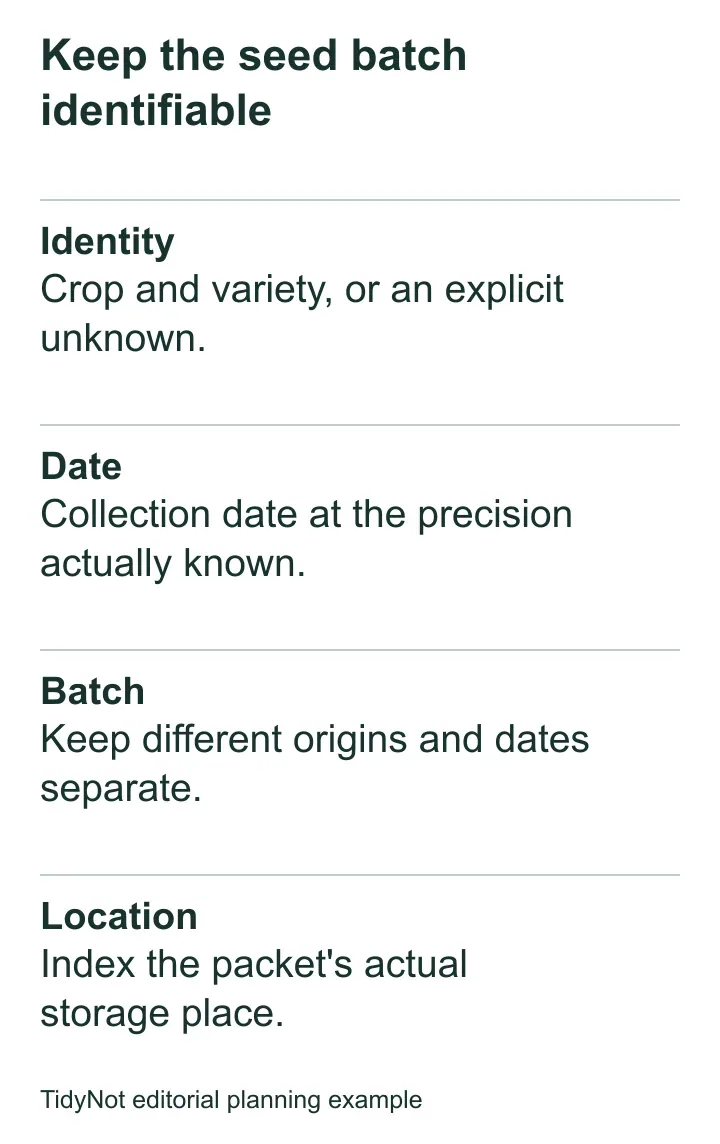
Keep the seed batch identifiable. Editorial planning example; not a photograph, product test or measured result.
Choose and document the storage location
Choose a location that meets the guidance for these vegetable seeds, rather than whichever shelf is empty. Check that the actual arrangement stays cool and dry; a cupboard name alone does not describe its conditions. Keep the outer container clearly identified as saved planting seed.
Place the packets so you can read their identifiers without opening every one. Arrange them in an order you will use, such as crop name followed by collection date. A small collection may need only a single contents card inside or beside the container.
Write the precise location in your garden notes, such as “Seed container, lower utility cupboard.” If you choose a different appropriate location later, update the index immediately. The label on the container and the record should point to the same place.
Build a short index and test it
Make one index line per packet: batch identifier, crop, variety or unknown flag, collection date, and storage location. Include a separate question field for anything needing advice before sowing. Avoid adding speculative expiry dates or guaranteed germination percentages.
Choose one packet from the index and retrieve it without opening the others. Check its label against the entry, then return it to its place. If finding it requires tipping out every packet, simplify the arrangement or make the identifiers more visible.
This process preserves identity and access. It does not establish whether an old batch will germinate or reproduce the parent plant’s characteristics. Keep commercial treated seed and unusual species under their own supplied instructions rather than folding them into a universal saved-seed rule.
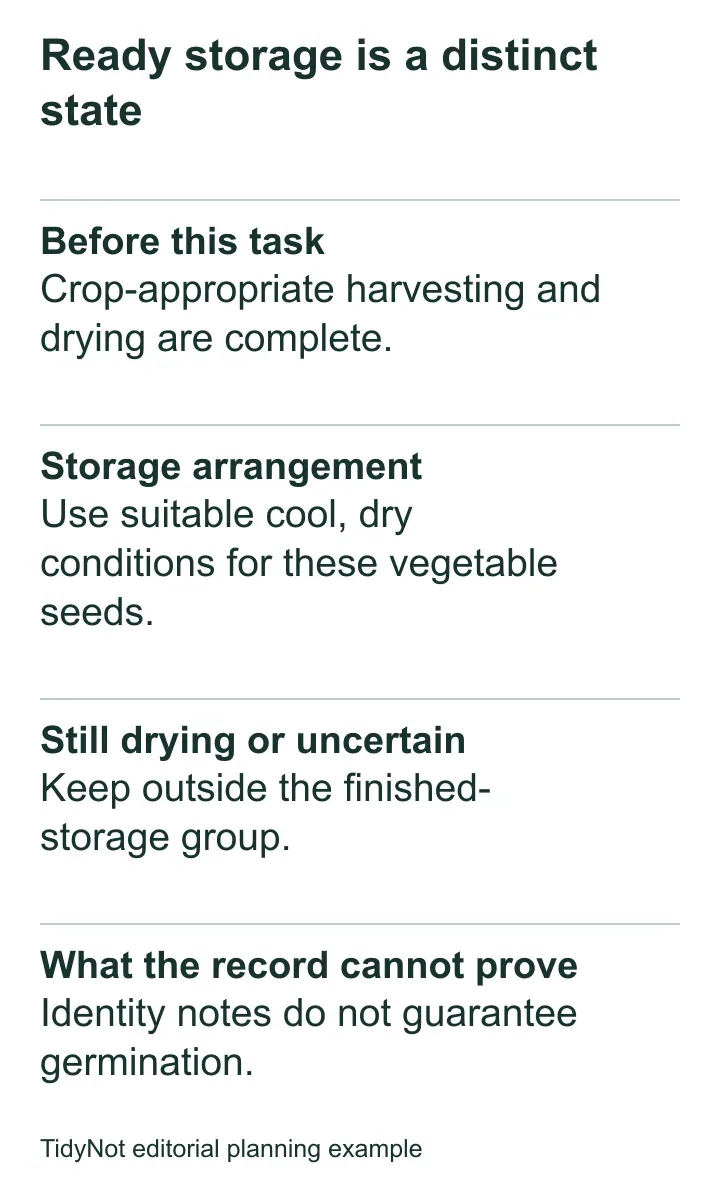
Ready storage is a distinct state. Editorial planning example; not a photograph, product test or measured result.
Final check
- Confirm the seeds are already appropriately harvested and dried.
- Label each batch with known identity and collection date.
- Use a suitable cool, dry storage arrangement.
- Record the location and retrieve one packet by its index.
When this task is done
Every stored packet has a readable identity and date, or a clearly stated unknown. The index leads to the correct batch without mixing others. Batches awaiting drying or advice remain visibly unfinished rather than disappearing into the ready collection.
Sources and limits
The step sequence, record fields, example entries, and completion tests are editorial applications of the cited guidance, not results of product testing or an evaluated organizing intervention.
- University of Minnesota Extension: Saving vegetable seeds. Source-package check: 2026-10-22. Vegetable-seed packet identification and cool, dry, sealed-container storage. Limits: Does not establish a particular batch’s identity, viability, or crop-specific exceptions.
Evidence and scope
1. University of Minnesota Extension: Saving vegetable seeds
Claim covered: Exclude seed known to come from diseased plants from this storage-ready group. University of Minnesota Extension advises saving seed from healthy plants. Uncertain plant-health history calls for crop-specific advice, not a clean-looking packet as reassurance. 1
UMN saved-seed storage/labeling and healthy-parent sections
University of Minnesota Extension: Saving vegetable seeds. English edition; jurisdiction limited to cited guidance. Checked: .
Vegetable-seed context. No viability or exact batch-identity check. The article avoids a universal expiration claim.
2. University of Minnesota Extension: Saving vegetable seeds
Claim covered: Extension recommends identifying saved seed with its name, variety, and collection date. Its storage guidance uses separate paper packets within a tightly sealed glass container and cool, dry conditions. Follow any different requirements for the particular crop. 1
UMN saved-seed storage/labeling and healthy-parent sections
University of Minnesota Extension: Saving vegetable seeds. English edition; jurisdiction limited to cited guidance. Checked: .
Vegetable-seed context. No viability or exact batch-identity check. The article avoids a universal expiration claim.
3. Editorial application
Claim covered: Organize saved vegetable seeds by preserving each batch’s identity before it goes into storage. Label the crop, variety, and collection date you actually know, keep batches separate, and record where they are stored. This task begins after crop-appropriate harvesting and drying; it does not teach seed extraction or treatment.
The step sequence, record fields, example entries, and completion tests are editorial applications of the cited guidance, not results of product testing or an evaluated organizing intervention.
TidyNot editorial suggestion. English edition. Checked: .
No germination guarantee, universal expiry date or automatic recommendation to discard older seed. The source addresses saved vegetable seeds; ornamental, treated commercial and unusual-species seed may have different requirements. Exclude seeds known to come from diseased plants; no bleach treatment, hot-water treatment, food-use advice or seed-eating instructions.